South Africa's Residential Property Market Analysis 2026
South Africa’s housing market is slowly recovering, driven by rising demand and an improving economic backdrop. House prices continue to show steady growth, while declining interest rates are enhancing affordability, encouraging more buyers to enter the market and prompting banks to extend additional home loans. First-time buyers are gradually returning, further contributing to the market’s momentum.
Table of Contents
- Housing Market Snapshot
- Historic Perspective
- Demand Highlights
- Supply Highlights
- Rental Market
- Mortgage Market
- Socio-Economic Context
Housing Market Snapshot
The Repeat Sales House Price Index rose by 4.9% in October 2025 as compared to the same period last year, according to figures released by the First National Bank (FNB). It was a slowdown from the previous month’s 5.1% increase, but it remains the third-highest year-on-year price growth seen since March 2022. The recent price growth was not significantly different from the average price increase of 5% recorded from 2012 to 2022.
South Africa's house price annual change:
When adjusted for inflation, prices increased by 1.25% y-o-y in October 2025, in contrast to the y-o-y price decline of 1.73% in the same period in the prior year. Real prices declined steadily from December 2021 through April 2025, before reversing course and beginning to rise in the following month.
The Western Cape continues to lead house price growth, fueled by strong demand fundamentals, while Gauteng and KwaZulu-Natal, previously stagnant, are now gaining momentum, signaling a geographically broadening recovery.
Demand is gradually improving, particularly in the affordable housing market, based on FNB’s Estate Agents Survey conducted in the third quarter of 2025.
“Estate agent-reported market activity edged higher in 3Q25, with the Activity Index rising slightly to 6.0 from 5.9 in 2Q25. This modest increase signals a gradual acceleration in market momentum,” said the FNB survey report. “The affordable housing market, defined as properties priced below R750 000, maintained a stronger performance with an activity level of 6.4 compared to 5.9 in the traditional market segment. Furthermore, 21% of agents rated the market as “highly active” (scores of 8–10), up from17% in 2Q25.”
Despite this, properties are taking longer to sell. The time-on-market, which refers to the number of days a property has been for sale from the listing date to the date the contract is signed, increased to 12 weeks and three days in Q3 2025, up from12 weeks and one day in Q1 2025, from 11 weeks in Q4 2024, and less than 10 weeks in 2022.
South Africa’s housing market has been sluggish over the past several years, mainly due to high unemployment, weak household finances, and an underdeveloped mortgage market. From 2007 to 2021, house prices rose by about 69%, but when adjusted for inflation, real prices actually fell by 19%.
Then, in 2022 and 2023, nominal house prices rose by a cumulative 5.6% but declined by 7.4% in real terms. With persistently high inflation during those years, the gap between nominal and real prices has dramatically widened. In 2024, house prices increased by a meager 1.2% from a year earlier and actually fell by 1.7% when adjusted for inflation.
After registering a post-pandemic growth of 5% in 2021, South Africa’s economic growth slowed to 1.9% in 2022, amidst the fallout of the war in Ukraine, coupled with several domestic setbacks, such as floods and an energy crisis.
The economic slowdown continued over the next two years, with real GDP growth decelerating to just 0.7% in 2023 and 0.6% in 2024, reflecting persistent structural and external pressures on the economy.
Encouragingly, South Africa’s economic performance has shown gradual improvement in recent months. In the third quarter of 2025, the economy expanded by 2.1% from a year earlier, a sharp improvement from a year-on-year growth of 0.9% in the previous quarter and 0.4% in the same period last year. In fact, it was the fastest expansion since Q3 2022, thanks to stronger mining, agriculture, trade, and services activity, supported by higher household spending and a recoveryin investment. Quarter-on-quarter, the country recorded a 0.5% growth in Q3 2025, marking its fourth consecutive rise in economic activity.
Accordingly, the latest forecast by SARB projects domestic economic growthwas approximately1.2% in 2025. Real GDP growth is expected to improve to 1.4% this year andto 1.9% by 2027.
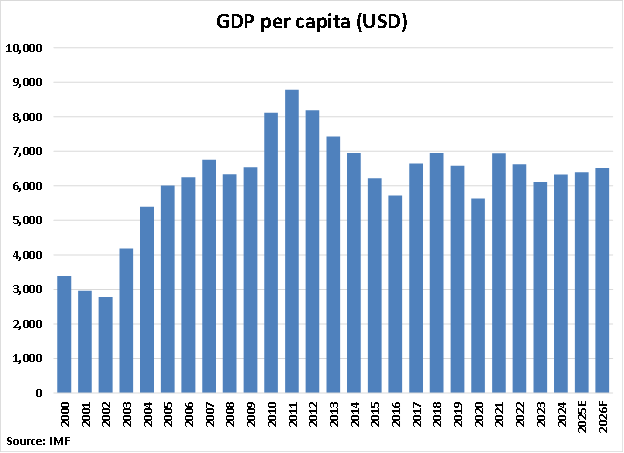
South Africa is Africa’s second-biggest economy. With a population of 64.1 million and a GDP per capita of US$6,400 in 2025, it has formidable manufacturing and financial sectors. It is the world’s largest exporter of gold and platinum. Tourism is also a key source of foreign exchange.
Historic Perspective:
South Africa’s housing market cycle
During South Africa’s housing boom (from 2000 to 2006), house prices rose by an average of 20% annually. These price rises peaked in October 2004 with 35.7% annual growth (32.5% in real terms), according to ABSA.
The boom was driven by 4 main factors:
- The emergence of a financially stable black middle class, which had a tremendous impact on housing demand, was encouraged by individual tax reliefs in the context of a growing economy.
- South Africans who had parked money offshore during the Apartheid era were allowed (and required) to bring it back by September 2004. Much of this money went into property.
- Better stability and security helped. During Apartheid and its sequel, property prices had lagged badly behind the economy, as the security situation went from bad to worse.
- Lastly, the Financial Sector Charter in 2003 boosted mortgage loan growth. Financial institutions are committed to providing ZAR 42 billion (US$2.58 billion) of housing finance to the low-income market. Then in 2006, the CGT exemption on primary residences was raised from ZAR 1 million (US$61,492) to ZAR 1.5 million (US$92,238). Transfer duties on properties were lowered, too. For example, no transfer duty is payable on properties valued at ZAR 500,000 (US$30,746) or less.
However, the boom ground to a halt following the global financial crisis. From 2008 to 2009, house prices fell by 3.2% (-16.5% in real terms). Aside from the global crisis and rising interest rates, the decline in prices was prompted by the implementation of the National Credit Act in mid-2007, which aimed to protect borrowers from over-indebtedness by limiting the amount of funds that can be borrowed and requiring every lender to assess borrowers’ creditworthiness. It requires lenders to disclose every term in the contract and gives borrowers the right to request their credit report and to challenge the report if there are inaccuracies. The act has tended to reduce the supply of mortgage loans.
The housing market rose a little in 2010, encouraged by South Africa hosting the 19th FIFA World Cup, and from 2011 to 2019, house prices rose by almost 51%. But after the ravages of inflation are deducted, that works out at a meager 0.4% growth in real terms.
House prices rose by a total of 8% in 2020 and 2021, amidst the Covid-19 pandemic. Yet when adjusted for inflation, prices actually declined by 1.1% over the same period. During 2022, nominal house prices rose by a modest 3.2% but fell by 4% in real terms.
The housing market had been weak in the following two years, with house prices increasing by a minuscule 1% (-4% in real terms) in 2023 and by just 1.2% (-1.69% in real terms) in 2024, amidst a struggling economy.
In recent months, the housing market has picked up momentum amid strengthening demand, with house prices rising nearly 5% in October 2025 compared with the same month last year.
| HOUSE PRICES, ANNUAL CHANGE (%) | ||
| Year | Nominal | Inflation-adjusted |
| 2008 | -5.08 | -13.16 |
| 2009 | 2.03 | -3.90 |
| 2010 | 3.10 | -0.23 |
| 2011 | 4.36 | -1.84 |
| 2012 | 5.77 | -0.04 |
| 2013 | 7.72 | 2.35 |
| 2014 | 6.20 | 0.82 |
| 2015 | 6.32 | 1.08 |
| 2016 | 4.75 | -2.16 |
| 2017 | 3.85 | -0.62 |
| 2018 | 4.12 | -0.27 |
| 2019 | 3.10 | -0.90 |
| 2020 | 4.10 | 0.99 |
| 2021 | 3.70 | -2.06 |
| 2022 | 3.20 | -4.00 |
| 2023 | 1.00 | -4.00 |
| 2024 | 1.20 | -1.73 |
| 2025* | 4.90 | 1.25 |
| Data Sources: FNB, Global Property Guide. | ||
Demand Highlights:
Market activity is improving
Demand is recovering as declining interest rates improve affordability, attract more buyers, and encourage banks to extend additional home loans. This trend is particularly evident in the affordable housing market, according to the FNB’s Estate Agents Survey conducted in the third quarter of 2025.
“Estate agent-reported market activity edged higher in 3Q25, with the Activity Index rising slightly to 6.0 from 5.9 in 2Q25. This modest increase signals a gradual acceleration in market momentum,” said the FNB survey report.
“The affordable housing market, defined asproperties priced below R750 000, maintained a stronger performance with an activity level of 6.4 compared to 5.9 in the traditional market segment. Furthermore, 21% of agents rated the market as “highly active” (scores of 8–10), up from17% in 2Q25,” added the same report.
In addition, rising household incomes are supporting housing demand in South Africa, according to BetterBond’s October 2025 Property Brief. In fact, in Q3 2025, home loan applications increased 11.6% quarter-on-quarter and 14.6% year-on-year, reaching their highest level since early 2022. The five consecutive repo rate cuts have clearly stimulated buyer activity, with applications now 26% above the 2023 low.
Data from ooba Home Loans indicates a steady return of first-time homebuyers, who now make up 46.8% of applications as of Q3 2025, up from 45.8% in the same period in 2024.
Despite this, properties are taking longer to sell. The time-on-market, which refers to the number of days a property has been for sale from the listing date to the date the contract is signed, increased to 12 weeks and three days in Q3 2025, up from 12 weeks and one day in Q1 2025, from11 weeks in Q4 2024, and less than 10 weeks in 2022, according to figures from FNB.
Foreign home buying still weak
Despite the recent improvement in overall market activity, foreign home buying remains subdued. Considering South Africa’s economic stagnation, exacerbated by the Covid-19 pandemic and ongoing global economic and geopolitical uncertainties, it is perhaps unsurprising that foreign demand has declined in recent years, even though property in South Africa is now significantly more affordable for international buyers than it was a decade ago
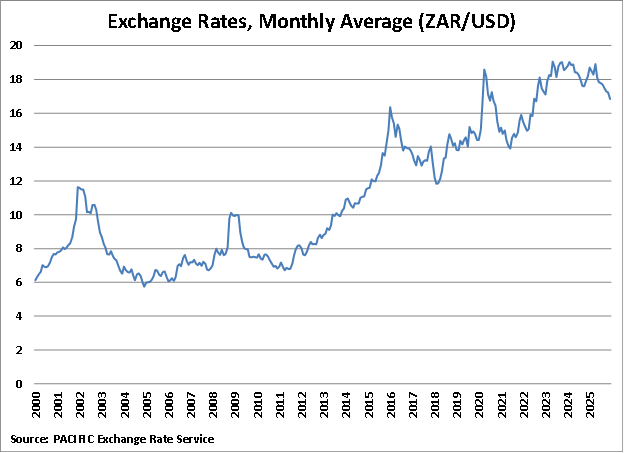
Even taking into account the recent appreciation of the rand on the back of higher metals prices, the value of the local currency remained about 59% lower against the US dollar from January 2011 to December 2025, falling from US$1 = ZAR 6.943 to US$1 = ZAR 16.844. Yet foreign homebuyers represent only 3.7% of total home buying in South Africa, significantly down from its peak of 6.5% in 2008.
Inbound demand (i.e., from foreigners buying property in South Africa as well as from South African expats buying property locally) has remained comparatively muted in recent years.
FNB attributed this to:
- Weak investor sentiment towards South Africa, due to the country's multi-year economic stagnation
- Uncertainty about the country's future economic policy
- Negative news, such as credit rating downgrades to“junk status.”
Most foreign owners in South Africa are based in Europe, mostly in the United Kingdom, as well as Germany, Italy, the Netherlands, and France. There are also buyers from African countries such as Mozambique, Zimbabwe, Angola, Cameroon, and Nigeria. Some homebuyers from China and Dubai are also eyeing properties in the KwaZulu-Natal and the Durban area, according to Craig Hutchison, chief executive of Engel & Völkers Southern Africa.
Foreigners can own immovable property in South Africa without restriction. However, all foreign funds remitted to the country must be declared and documented. The property must also be endorsed‘non-resident’, as a condition for repatriation of funds.
Non-resident investors have to pay capital gains tax when they later sell their properties. The purchaser of the property is required to deduct a prescribed percentage from the proceeds of the sale and remit it directly to the South African Revenue Service before paying the balance to the seller.
Supply Highlights:
Residential construction activity shows mixed results
The performance of South Africa’s residential construction sector has been mixed. In the first ten months of 2025, the total value of residential building plans approved dropped by 5.4% y-o-y to ZAR 38.91 billion (US$2.4 billion), following annual declines of 6.9% in 2024 and 19.1% in 2023, according to Statistics South Africa (Stats SA).
In contrast, the value of residential dwelling completions was up by 2.5% to ZAR 25.03 billion (US$1.54 billion) in Jan-Oct 2025 as compared to a year earlier, following annual contractions of 19% in 2024 and 6.5% in 2023.
For residential building approvals:
- Houses measuring less than 80 sq. m: the number of approvals increased by 14.6% y-o-y to 6,038 units in the first ten months of 2025. Likewise, the value of approvals also rose by 11.9% to ZAR 2.25 billion (US$138.84 million).
- Houses measuring 80 sq. m and above: the number of approvals was up by 6.2% y-o-y to 10,280 units in Jan-Oct 2025, while approvals value increased by 3.8% to ZAR 24.81 billion (US$1.53 billion).
- Flats and townhouses: both the number and value of approvals plummeted by 25.2% y-o-y to 10,791 units and by 24.5% to ZAR 10.64 billion (US$654.84 million), respectively.
For residential completions:
- Houses measuring less than 80 sq. m: the number of completions increased by 9.2% y-o-y to 4,260 units in Jan-Oct 2025. Likewise, the value of completions was up by 4.5% to ZAR 1.54 billion (US$94.54 million) over the same period.
- Houses measuring 80 sq. m and above: completions were down by 11.9% y-o-yt o 5,403 units in Jan-Oct 2025, while total value decreased by 9.1% to ZAR 12.81 billion (US$788.44 million).
- Flats and townhouses: the number of completions rose by 12.2% y-o-y to 10,648 units in the first ten months of 2025. Completions’ total value also surged by 16.8% y-o-y to ZAR 10.05 billion (US$618.93 million).
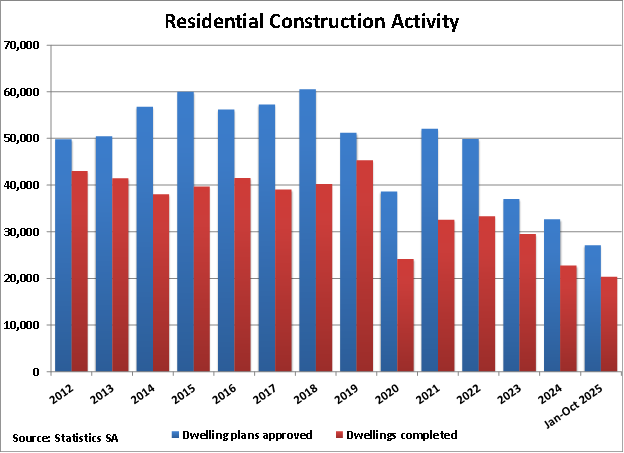
Residential development activity in South Africa is led by the Western Cape and Gauteng, which together accounted for nearly two-thirds of all approved residential building plans and nearly three-quarters of completed homes in the first ten months of 2025.
Rental Market:
Rental yields are very good
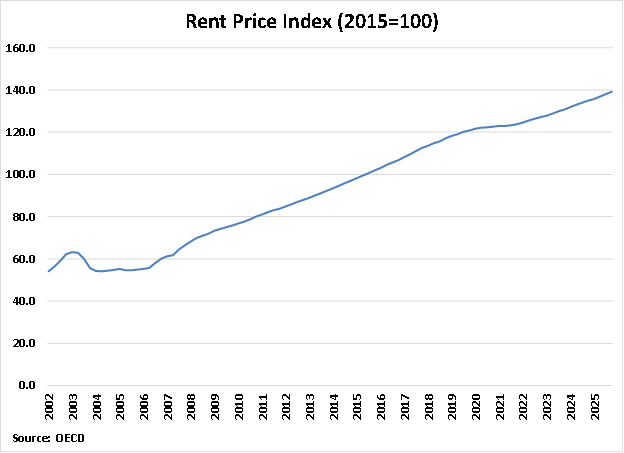
Despite all these, from one perspective, property owners should be happy. The gross rental yields for apartments in South Africa, i.e., the gross rental return on a property if fully rented out, are spectacularly high, at an average of 10.93% in Q4 2025, up from 10.36% in Q2 2025, 9.96% in Q4 2024, and 10.15% in Q1 2024, according to a recent research conducted by the Global Property Guide.
South Africa's rent price index:
In Johannesburg, apartments offer rental returns ranging from 9.57% to as high as 16.49% in Q4 2025, with a city average of 13.69%, far higher than the national average. The most desirable neighborhoods in Johannesburg are in the north of the city, including suburbs like Dunkeld, Hyde Park, Houghton, Illovo, Inanda, Melrose, Parkhurst, Parktown, Parkview, Sandhurst, Saxonwold, and Westcliff.
In Cape Town, gross rental yields on apartments are lower, currently ranging from 4.55% to 11.97%, with a city average of 8.98% in Q4 2025. Cape Town is the most popular tourist destination in Africa. Its amazing beaches and weather are ideal for retirees and foreign property buyers. Atlantic Seaboard properties are among the most sought-after because of the beaches and cliffs, upscale neighborhoods like Bakoven, Bantry Bay, Camps, Clifton, Fresnaye, Green Point, and Mouille Point. Some houses nestled on cliffs have sweeping views of the Atlantic Ocean. City Bowl, which includes the central business district of Cape Town, is another upscale residential suburb. It is one of the most stable residential markets in Cape Town because of its prime central location and vibrant cosmopolitan lifestyle.
In other locations:
- In Durban, gross rental yields for apartments currently range from 7.48% to 11.74%, with a city average of 10.96%.
- In Centurion, gross rental yields for apartments range from 12.18% to 14.62%, with a city average of 13.21%.
- In Dolphin Coast, apartment rental yields are relatively lower, ranging from 6.84% to 9.46%, with an average of 7.81%.
Mortgage Market:
Mortgage interest ratescontinue to fall, amidst SARB’s recent rate cuts
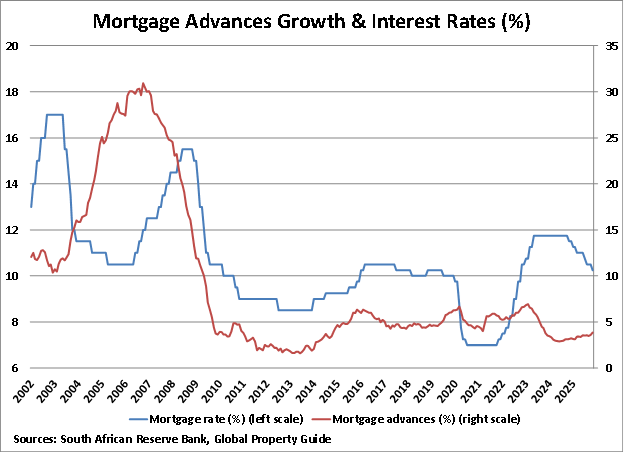
In November 2025, the South African Reserve Bank (SARB), the country’s central bank, slashed its benchmark repo rate by 25 basis points to 6.75%, its sixth consecutive rate cut since September 2024, in an effort to buoy economic activity amidst easing inflationary pressures.
South Africa's mortgage loan interest rates:
“Domestic growth is looking better than last year. The second quarter data surprised on the upside, and the third quarter indicators are looking broadly positive. Household consumption has also been rising, but investment continues to disappoint,” said the central bank.
“We assess the risks to the inflation outlook as balanced. Against this backdrop, the MPC decided to reduce the policy rate by 25 basis points, to 6.75%, with effect from 21 November. The decision was unanimous. Members agreed there was scope now to make the policy stanceless restrictive, in the context of an improved inflation outlook,” added the central bank.
Prior to the policy shift, the central bank implemented ten straight rate hikes in less than two years from November 2021 to May 2023, in an effort to rein in inflationary pressures.
“The MPC has long emphasised the need for macroeconomic and structural reforms to boost potential growth, achieve a sustainable debt path, and shift to a low-inflation regime. There has been significant progress on reform this year, as underscored by the recent credit rating upgrade from Standard & Poor’s, as well as South Africa’s exit from the Financial Action Task Force grey list. The global environment nonetheless remains challenging, so it is urgent to sustain domestic reform efforts,” noted the central bank.
Amidst the central bank’s successive rate cuts, mortgage interest rates are now noticeably falling. In September 2025, the flexible interest rate on mortgage advances fell to 10.01%, down from 11.16% from the same period in the prior year. Likewise, the fixed rate on mortgage advances declined to 9.48%, down from 10.31% in the previous year.
Currently, the predominant rate on new mortgage loans stands at 10.25%, down from 11.5% a year earlier, but still far higher than the single-digit interest rates seen from 2020 to 2022.
Housing loans rising modestly, size of the mortgage market remains steady
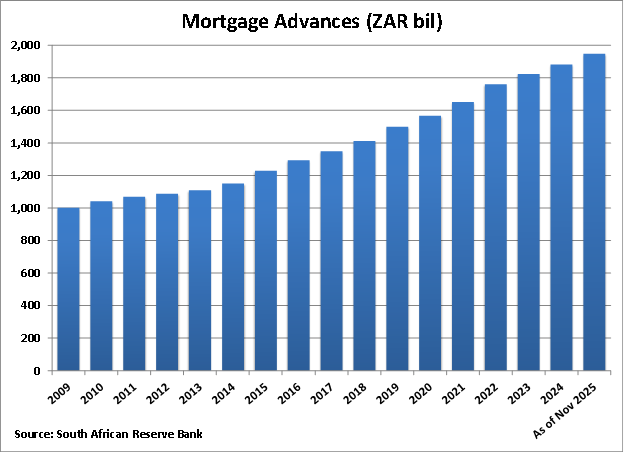
Housing loans continue to rise modestly, amidst declining interest rates as well as an increased willingness of banks to provide loans to prospective borrowers. In November 2025, total mortgage advances rose by 3.8% y-o-y to about ZAR 1.95 trillion (US$118.9 billion), according to figures from SARB.
“Loan-to-price ratios, a proxy for loan-to-value, have continued to rise, suggesting willingness by lenders to finance a bigger proportion of the purchase price,” said the FNB. “....the surge in LTPs predates the pandemic - it began in 2017 - and is largely attributed to intense competition among lenders in a thin volume market.”
This is supported by other local market experts. “Property ownership is now more accessible... Potentially, renters may be able to buy a home at a lower monthly cost than their current rental payment,” said Rhys Dyer, chief executive of home loan comparison service firm, Ooba.
The housing market recovery may strengthen if stable or lower interest rates boost affordability, encourage borrowing, and lead to increased mortgage lending, which could help sustain house price growth.
“A key question going forward is whether the credit cycle will begin to reinforce the housing market recovery. If interest rates remain stable or decline further, improved affordability could encourage more buyers to finance purchases, and banks may become more willing to extend home loans. A pickup in mortgage lending would provide an additional tailwind to sustain house price growth,” said FNB in its August 2025 report.
However, the housing loan growth has been notably slower in recent months. During 2024, housing loans increased by 3.1% from a year earlier, a deceleration from an annual average growth of 4.6% in 2009-23, and far lower than the average growth of 21% in 2002-08.
“Growth in residential property mortgages was more subdued but still accelerated marginally, from 2.6% in February 2025 to 3.1% in October. As a result, growth in total mortgage advances edged up slightly, remaining within a narrow band between 3.1% and 3.6% over the first 10 months of 2025, despite lower interest rates,” said SARB in its December 2025 Quarterly Bulletin.
Overall, the size of the mortgage market relative to GDP remains more or less steady. As a percentage of GDP, the mortgage market stood at around 25.5% in 2025, almost unchanged in the past nine years but still down from an average of 34% of GDP in 2009-2011.
“Over the last ten years, the mortgage market has not made notable expansions, but instead has remained fairly steady, at an average of 122,000 bonds issued a year,” said the Centre for Affordable Housing Finance in Africa (CAHF).
Socio-Economic Context:
Household finances are troublingly weak, aggravated by high unemployment
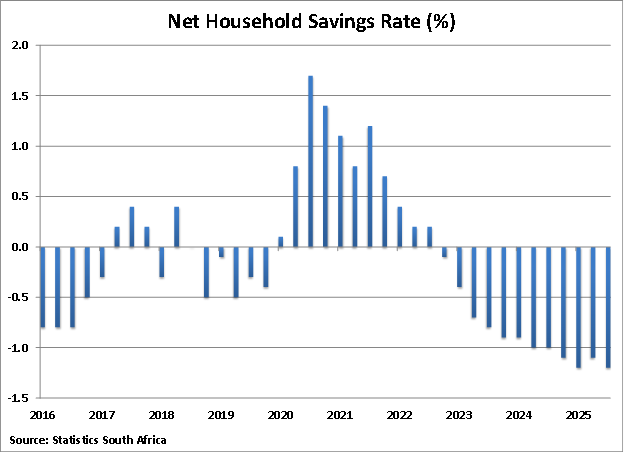
Many households in South Africa are under financial strain because of slow economic growth and low employment levels. The net household savings rate stood at-1.2% of disposable income in Q3 2025, worse than the -1.1% in 2024, -0.9% in 2023, -0.1% in 2022, and 0.7% in 2021.
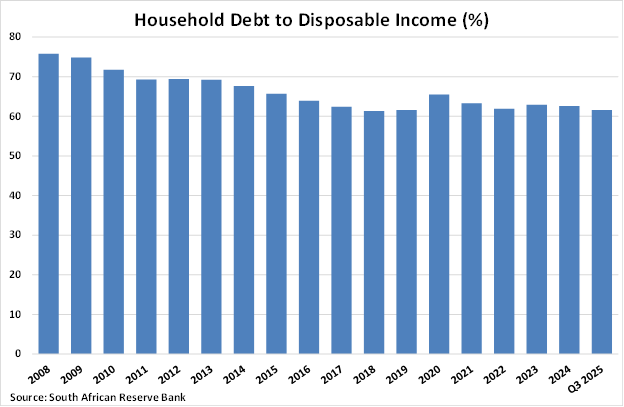
But not all is bad news. In Q3 2025, the ratio of household debt to disposable income declined to 61.6%, down from 62.1% in the previous quarter, 62% in Q4 2024, 62.4% in Q3 2024, and 62.2% in Q2 2024, according to SARB’s December 2025 Quarterly Bulletin. It hovered at about 62% to 63% in the past three years. Yet it was far lower than the 77% recorded five years ago.
“The ratio of household debt to disposable income edged lower to 61.6% in the third quarter of 2025 from 62.1% in the previous quarter, as household debt increased at a slightly slower pace than nominal disposable income. Households’ cost of servicing debt relative to disposable income fell to 8.5% from 8.7% over this period,” said the central bank.
Likewise, households’ debt-service cost to disposable income declined to 8.5% in Q3 2025, down from 8.7% in the previous quarter, 8.9% in Q4 2024, 9.1% in Q3 2024, and 9% in Q4 2023.
“Households’ net worth continued to improve in the third quarter of 2025, as the market value of their total assets increased more rapidly than their total liabilities. The rise in assets was largely due to a notable increase in share prices, as both domestic and global equity prices rallied, with the FTSE/JSE All-Share Index reaching new all-time highs after surging by 11.9% in the third quarter. The value of housing stock also rose further as residential property prices continued to increase,” added the central bank.
Total outstanding household debt in South Africa increased at an average annual rate of 5.2% between 2015 and 2022, reaching ZAR 2.78 trillion (US$169.45 billion) in 2023 following an accelerated growth rate of 7.1%. However, in 2024, the pace of debt accumulation slowed, with household debt rising by 4.9% to approximately ZAR2.92 trillion (US$177.98 billion). Household debt was estimated to have increased further to about ZAR 3.1 trillion (US$188.95 billion) last year.
Of which, credit extended by banks accounted for 75%, while non-bank institutions accounted for the remaining 25%. Mortgage advances, the largest credit category, represent about 46% of total household debt.
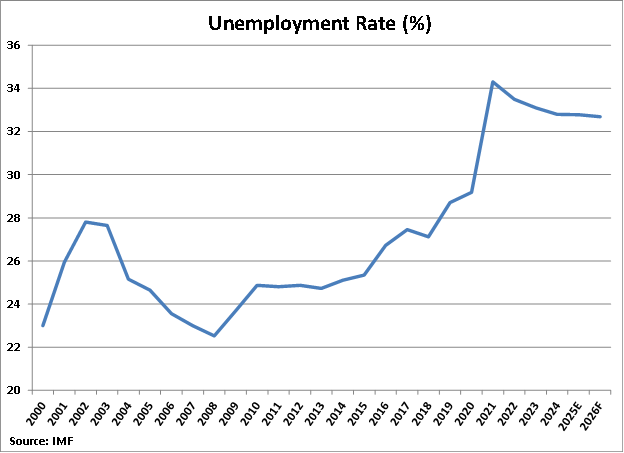
Although there are signs of gradual improvement, nationwide unemployment in South Africa remains exceptionally high by international standards. In Q3 2025, the country’s official unemployment rate stood at 31.9%, down from 33.2% in the previous quarter and from 32.1% in the same period last year, according to Stats SA. Despite this, it remains far higher than the 29.1% recorded before the pandemic. When the expanded definition is used, which includes those discouraged from seeking work, the jobless rate was actually at 42.4% in Q3 2025, slightly down from 43% in the prior quarter.
“A prolonged period of low economic growth, skills mismatches, and other entrenched structural factors have resulted in persistent high unemployment in South Africa,” said the central bank. “Over the past decade, employment grew by 0.7% per annum while the labour force increased at an average rate of 2.1% per year, resulting in rising long-term unemployment and elevated youth unemployment, which reached 46.1% in the second quarter of this year. The labour market remains fragile, as reflected inpersistent job-shedding since mid-2023.”
Youth unemployment, measuring job-seekers between 15 and 24 years old, fell to a two-year low of 58.5% in Q3 2025.
The total number of unemployed people in South Africa totaled 8.1 million in Q3 2025, a decline of 360,000 from the previous quarter.
Economic conditions improving, inflation remains manageable
South Africa is Africa’s second-biggest economy. With a population of 64.1 million and a GDP per capita of US$6,400in 2025, it has formidable manufacturing and financial sectors. It is the world’s largest exporter of gold and platinum. Tourism is also a key source of foreign exchange.
After registering a post-pandemic growth of 5% in 2021, South Africa’s economic growth slowed to 1.9% in 2022, amidst the fallout of the war in Ukraine, coupled with several domestic setbacks, such as floods and an energy crisis.
The economic slowdown continued over the next two years, with real GDP growth decelerating to just 0.7% in 2023 and 0.6% in 2024, reflecting persistent structural and external pressures on the economy.
“The South African economy recorded disappointing growth over the past two years, mostly reflecting serious bottlenecks in the energy and logistical sectors,” said SARB in its Monetary Policy Review last year.“While notable progress has been achieved in stabilising these sectors, they may continue to drag on economic activity for some time. These hysteresis effects are exacerbated by competitiveness factors, including elevated long-term borrowing costs as well as high costs of production skills, gaps and red tape, the materiality impact of which is becoming increasingly evident.”
Encouragingly, South Africa’s economic performance has shown gradual improvement in recent months. In the third quarter of 2025, the economy expanded by 2.1% from a year earlier, a sharp improvement from a year-on-year growth of 0.9% in the previous quarter and 0.4% in the same period last year. In fact, it was the fastest expansion since Q3 2022, thanks to stronger mining, agriculture, trade, and services activity, supported by higher household spending and a recovery in investment.
Quarter-on-quarter, the country recorded a 0.5% growth in Q32025, marking its fourth consecutive rise in economic activity.
Accordingly, the latest forecast by SARB projects domestic economic growth at 1.2% in 2025, before improving to 1.4% this year and to another1.9% by 2027.
“The domestic economy is expected to grow by 1.2% this year, rising to 1.9% by 2027,” said the central bank.“Investment is projected to recover and strengthen as reforms in key sectors, energy, logistics, and water advance further, encouraging greater private sector participation through initiatives such as embedded energy generation and concessioning in rail and port infrastructures. Accelerated and comprehensive implementation of the Operation Vulindlela reforms could further enhance both potential and actual GDP growth.”
This outlook is broadly consistent with projections from the International Monetary Fund (IMF), which anticipates real GDP growth of 1.3% in 2025 and 1.4% in 2026.
“Following two quarters of strong activity, growth is projected to reach 1.3 and 1.4 percent in 2025-26, driven by continued robust private consumption. While exports remain hampered by tariffs and continued global trade policy uncertainty, strong commodity prices are supporting export receipts in the near term,” said the IMF in its December 2025 country report.
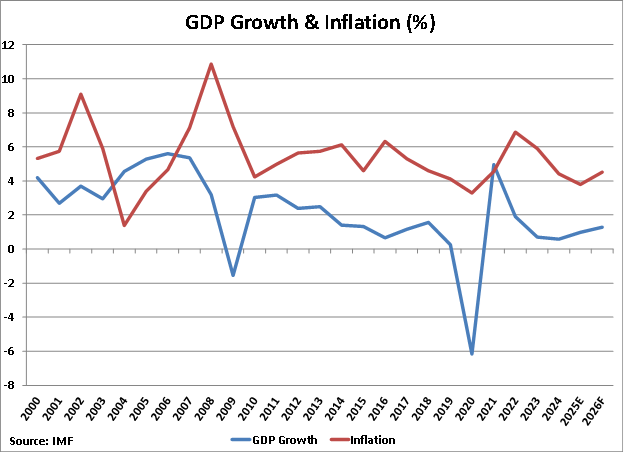
Inflationary pressures remain manageable. In November 2025, the annual headline inflation was 3.5%, slightly down from 3.6% in the previous month but up from 2.9% in the same period last year, based on figures from Stats SA. Nationwide inflation averaged less than 5% from 2010 to 2021, before accelerating to 6.9% in 2022. Inflation eased to 5.9% in 2023 and to 4.4% in 2024.
In late 2025, SARB revised its inflation framework to a 3% target with a ±1 percentage point band (2% to 4%), replacing the former 3% to 6% range to align with global standards and anchor expectations.
South Africa’s public finances show signs of improvement. During 2025, the budget deficit stood at approximately 4.4% of GDP, following shortfalls of 5% of GDP in 2024, 4.9% in 2023, 4.2% in 2022, 5.7% in 2021, 10% in 2020, and 6.9% in 2019. Also, it is now at par with the annual average shortfall of 4.4% in 2012-18. The country’s public finances worsened during the onset of the COVID-19 pandemic after President Cyril Ramaphosa introduced a fiscal stimulus package worth ZAR 500 billion (US$30.65 billion), or a tenth of the economy, the largest ever spending plan in the country’s history.
According to the National Treasury, as presented in the 2025 Medium-Term Budget Policy Statement, the budget deficit is projected to narrow to about 3.8% of GDP in 2026/27 and further decline to approximately 2.7% to 2.9% by 2028/29, subject to favorable economic conditions.
Despite this, South Africa’s debt burden widened to 76.9% of GDP in 2024 and rose further to about 77.9% in 2025, up from 73.4% in 2023, 72.8% in 2022, 69.9% in 2021, and 70.7% in 2020, marking the highest level in the country’s recent history.
In 2025, all three major credit rating agencies reviewed South Africa’s sovereign credit ratings, with Fitch, S&P, and Moody’s affirming or upgrading their assessments amid ongoing fiscal and structuraldevelopments.
- In September 2025, Fitch Ratings affirmed South Africa’s long-term foreign and local currency debt ratings at BB- with a stable outlook, highlighting persistent structural challenges such as slow growth, high public debt, and inequality, while noting support from favourable debt structure and macroeconomic policies.
- In November 2025, Standard & Poor’s (S&P) upgraded South Africa’s long-term sovereign credit ratings to BB (foreign currency) and BB+ (local currency) with apositive outlook, reflecting improving fiscal consolidation and growth prospects.
- In December 2025, Moody’s Investors Service affirmed the country’s Ba2 (sub-investment or “junk” status)rating with a stable outlook, acknowledging progress in fiscal metrics and macroeconomic resilience but noting that sustained reforms and stronger growth would be needed for further upgrades.
“South Africa’s‘BB-’IDR is constrained by low real GDP growth, a high level of poverty and inequality, a high and rising government debt/GDP ratio, and a rigid fiscal structure that hampers budget deficit reduction,” said Fitch Ratings.
“The ratings are supported by a favourable government debt structure with long maturities and mostly local-currency-denominated, strong institutions and a credible monetary policy framework,” added Fitch Ratings.
Progress and challengesunder Ramaphosa’s second term
In June 2024, South Africa’s parliament re-elected Cyril Ramaphosa as president after a historic coalition between the governing ANC, the centre-right Democratic Alliance (DA), and smaller parties. The deal followed weeks of speculation on who would hold power in the new administration after the ANC lost its parliamentary majority for the first time in three decades in the May 2024 elections. ANC got 40% of the votes while the DA came in second with 22%.
More than ayear into this Government of National Unity(GNU), Ramaphosa has maintained political stability and some investor confidence, but tangible results on economic growth, job creation, and structural reformhave fallen short, leaving his administration at a critical crossroads
Ramaphosafirst became president in February 2018 after Jacob Zuma resigned amid corruption allegations. A long-time ANC stalwart, trade union leader, andbusinessman, he was implicated in the 2012 Marikana massacre but haslargely avoidedthe scale of corruption accusations that plagued Zuma. Despite challenges, he was re-elected ANC president in December 2022, and the Public Protector’s June 2023 report found no wrongdoing in the Phala Phala scandal.
In 2025, the GNU faced budget disputes and political tensions that exposed coalition fragility, but Ramaphosa advanced reforms through Operation Vulindlela and infrastructure initiatives. The government reported the creation of roughly 250,000 jobs, consecutive primary budget surpluses, and South Africa achieved its first sovereign credit rating upgrade in nearly two decades. Public frustration remains high over unemployment, poverty, and service delivery, compounded by controversial decisions such as the 3.8% salary increase for ministers in early 2026.
Internationally, Ramaphosa led South Africa’s G20 Presidency and was elected interim Chair of the Southern African Development Community (SADC)in November 2025, strengthening the country’s regional and global influence despite tensions with the United States. By late 2025, his administration had managed incremental reforms and diplomatic engagement, but still faces persistent domestic and economic challenges.
Sources:
- Property Barometer – November 2025 (FNB): https://s3.entegral.net/
- Property BarometerFNB Estate Agents Survey – 3Q25 (FNB): https://s3.entegral.net/
- FNB Residential Property Barometer-September 2025 (Novus Group): https://novuspressbulletin.co.za/
- Property Brief – October 2025 (Better Bond): https://www.betterbond.co.za/
- Oobarometer Quarter 3 2025: Optimism Returns to South Africa’s Housing Market (oobaHome Loans): https://www.ooba.co.za/
- P5041.1 - Selected building statistics of the private sector as reported by local government institutions, October 2025 (Statistics South Africa): https://www.statssa.gov.za/
- Gross rental yields in South Africa: Cape Town and 5 other cities (Global Property Guide): https://www.globalpropertyguide.com/
- Statement of the Monetary Policy Committee, November 2025 (South African Reserve Bank): https://www.resbank.co.za/
- Current Market Rates (South African Reserve Bank): https://www.resbank.co.za/
- Mortgage advances (South African Reserve Bank): https://www.resbank.co.za/
- South Africa Housing Market Report - 2021 (Centre for Affordable Housing Finance in Africa): https://housingfinanceafrica.org/
- Monetary Policy Review – October 2025 (South African Reserve Bank): https://www.resbank.co.za/
- Quarterly Bulletin December 2025 (South African Reserve Bank): https://www.resbank.co.za/
- South Africa Consumer Price Index (Trading Economics): https://tradingeconomics.com/
- South Africa (International Monetary Fund): https://www.imf.org/
- South Africa: Staff Concluding Statement of the 2025 Article IV Mission (International Monetary Fund): https://www.imf.org/
- South Africa Unemployment Rate (Trading Economics): https://tradingeconomics.com/
- The economy posts its fourth straight gain (Statistics South Africa): https://www.statssa.gov.za/
- South Africa: Economy extends growth streak in Q3 (Focus Economics): https://www.focus-economics.com/
- South Africa: Staff Concluding Statement of the 2025 Article IV Mission (International Monetary Fund): https://www.imf.org/
- IMF raises SA’s 2026 GDP growth forecast as Team SA takes sales pitch to Davos (Daily Maverick): https://www.dailymaverick.co.za/
- Consumer inflation slows in November (Statistics South Africa): https://www.statssa.gov.za/
- South Africa Government Budget (Trading Economics): https://tradingeconomics.com/
- Fitch Affirms South Africa at‘BB-’; Outlook Stable (Fitch Ratings): https://www.fitchratings.com/
- South Africa Foreign Currency Rating Raised To 'BB'; Local Currency Rating Raised To 'BB+'; Outlook Positive (S&P Global): https://www.spglobal.com/
- Moody’s too cautious on SA’s reform progress, say economists (Business Day): https://www.businessday.co.za/
- South Africa’s clean President Ramaphosafaces his own scandal (BBC): https://www.bbc.com/
- Cyril Ramaphosare-elected South African president (BBC): https://www.bbc.com/
- Ramaphosa approves R100,000 salary increase for South Africa’s millionaire ministers (Business Tech): https://businesstech.co.za/
- President Ramaphosa elected interim Chair of SADC (SA News): https://www.sanews.gov.za/