Georgia's Residential Property Market Analysis 2026
Sales prices in Georgia’s main urban submarkets demonstrate a slower and more uneven growth, while asking rents in the capital are in decline, reflecting the continued market normalization after the extraordinary migration-driven surge in the previous years.
This extended overview from Global Property Guide covers key aspects of the Georgian housing market and takes a closer look at its most recent developments and long-term trends.
Table of Contents
- Property Prices and Price Index
- Property Demand Trends
- Property Supply Trends
- Rental Market: Rents and Rental Yields
- Mortgage Market and Interest Rates
- Economic and Social Factors
Property Prices and Price Index
House prices in Georgia’s main urban markets continued to rise in 2025, but growth lost momentum, and local dynamics became more uneven. In Tbilisi, the National Statistics Office of Georgia’s (Geostat) Residential Property Price Index (RPPI) for new residential properties indicated that prices continued to rise in nominal terms in late 2025, but only modestly and not enough to exceed inflation. In Q4 2025, the index rose by 3.27% year-on-year, equivalent to a real decline of 0.67%. Within the index, apartment prices increased by 3.47% year-on-year, while detached house prices rose by 2.55%, implying slight real declines in both segments.
The broader shift was consistent with the National Bank of Georgia’s (NBG) interpretation of the market cycle. According to the NBG, the earlier surge in prices was driven by strong economic activity and migration-related demand in 2022-2024, while the subsequent slowdown reflected softer growth and a normalization in demand conditions. The central bank also pointed to easing construction-cost pressures and strong permit issuance in recent years as factors that helped contain further price acceleration.
Georgia's house price annual change:
Within Tbilisi, pricing remained highly differentiated. Geostat’s median offer-price data for new-build properties showed the highest apartment prices in central and premium locations such as Mtatsminda and Vake, while lower levels were recorded in Samgori and Gldani. Annual apartment price growth remained positive across all districts covered by Geostat, suggesting that upward pressure was still relatively broad-based. Detached house price movements were more mixed, pointing to a less uniform market outside the apartment segment.
Median home prices in Tbilisi districts:
| Median Apartment Price, Q4 2025 GEL/sqm |
Median Apartment Price, Q4 2025 USD/sqm |
YoY, % | Median Detached House Price, Q4 2025 GEL/sqm |
Median Detached House Price, Q4 2025 USD/sqm |
YoY, % | |
| Gldani | GEL 3,731 | USD 1,383 | 4.55% | GEL 2,985 | USD 1,106 | 11.29% |
| Didube | GEL 4,054 | USD 1,502 | 5.19% | GEL 3,369 | USD 1,248 | -7.85% |
| Vake | GEL 5,874 | USD 2,176 | 7.76% | GEL 4,311 | USD 1,597 | 21.14% |
| Isani | GEL 3,854 | USD 1,428 | 9.71% | GEL 3,110 | USD 1,152 | 11.29% |
| Krtsanisi | GEL 4,181 | USD 1,549 | 11.17% | GEL 2,830 | USD 1,049 | -1.39% |
| Mtatsminda | GEL 6,738 | USD 2,497 | 12.55% | GEL 4,594 | USD 1,702 | 2.72% |
| Nadzaladevi | GEL 3,978 | USD 1,474 | 6.39% | GEL 2,660 | USD 986 | -0.27% |
| Saburtalo | GEL 4,313 | USD 1,598 | 3.33% | GEL 3,504 | USD 1,298 | 4.49% |
| Samgori | GEL 3,549 | USD 1,315 | 4.66% | GEL 3,121 | USD 1,156 | 24.58% |
| Chughureti | GEL 4,353 | USD 1,613 | 10.34% | GEL 3,088 | USD 1,144 | 2.45% |
| Note: Exchange rate as of December 2025, USD 1 = GEL 2.6988. | ||||||
| Data Source: Geostat. | ||||||
In Batumi, where the available pricing evidence is based on Galt & Taggart’s primary-market turnkey apartment series rather than Geostat’s official indices, price growth remained stronger but at the same time appeared less secure. According to the consultancy, the average primary-market price reached USD 1,865 per square meter in 2025, up by 9.4% year-on-year, while Old Batumi remained the most expensive submarket at USD 3,028 per square meter. However, Galt & Taggart also warned that price growth in the primary segment was running ahead of demand, with rising unsold stock and a substantial supply pipeline indicating that excess supply had yet to be fully absorbed.
Home prices on the primary market for turnkey apartments in Batumi submarkets:
| Min price, Q4 2025, USD/sqm |
Max price, Q4 2025, USD/sqm |
Average price, Q4 2025, USD/sqm |
YoY, % | |
| Old Batumi | USD 1,650 | USD 4,450 | USD 3,028 | 1.85% |
| Alley of Heroes | USD 1,400 | USD 3,325 | USD 2,095 | 10.32% |
| Gonio-Kvariati | USD 1,350 | USD 4,560 | USD 2,048 | 8.07% |
| Makhinjauri | USD 1,100 | USD 2,700 | USD 1,854 | 4.98% |
| New Boulevard Area | USD 1,230 | USD 2,900 | USD 1,761 | 12.45% |
| Inner Areas | USD 1,300 | USD 2,200 | USD 1,730 | 12.48% |
| Peripheral Areas | USD 1,080 | USD 2,500 | USD 1,487 | 10.72% |
| Kobuleti* | USD 1,050 | USD 2,400 | USD 1,721 | 5.58% |
| Note: *Kobuleti is not part of Batumi proper; it is included as a separate nearby coastal market. | ||||
| Data Sources: Galt & Taggart. | ||||
Overall, the market in 2025 was still expanding, but no longer in a broad-based upswing. Tbilisi entered a slower and more balanced pricing phase, while Batumi continued to record stronger growth, albeit with clearer signs of supply-side strain. Looking ahead, nominal prices are expected to keep rising in 2026, but at a more restrained pace. In Tbilisi, Galt & Taggart expects demand to remain broadly in line with 2025, with price growth staying within the single digits and depending heavily on the supply pipeline and continued permit issuance. TBC Capital’s forecast is similarly moderate, pointing to around 3.2% average property price growth in Tbilisi in 2026. In Batumi, Galt & Taggart expect primary-market price growth to slow to 4%-6% year-on-year.
Property Demand Trends
Market Activity Stays Resilient as Post-Surge Conditions Normalize
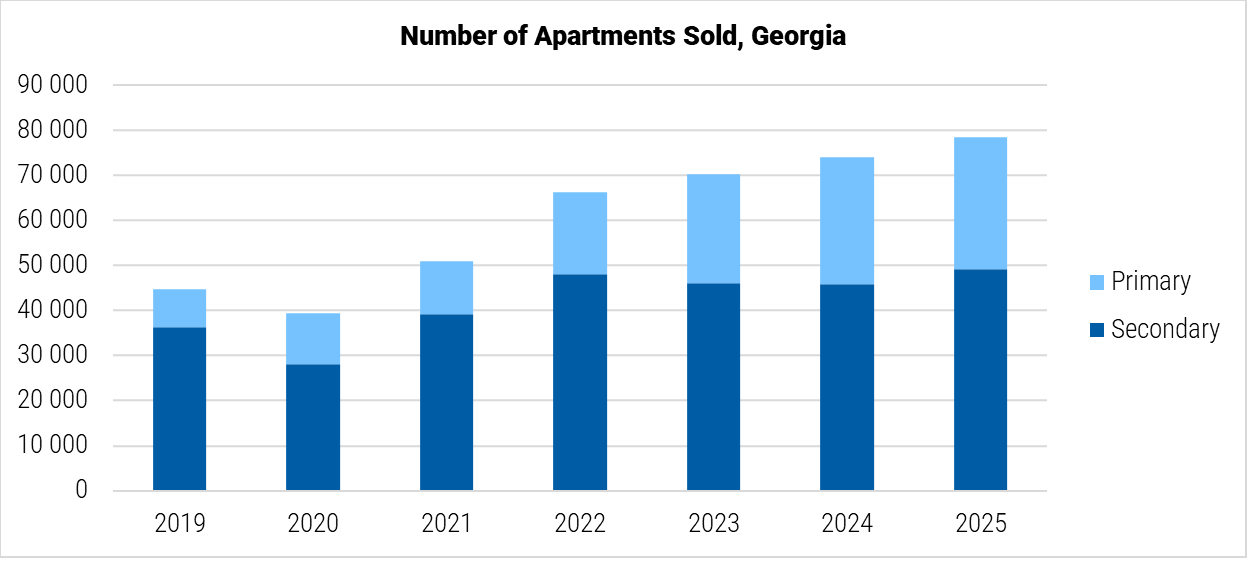
Georgia’s residential real estate market remained resilient in 2025, although activity increasingly reflected normalization. According to data from the National Agency of Public Registry (NAPR), compiled and analyzed by TBC Capital, 78.50 thousand apartments were sold across Georgia in 2025, up by 5.94% year-on-year. The secondary market accounted for the majority of transactions, representing 63% of total sales and recording growth of 7.42% year-on-year, while the primary segment made up the remaining 37% and expanded by a more moderate 3.53%.
This suggests that demand remained healthy at the national level, but the market was no longer operating under the exceptional conditions seen in the immediate aftermath of the migration-driven surge. Instead, 2025 looked more like a year of normalization, with transaction growth continuing but at a more measured and uneven pace across segments and cities.
Data Sources: NAPR, TBC Capital.
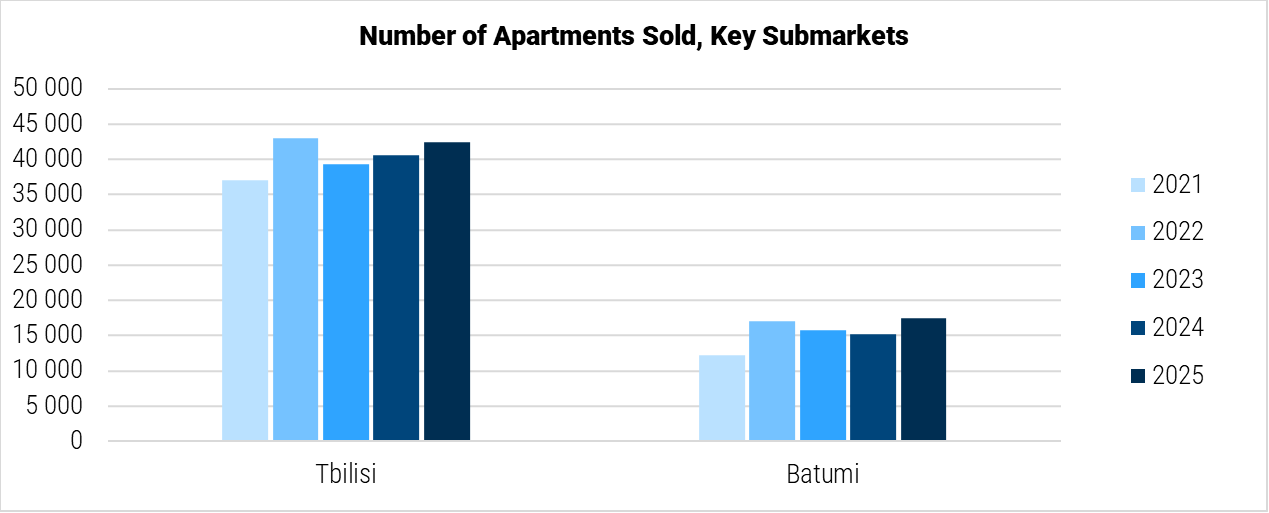
In Tbilisi, apartment sales totaled 42,388 in 2025, up by 4.31% year-on-year, according to Galt & Taggart. The firm noted that a weak start to the year initially raised concerns about a correction, but activity recovered later as pent-up demand returned. Domestic buyers remained the backbone of the capital’s market. According to Galt & Taggart’s January 2026 survey of key residential developers, Georgian buyers accounted for around 77% of primary residential sales in the surveyed group, while the largest foreign buyer groups were from Israel and Russia, representing approximately 10% and 3% of sales, respectively.
Batumi recorded stronger headline momentum. Galt & Taggart reported 17,478 apartment sales in 2025, an increase of 15.02% year-on-year. According to the consultancy, this rebound was supported both by new large-scale project launches and by stronger resale activity, as the growing stock of completed apartments expanded opportunities on the secondary market. Foreign demand remained materially more important in Batumi than in Tbilisi, with foreign buyers accounting for 52% of apartment sales in the surveyed projects. The buyer mix was also more diverse, with buyers from the EU and Israel each accounting for 13% of total sales, while buyers from Ukraine, Russia, and Belarus together represented 11%.
Data Sources: NAPR, Galt & Taggart.
Market participants expect the market to continue stabilizing in 2026, with performance increasingly dependent on foreign buyer activity and the wider geopolitical backdrop. According to TBC Capital, the impact of the conflict in the Middle East on Georgia’s residential market will depend largely on its duration and scale. Under its pre-conflict baseline, apartment sales are expected to rise by 1.40% in 2026 to 79,600 units, while under a short-conflict-resolution scenario, the increase could reach 2.00%, bringing transactions to 80,100 units. At the same time, TBC Capital warns that prolonged uncertainty could weaken buyer confidence, delay purchase decisions, and reduce demand.
At the city level, Galt & Taggart expects demand in Tbilisi to remain broadly in line with 2025, supported by long-term fundamentals such as urbanization, declining household size, and attractive yields. In Batumi, primary sales are projected to remain broadly flat in 2026, while secondary-market transactions may continue to rise as the growing stock of completed apartments further deepens the resale market.
Property Supply Trends
New Delivery Eased, but Future Supply Remains Elevated
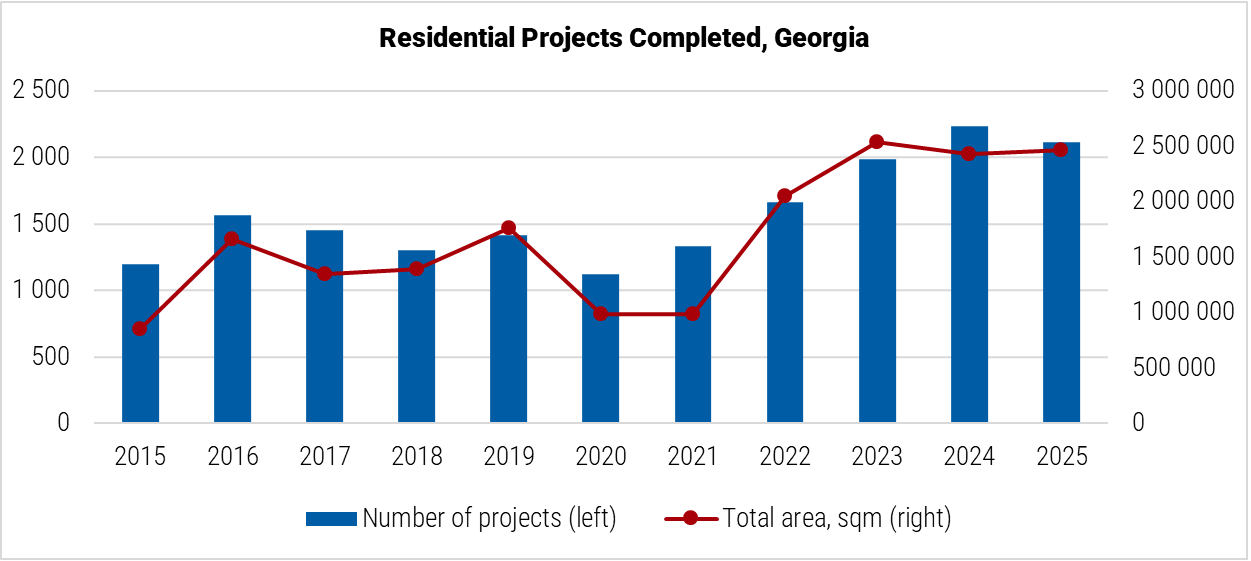
Housing supply in Georgia remained substantial in 2025, although both completions and new authorizations eased in project-count terms. According to Geostat’s residential-by-type series, residential completions totaled 2,112 projects in 2025, down by 5.38% year-on-year. At the same time, the total completed residential area increased by 1.65% to 2.468 million square meters, indicating that fewer but larger projects were delivered.
Data Source: Geostat.
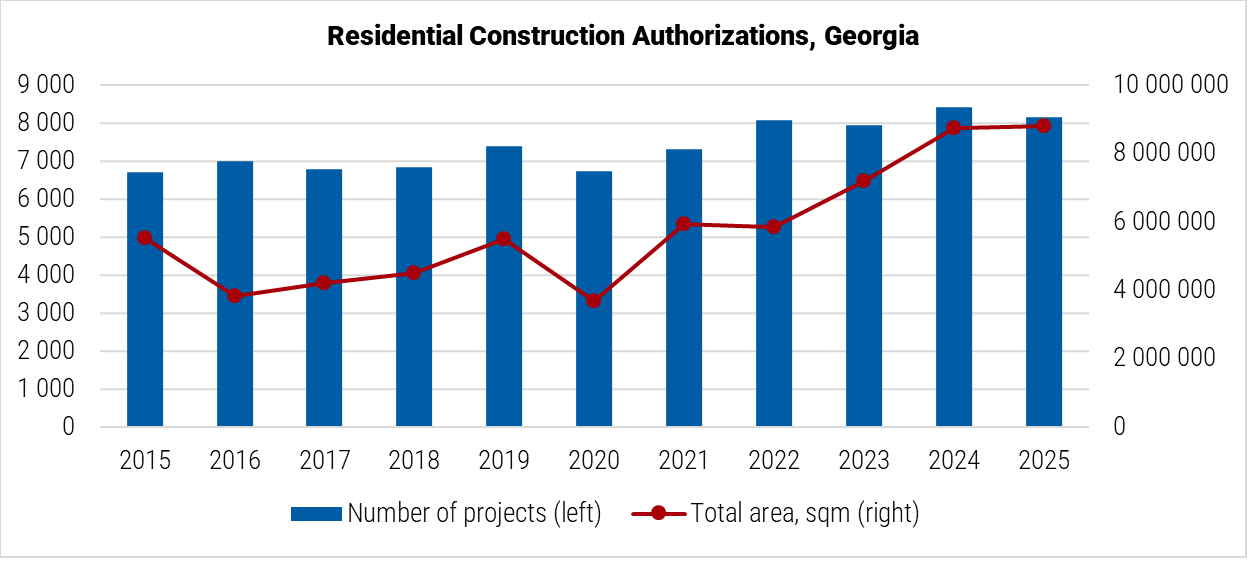
A similar pattern was visible in the permitting data. A total of 8,167 residential projects were authorized across Georgia in 2025, down by 3.23% year-on-year, while the total authorized area edged up by 0.90% to 8.816 million square meters. This points to some moderation in the number of new projects entering the pipeline, but not to a meaningful reduction in future supply volumes.
Data Source: Geotstat.
That softer national picture is broadly consistent with Tbilisi-focused market intelligence, although local private-sector sources use narrower definitions than Geostat and are therefore not directly comparable. Using Tbilisi Architecture Service (TAS) data for Class III and IV multi-apartment and multifunctional residential buildings, Galt & Taggart reported that 208 construction permits were issued for residential real estate in Tbilisi in 2025, down by 4.20% year-on-year, while permitted living area fell by 10.73% to 1.734 million square meters. Even so, the consultancy noted that permit issuance remained elevated, standing 32% above the 2015-2022 average “healthy” level.
Against this backdrop, the supply outlook in Tbilisi is better characterized by continued pipeline pressure than by outright oversupply in completed stock. Galt & Taggart noted that elevated permit issuance had “yet to fully realign with the lower post-peak sales,” while TBC Capital similarly warned that potential residential supply in the capital “continues to grow, intensifying competition.” This indicates that the main supply-side risk in Tbilisi lies in the still-elevated forward pipeline, which is likely to keep competition high, weaken pricing power, and limit the scope for stronger price growth.
Rental Market: Rents and Rental Yields
Market Normalization Continues, Asking Rates Down in Tbilisi
The rental sector in Georgia remains relatively small compared to the private ownership sector. The latest available census figures show that as of 2014, only 3.8% of households rented their residence. More recently, a Geostat gender equality study revealed that 3.8% of households headed by men and 5.0% of households headed by women resided in rented housing in 2024.
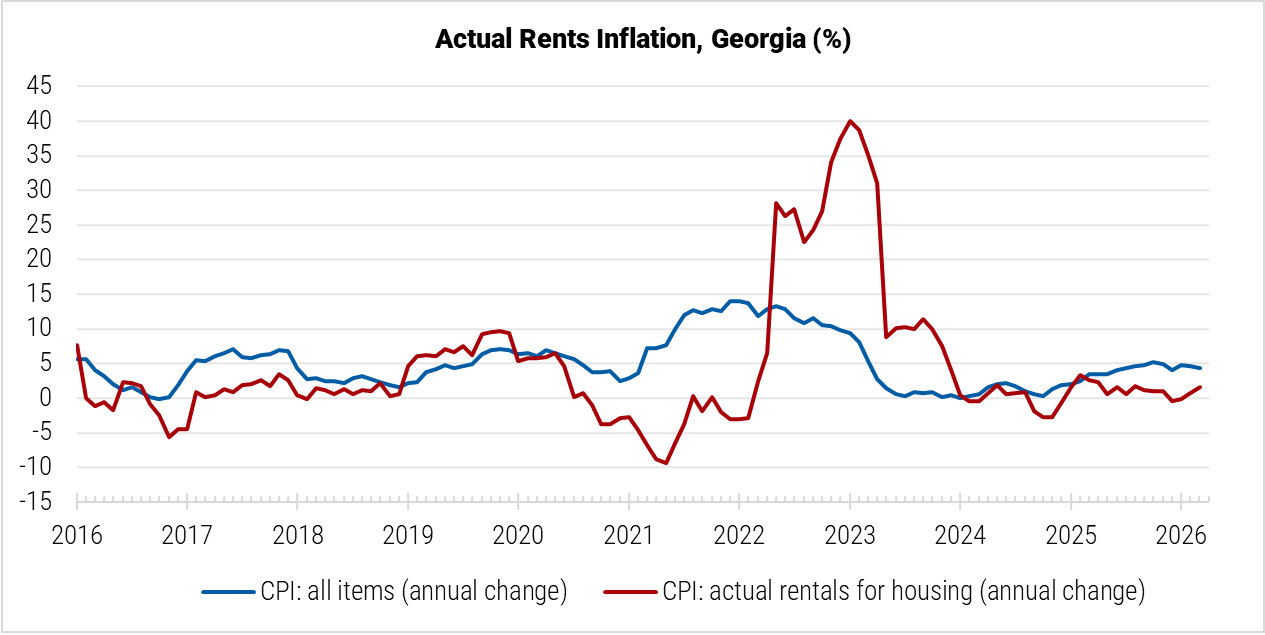
Against this background, after easing from the extraordinary spike of 2022-2023, fueled by foreign migration, rental inflation in Georgia has stabilized at low levels, trending below the overall price growth throughout 2025 and early 2026. In March 2026, Geostat reported a 1.9% annual increase in the actual rentals for the housing component of the consumer price index (CPI), while the all-item CPI recorded a 4.3% growth over the same period.
Data Source: Geostat.
In nominal terms, the analysis by Galt & Taggart based on 50-60 sqm new apartments in Tbilisi found the average rent at USD 10.1 per square meter in February 2026. Within the capital city, the highest average rents for these types of properties were observed in the districts of Vake (USD 13.8), Mtatsminda (USD 11.7), and Saburtalo (USD 11.7), while the lowest rates were recorded in Samgori (USD 8.4) and Gldani (USD 8.4).
In parallel, data from TBC Capital indicates a continued correction in asking rents in Tbilisi, with rates dropping by 8% in 2024 and 11% in 2025. In the first two months of 2026, according to TBC Capital, the average rent per square meter in the capital city reached USD 10.0 (-6% year-on-year). The corresponding rental yields, while still remaining higher than those in many European and global markets, have also returned closer to their historic average of around 8% after the 2022-2023 spike.
In line with this dynamic, research conducted by Global Property Guide found gross rental yields for properties in Georgia at the average level of 7.42% in February 2026, compared to 7.53% previously reported in February 2025. Between the two key submarkets, Tbilisi (7.53%) continued to demonstrate a slightly higher potential performance than Batumi (7.31%).
Looking ahead, TBC Capital expects rental rates in Tbilisi to continue adjusting, with a projected decline of 2.1% in 2026.
Mortgage Market and Interest Rates
Lending Activity Continues to Grow Despite Elevated Interest Rates
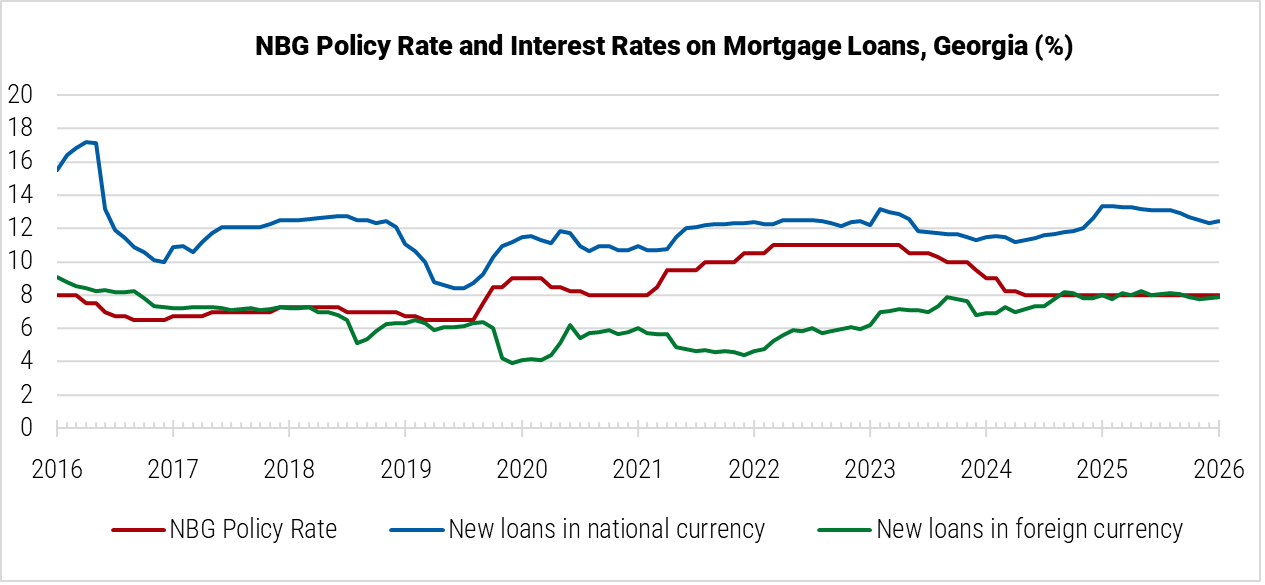
Mortgage rates in Georgia had not fallen in line with policy rate cuts in 2023-2024 and remain structurally elevated, with no notable shifts likely in the coming quarters, as individual banks maintain high spreads and a cautious lending stance.
Georgia's mortgage loan interest rates:
Further supporting this view, the latest financial stability report from the NBG suggests that “household debt service burden will remain relatively high”, as the pace of monetary policy normalization has slowed amid ongoing risks and elevated uncertainty. The central bank’s policy rate has been kept unchanged at 8.0% since May 2024 and is now expected by local experts to remain at this level for the rest of the year in light of rising global uncertainty linked to the Middle East conflict.
According to NBG figures, the weighted average interest rate on new mortgage loans in national currency eased somewhat over 2025, but remained above the comparable 2024 level, standing at 12.14% as of February 2026. For new mortgage loans in foreign currency, the indicator continued to fluctuate around 8% during this period, most recently reported at 8.01%.
Note: Loans to households for purchasing and renovation of real estate secured by real estate.
Data Source: NGB.
Weighted average interest rates on new mortgage loans to households:
| Feb 2026 | YoY | Feb 2025 | YoY | Feb 2024 | |
| Loans in national currency | 12.14% | ↓ | 13.31% | ↑ | 11.51% |
| Loans in foreign currency | 8.01% | ↑ | 7.73% | ↑ | 6.94% |
| Note: Loans to households for purchasing and renovation of real estate secured by real estate. | |||||
| Data Source: NBG. | |||||
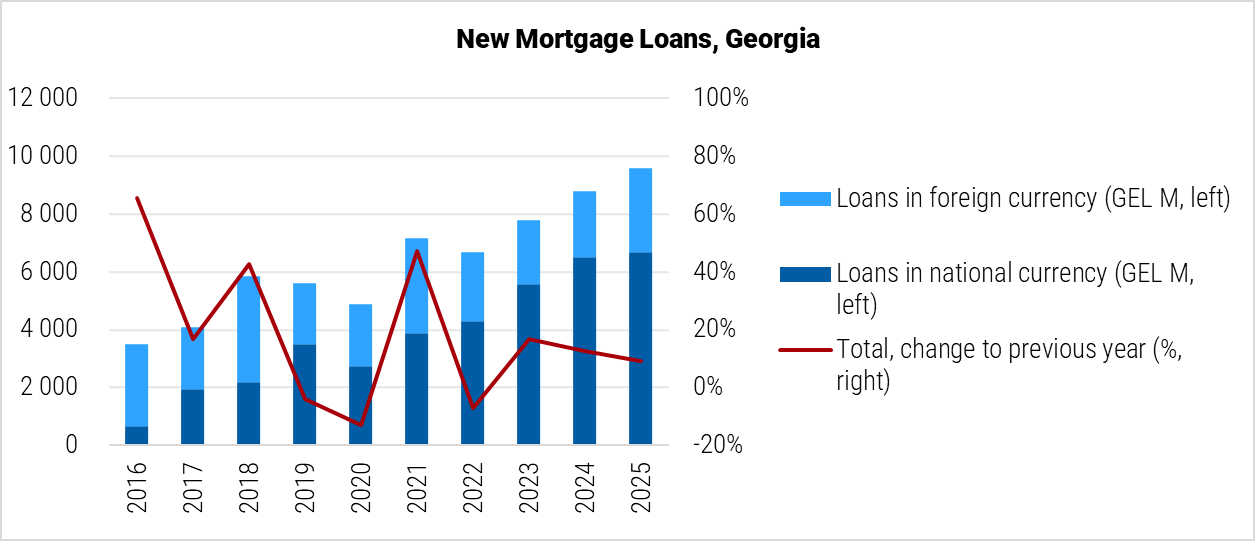
Despite relatively tight credit conditions, household lending activity in the country exhibits high and steady growth, with consumer and mortgage loans issued by commercial banks making substantial contributions to this trend, according to the NBG. The cumulative value of new mortgage loans granted to individuals in 2025 reached GEL 9.6 billion (USD 3.5 billion), demonstrating, however, a more moderate 9.1% year-on-year increase compared to double-digit growth observed in the previous two years, pointing to gradual stabilization of loan demand in the environment of still-high interest rates and affordability constraints. Loans in national currency made up nearly 70% of all new mortgages in 2025.
Note: Loans secured by real estate granted to individuals, including individual entrepreneurs, since December 1, 2015.
Data Source: NGB.
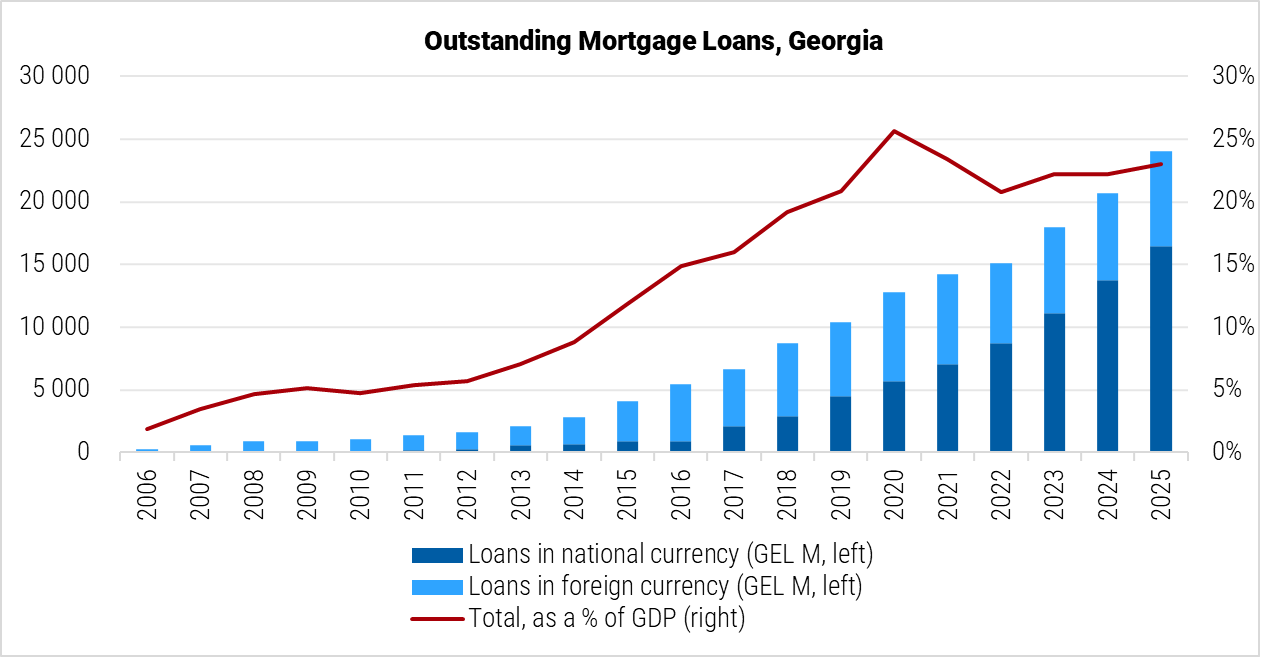
The overall size of the market also continues to expand, with the total value of outstanding mortgage loans to individuals annually growing by 19.6%, on average, over the past decade. In 2025, the housing loan stock increased by 16.2% and reached GEL 24.2 billion (USD 9.1 billion) by February 2026. Sized against the national economy, the mortgage market expanded from 11.8% of GDP in 2015 to an estimated 23.0% in 2025.
Note: Loans secured by real estate granted to individuals, including individual entrepreneurs, since December 1, 2015.
Data Source: NGB.
Economic and Social Factors
Growth and Inflation Trends Impacted by Global Developments
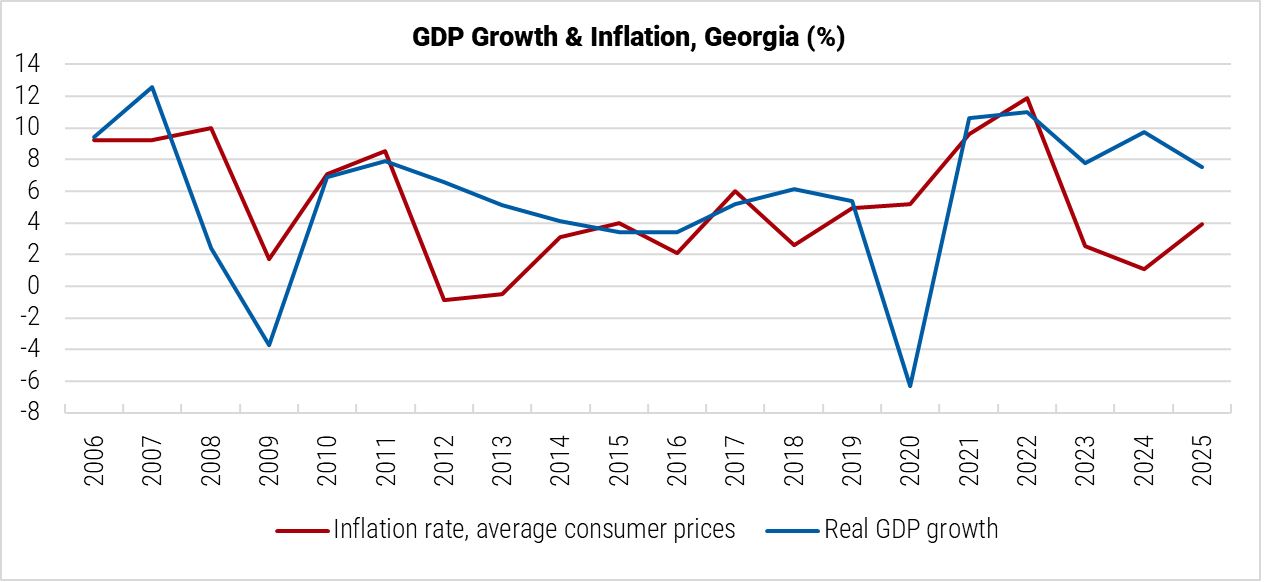
Despite elevated domestic and geopolitical uncertainty, the Georgian economy has performed remarkably well, with real GDP growth, supported by private consumption, still strong at 7.5% in 2025, following a 9.7% expansion in 2024. However, a moderation in economic activity is now anticipated, as growth in the developing countries of Europe and Central Asia is likely to slow substantially this year due to the impact of the Middle East conflict, geopolitical tensions, and trade fragmentation. In its latest regional economic update, the World Bank forecasted 5.0% and 5.5% growth for Georgia in 2026 and 2027, respectively. Similarly, the International Monetary Fund (IMF) projects a slowdown to 5.3% in 2026 and 5.0% in 2027.
“Georgia’s economic performance has been robust, supported by sound macroeconomic management and policies. At the same time, amid rising global uncertainty, notably from the war in the Middle East, the outlook is becoming more challenging,” said Alejandro Hajdenberg of the IMF upon the conclusion of the most recent Article IV mission to the country. “Assuming the conflict is short-lived, growth is expected to remain strong, albeit moderating, extending the solid performance observed in recent years.”
After averaging 3.9% in 2025, consumer price index (CPI) inflation in the country stood at 4.3% in March, reflecting higher imported food and oil prices, partly related to the war in the Middle East, and is expected to stay elevated in the first half of 2026, before gradually converging to target over the next two years, as the one-off effects of higher food and energy prices dissipate and demand moderates. The World Bank outlook projects inflation in Georgia at 5.0% in 2026, 3.8% in 2027, and 3.0% in 2028.
Data Source: IMF.
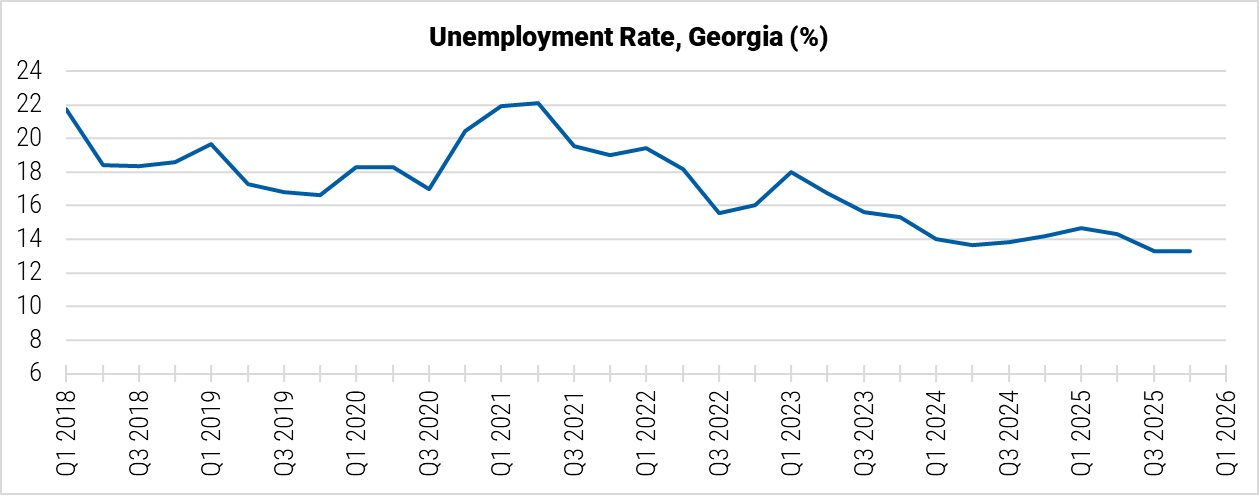
The situation in Georgia’s labor market improved significantly in previous years, but structural issues persist. High-quality job creation is limited, and employment remains concentrated in low-productivity agriculture, self-employment, and informal activities, constraining income convergence and inclusive growth. The unemployment rate is at its lowest levels in over two decades, most recently reported by Geostat at 13.3% in Q4 2025, but remains structurally high, especially for the young population.
“A key challenge is structurally high unemployment — particularly among youth — driven by skill mismatches and weak work incentives amid low wages,” noted the IMF staff in the Article IV mission concluding statement. “Reforms should focus on supporting vocational education and training and improving public employment services to better align skills with labor market needs, aligning social assistance with work incentives, and supporting high-productivity sectors that generate well-paid jobs.”
Data Source: Geostat.
Overall, Georgia’s small, open economy continues to post solid GDP growth alongside relatively low inflation, but the current outlook is highly uncertain and dependent on external developments, including the deteriorating EU relations, which previously led to the suspension of accession negotiations. Domestically, downside risks stem from continued political polarization and slow progress with structural reforms.
In November 2025, Fitch Ratings affirmed Georgia’s ‘BB’ sovereign rating, while revising the outlook for it from negative to stable due to increased international reserves, reduced current account deficit, and solid growth prospects. More recently, in February 2026, S&P Global Ratings also affirmed the country’s ‘BB’ standing with a stable outlook.
Sources:
- National Statistics Office of Georgia (Geostat)
- Residential Property Price Index in Georgia, 2025 IV Quarter: https://www.geostat.ge/
- Information About Permissions Granted for Construction and Completed Objects: https://www.geostat.ge/
- Gross Domestic Product (GDP): https://www.geostat.ge/
- Consumer Price Index (Inflation): https://www.geostat.ge/
- Employment and Unemployment: https://www.geostat.ge/
- Women and Men in Georgia, 2025: https://www.geostat.ge/
- 2014 General Population Census Results: https://www.geostat.ge/
- National Bank of Georgia (NBG)
- Monetary Policy Committee Decisions: https://nbg.gov.ge/
- Statistics Data: https://nbg.gov.ge/
- Financial Stability Report 2025: https://nbg.gov.ge/
- Current Macroeconomic Review: https://nbg.gov.ge/
- European Commission
- Economic Forecast for Georgia: https://economy-finance.ec.europa.eu/
- EU – Georgia Relations: https://enlargement.ec.europa.eu/
- International Monetary Fund (IMF)
- Country Overview: Georgia: https://www.imf.org/
- Georgia: Staff Concluding Statement of the 2026 Article IV Mission: https://www.imf.org/
- 2025 Article IV Staff Report: https://www.imf.org/
- Georgia: Selected Issues: https://www.imf.org/
- World Bank
- Europe & Central Asia Economic Update, April 2026: https://openknowledge.worldbank.org/
- Georgia MPO, April 2026: https://thedocs.worldbank.org/
- Galt & Taggart
- Batumi Residential Real Estate, 2025 Review and 2026 Outlook: https://ramad.bog.ge/
- Tbilisi Residential Real Estate, 2025 Full Year Overview: https://ramad.bog.ge/
- Tbilisi Residential Real Estate, February 2026 Update: https://ramad.bog.ge/
- TBC Capital
- Residential Real Estate Market in Georgia. 2025 Summary, 2026 Outlook: https://tbccapital.ge/
- The Impact of the War in the Middle East on Georgia’s Residential Real Estate: https://tbccapital.ge/
- Fitch Ratings
- Fitch Revises Georgia's Outlook to Stable; Affirms at 'BB': https://www.fitchratings.com/
- S&P Global
- Georgia 'BB/B' Ratings Affirmed; Outlook Stable: https://www.spglobal.com/
- Georgia Today
- G&T Revises Outlook, No Rate Cuts by National Bank in 2026: https://georgiatoday.ge/