India's Residential Property Market Analysis 2026
India’s housing market continues to demonstrate sustained but selective growth, with sales price gains concentrated in premium segments of major cities and rent increases most pronounced in areas of infrastructure- and job-based demand.
This extended overview from Global Property Guide covers key aspects of the Indian housing market and takes a closer look at its most recent developments and long-term trends.
Table of Contents
- Property Prices and Price Index
- Property Demand Trends
- Property Supply Trends
- Rental Market: Rents and Rental Yields
- Mortgage Market and Interest Rates
- Economic and Social Factors
Property Prices and Price Index
Residential property prices in India continued to rise in 2025, with the strongest momentum concentrated in premium segments and selected major cities. Preliminary data released by the Reserve Bank of India (RBI) in February 2026 show that the All-India House Price Index increased by 3.58% year-on-year in Q3 2025-26, the quarter ending December 2025, while also rising by 1.24% quarter-on-quarter. At the city level, pricing remained firmer, particularly in the major metropolitan markets.
India's house price annual change:
Knight Frank research points to continued average price growth across the main urban centers, with the strongest increases recorded in NCR, Bengaluru, and Hyderabad. This momentum was supported by the continued shift in both launches and sales toward higher-ticket projects, alongside selective developer price increases and sustained traction in larger ticket-size segments.
JLL describes a similar market dynamic, noting that prices continued to rise as developers concentrated on premium housing, construction costs remained elevated, and buyer appetite in the higher-value segment stayed resilient. Monetary easing also provided an additional supportive backdrop by improving financing conditions.
Residential property prices in selected markets:
| City | Average Price, H2 2025, INR/sqm |
Average Price, H2 2025, USD/sqm |
YoY, % |
| Mumbai | INR 95,326 | USD 1,070 | 7% |
| National Capital Region (NCR) | INR 64,885 | USD 728 | 19% |
| Bengaluru | INR 79,525 | USD 893 | 12% |
| Pune | INR 53,992 | USD 606 | 5% |
| Chennai | INR 55,273 | USD 620 | 7% |
| Hyderabad | INR 72,345 | USD 812 | 13% |
| Kolkata | INR 43,454 | USD 488 | 6% |
| Ahmedabad | INR 34,413 | USD 386 | 3% |
| Note: Exchange rate as of Q4 2025, USD 1 = INR 89.0982. | |||
| Data Source: Knight Frank Research. | |||
The near-term outlook suggests that residential prices should continue to move upward, but at a more measured and uneven pace. A Reuters poll of property analysts conducted between February 23 and March 10, 2026, indicates that home prices in major urban centers, including Mumbai, Delhi, NCR, Bengaluru, and Chennai, are expected to rise by 5% to 7% annually over the next three years.
At the same time, PropTiger expects buyer behavior to become more selective, with pricing increasingly shaped by city-specific conditions, project quality, and micro-market fundamentals rather than broad-based speculative momentum. As a result, residential prices are expected to remain firm in 2026, but gains are likely to be more moderate and uneven, with developers in some segments relying more on incentives, flexible payment plans, and phased offerings than on further sharp headline price increases.
Property Demand Trends
Resilient Buyer Activity Persists as Demand Shifts Further Upmarket
India’s residential market remained resilient in 2025, although demand became increasingly differentiated across ticket sizes and cities. According to Knight Frank, 348,207 housing units were sold across the eight major cities, down by 0.69% year-on-year. As the report noted, sales “moderated marginally,” but demand remained “well supported,” indicating continued market resilience even as headline momentum softened.
At the same time, the annual data suggest a more selective demand environment. Overall activity remained firm, but demand became increasingly concentrated in higher-value segments, while lower-ticket housing lost momentum amid tighter supply conditions. Sales of homes priced below INR 5 million (USD 56,118) and in the INR 5-10 million (USD 56,118 - USD 112,236) segment fell by 17% and 8% year-on-year, respectively. By contrast, homes priced above INR 10 million (USD 112,236) recorded 14% growth and accounted for 50% of total annual sales, underscoring the continued premiumization of housing demand.
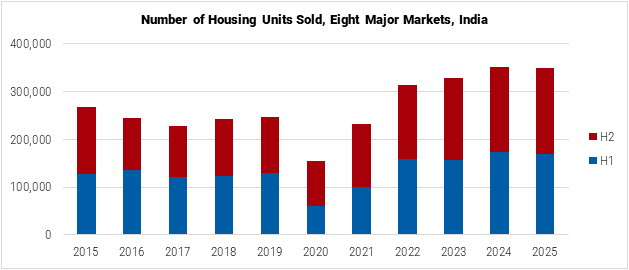
Note: Monitored markets include Mumbai, National Capital Region (NCR), Bengaluru, Pune, Hyderabad, Ahmedabad, Kolkata, and Chennai.
Data Source: Knight Frank Research.
Demand patterns also varied across cities. Mumbai remained the largest market in absolute terms, with 97,188 units sold in 2025, accounting for about 28% of total sales across the eight major cities. Chennai and Hyderabad recorded the strongest annual growth, with sales rising by 12% and 4%, respectively, while Bengaluru was broadly stable.
By contrast, NCR posted a 9% year-on-year decline in sales. Knight Frank attributes the softer performance to a combination of sharp price escalation, a relatively greater presence of investor-led and speculative activity, and very limited availability in the mid-income and affordable segments in well-located micro-markets. Upper-end demand, however, remained robust, particularly in the INR 20-200 million (USD 224,471 — USD 2,244,714) range.
Number of housing units sold in selected markets:
| City | Number of Housing Units Sold, 2025 |
YoY, % |
| Mumbai | 97,188 | 1.04% |
| Bengaluru | 55,373 | 0.02% |
| Pune | 50,881 | -2.80% |
| National Capital Region (NCR) | 52,452 | -9.02% |
| Hyderabad | 38,403 | 3.86% |
| Ahmedabad | 18,752 | 1.57% |
| Chennai | 18,262 | 12.46% |
| Kolkata | 16,896 | -2.84% |
| Data Source: Knight Frank Research. | ||
Looking ahead, the outlook remains positive. Premium and luxury housing are expected to remain the main drivers of residential demand in the near term, with Cushman & Wakefield noting that this segment should “sustain in 2026,” supported by lifestyle-driven preferences and rising participation from affluent domestic buyers and Indians living abroad.
By contrast, demand in lower-ticket segments is likely to depend more heavily on government support and gradual improvements in affordability. In this regard, official releases on the government’s Pradhan Mantri Awas Yojana–Urban 2.0 (PMAY-U 2.0) housing programme point to continued support for economically weaker, lower-income, and middle-income urban households, which should help underpin end-user demand over time. Knight Frank likewise expects affordable housing initiatives, easing financial conditions, and pro-business reforms to continue supporting buyer confidence.
Property Supply Trends
Launches Remain Elevated, with New Supply Increasingly Concentrated in Premium Housing
Residential development activity in India remained elevated in 2025, although the pace of expansion moderated after the strong post-pandemic upcycle. According to Knight Frank, 362,148 units were launched across India’s eight major markets in 2025, down 2.89% year-on-year, yet still marking the second-highest annual launch volume since 2014.
The composition of new supply remained skewed toward higher-ticket housing: launches priced above INR 10 million (USD 112,236) increased by 12% year-on-year in 2025, while supply in the sub-INR 5 million (USD 56,118) and INR 5-10 million (USD 56,118 - USD 112,236) segments declined by 28% and 9%, respectively. JLL similarly argues that developers continued to prioritize premium and high-end projects, where margins are stronger, and demand has remained more resilient, reinforcing the broader shift in new supply away from lower-ticket housing.
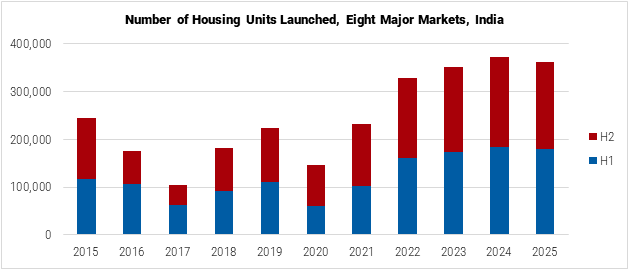
Note: Monitored markets include Mumbai, National Capital Region (NCR), Bengaluru, Pune, Hyderabad, Ahmedabad, Kolkata, and Chennai.
Data Source: Knight Frank Research.
Geographically, launches remained concentrated in the country’s largest and most liquid metropolitan markets. Mumbai accounted for 23% of total launches in 2025, followed by Bengaluru at 18% and Pune at 15%. Among the major markets, Bengaluru recorded the strongest growth in launches, up 22.76% year-on-year, while NCR posted the steepest decline, with new supply down 16.36%.
Number of housing units launched in selected markets:
| City | Number of Housing Units Launched, 2025 |
YoY, % |
| Mumbai | 87,114 | -9.70% |
| Bengaluru | 68,760 | 22.76% |
| Pune | 56,118 | -5.76% |
| National Capital Region (NCR) | 50,769 | -16.36% |
| Hyderabad | 40,737 | -7.44% |
| Ahmedabad | 22,041 | -0.01% |
| Chennai | 20,865 | 19.70% |
| Kolkata | 15,780 | -5.61% |
| Data Source: Knight Frank Research. | ||
Although unsold inventory continued to rise, supply conditions remained broadly manageable rather than excessive. Knight Frank reports that unsold stock across the eight major markets increased by 2.82% year-on-year to 509,815 units in 2025. However, the quarters-to-sell metric, which estimates the time required to absorb existing inventory based on the trailing eight quarters of sales, remained stable at 5.8 quarters, or less than 18 months.
The increase in inventory was concentrated in the INR 10 million (USD 112,236) and above segment, where stock rose by 19% year-on-year, while inventory in the sub-INR 5 million (USD 56,118) and INR 5-10 million (USD 56,118 - USD 112,236) categories declined by 7% and 3%, respectively, indicating that the main supply overhang is segment-specific and linked to developers’ sustained emphasis on premium product.
Residential market health in major markets, by city:
| City | Unsold Inventory, 2025 |
YoY, % | Quarters to Sell (QTS), 2025 |
| Mumbai | 155,604 | -6% | 6.4 |
| NCR | 104,969 | -2% | 7.6 |
| Bengaluru | 67,518 | 25% | 4.9 |
| Hyderabad | 54,878 | 4% | 5.8 |
| Pune | 51,653 | 11% | 4.0 |
| Ahmedabad | 36,231 | 10% | 7.8 |
| Kolkata | 19,630 | -5% | 4.6 |
| Chennai | 19,332 | 16% | 4.5 |
| Total Major Markets | 509,815 | 3% | 5.8 |
| Data Source: Knight Frank Research. | |||
At the same time, the shortage of lower-cost housing remains a key structural weakness on the supply side. Knight Frank estimates that India’s urban affordable housing deficit currently stands at 9.4 million units and, with accelerating urbanization, is projected to widen to nearly 30 million units by 2030. Recent government updates on PMAY-U 2.0 also indicate continued public-sector efforts to expand affordable and rental housing supply, underlining that meaningful improvement in this segment is still likely to depend more on policy support than on private-market launches alone.
Overall, the supply outlook remains constructive, though increasingly uneven across segments. Cushman & Wakefield expects residential launches to remain above 300,000 units in 2026, supported by urbanization, infrastructure upgrades, and continued end-user demand. At the same time, both Cushman & Wakefield and JLL indicate that premium and high-end housing should continue to attract the greatest developer focus, implying that India’s residential pipeline is likely to remain active in 2026 but still tilted toward higher-value projects unless affordability improves more meaningfully in the lower-ticket segment.
Rental Market: Rents and Rental Yields
Rental Growth Set to Remain Above Consumer Inflation Amid Market Recalibration
The rental segment of the housing market in India has been surging in recent years, driven by urban migration trends, rental reforms under the Model Tenancy Act (introduced in 2019), and a shift towards luxury development on the supply side, which leaves many households in the middle- and low-income groups priced out of homeownership. Commenting on the state of the housing market for Reuters in March 2026, Avneesh Sood of the Delhi-based Eros Group noted that home prices, especially in major cities, are rising faster than incomes, “forcing a larger proportion of the population to remain in the rental pool for much longer periods".
At the same time, reporting from local real estate platforms indicates that the market continues to transition from the post-pandemic surge era, demonstrating sustained but more selective growth. While infrastructure corridors and job hubs are seeing sharp rental increases, peripheral areas outside major urban centers are gaining demand as tenants seek affordability.
According to the property platform NoBroker (as cited by The Economic Times), the average rental inflation in India’s six major metro areas (Bengaluru, Mumbai, Delhi-NCR, Hyderabad, Pune, and Chennai) in the first half of 2025 stood between 7% and 9%, a significant decline from the aggressive 12-24% annual hikes seen between 2021 and 2024.
More recently, property platform Magicbricks reported a 2.2% quarter-on-quarter growth in rents in the December quarter of 2025, a notable moderation from 4.4% growth in the July quarter, 4.8% in the June quarter, and 10.6% in the March quarter. Regionally, cities such as Bengaluru (10.2% quarter-on-quarter), Chennai (8.7% quarter-on-quarter), Kolkata (10.2% quarter-on-quarter), Delhi (6.7% quarter-on-quarter), and Greater Noida (5.4% quarter-on-quarter) recorded the most notable rent increases, while submarkets like Mumbai, Navi Mumbai, Pune, Thane, Gurugram, and Ahmedabad registered quarterly declines, which “reflected healthy price normalization following earlier upcycle”.
Overall, the Magicbricks report outlines an increasingly micro-location driven market, shaped by infrastructure-based demand pockets and affordability thresholds amid tight supply availability in preferred submarkets. “India’s rental market entered a phase of measured recalibration <…> marked by selective moderation in demand, calibrated supply movements, and steady rental appreciation at the national level,” summarized Sudhir Pai, the platform’s CEO.
Moderate Rental Yields
In nominal terms, the research conducted by Global Property Guide in November 2025 found average asking rents in India’s key urban submarkets at USD 70-170 for studio units, USD 100-320 for 1-bedroom units, USD 240-470 for 2-bedroom units, and USD 380-680 for 3-bedroom units. The corresponding gross rental yields averaged 5.09% nationwide, with the highest potential performance for rental properties estimated in Delhi (5.81) and Kolkata (5.79%), while comparatively more expensive Mumbai market offered lower yields (3.84%).
Looking ahead, despite the apparent moderation, the upward trend for rents across India is set to continue this year. “In 2026, we expect rentals to remain on an upward trajectory, with more growth towards established corridors, while affordability pressures may push incremental demand towards peripheral locations,” Shveta Jain from Savills India told The Economic Times.
Local experts polled by Reuters in February-March 2026 also projected rents across India will continue to rise over the year ahead, trending substantially above consumer inflation. Poll medians showed average urban rents are expected to increase by 6-8%, with some analysts anticipating an even stronger growth of 7-15%.
Mortgage Market and Interest Rates
Interest Rates Likely on Hold, Lending Activity Continues to Grow
The Reserve Bank of India (RBI) previously reduced its policy rates by a cumulative 125 bps throughout 2025, bringing the Policy Repo Rate to 5.25% and the Bank Rate to 5.50% in December. Since then, however, the regulator has maintained its neutral stance, not taking any further steps to adjust monetary policy, and the latest Reuters poll suggests it is now expected to hold the rate until at least mid-2027, as below-target inflation and benign price pressures “give it space to assess the impact from the Middle East conflict”.
"Inflation is already quite benign. So there is some space for oil price shocks to get absorbed into higher inflation without really rocking the boat of the economy… but the risks are clearly to the upside for the policy rate," said Dhiraj Nim, an economist at ANZ, as quoted by Reuters.
As Indian banks have most of their floating-rate retail loans linked to the Repo Rate since October 2019, major lenders have continued to pass on the earlier reductions, with best home loan interest rates now approaching 7%, the lowest level since 2022. According to information accumulated by the fintech company Clear, as of February 2026, interest rates on home loans offered by major banks ranged from 7.10% to 12.50%, depending on the type of loan and borrower category.
Considering the current market consensus on the RBI policy stance, notable changes in home loan interest rates are unlikely in the coming months.
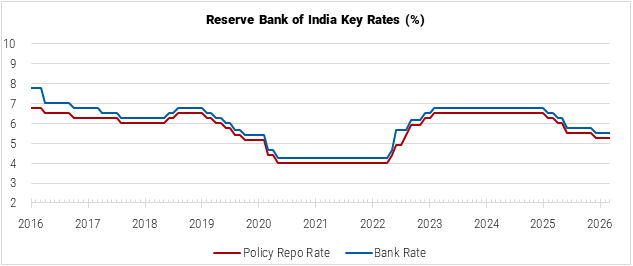
Data Source: RBI.
Overall, India’s residential lending market has undergone significant changes in recent years due to policy support through both demand- and supply-side interventions by the government, the establishment of the Real Estate Regulatory Authority (RERA), singular Goods and Services Tax implementation, stamp duty concessions, tax deductions on housing loans, and “Housing for All” (PMAY) subsidy scheme.
As a result, home loan originations have been growing in value consistently in recent years, although the growth rate for new credit has slowed from 18.8% in financial year 2022-23 to 9.9% in 2023-24 and 2.7% in 2024-25, indicating a potential plateau in lending expansion, noted the credit bureau CRIF High Mark in their report for the previous financial year. More recently, a total of 2.6 million new loans amounting to INR 8.3 trillion (USD 92.6 billion) were granted in the first three quarters of 2025-26. As of the December 2025 quarter, 50.3% of the new credit value was attributed to loans from public banks, 23.3% to loans from private banks, and the remaining 26.4% to loans from housing finance companies and other non-bank lenders.
In this environment, while still relatively low compared to many other nations (estimated to equal 12.3% of GDP in 2024-25), the total value of outstanding housing credit in India’s financial system (including public and private banks, housing finance companies, and other types of lenders) also continues to grow. The combined stock expanded by 12.7% in 2023-24 and by 13.1% in 2024-25, reaching INR 43.0 trillion (USD 473.9 billion) in February 2026 (+5.9% since the beginning of the financial year).
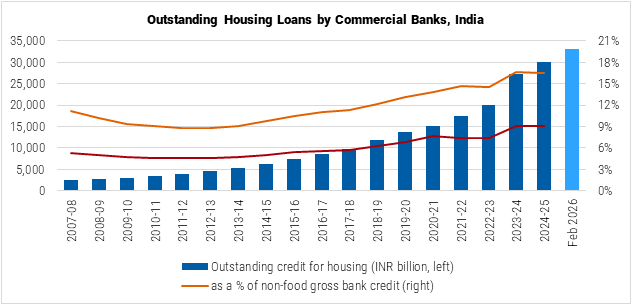
Based on the latest figures from the RBI, housing loans maintained by commercial banks (representing over 70% of the total amount in the financial system) demonstrated a more moderate 10.7% growth in the financial year 2024-25, compared to a 36.5% increase in 2023-24. Over the eleven months of 2025-26, the stock increased by a further 9.8%, reaching INR 33.1 trillion (USD 364.3 billion) by February 2026. After rising notably over the past decade, the share of housing loans in the non-food gross credit extended by commercial banks remains relatively stable, reported at 16.5% in 2024-25, compared to 16.6% in 2023-24.
Note: Reporting for financial years ending in March.
Data Source: RBI.
Economic and Social Factors
Resilient Growth Despite Global Headwinds
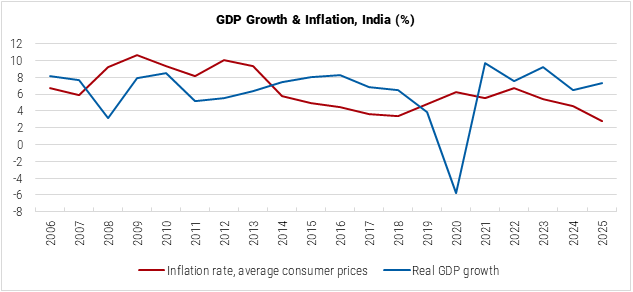
Despite external headwinds, including tariff escalations, India’s economy continued to perform well in 2025, supported by favorable domestic conditions. Real GDP growth for the year was estimated by the International Monetary Fund (IMF) at 7.3% and is expected to remain robust in the upcoming periods, although heightened global uncertainties and rising energy prices will likely weigh on it. At the end of March, the Organization for Economic Co-operation and Development (OECD) lowered India’s growth forecast for 2026 from 6.2% to 6.1%.
Reflecting lower domestic food prices from good harvests, consumer price index (CPI) inflation in the country fell from the average annual level of 4.6% in 2024 to 2.8% in 2025, allowing for substantial relaxation of the RBI’s monetary policy throughout the year. Most recently, the indicator was reported at 3.2% in February 2026, still below the central bank’s target. Prior to the conflict in the Middle East (which already clearly prolonged global inflation pressures), forecasts from the IMF and OECD saw inflation in India gradually converging to the target over the next two years.
Data Source: IMF.
As outlined in the latest Article IV staff report from the IMF, despite recent improvements in headline indicators, such as the labor force participation rate and employment, conditions in India’s labor market, characterized by high informality and underemployment, and declining but still high youth unemployment for the most educated, remain challenging.
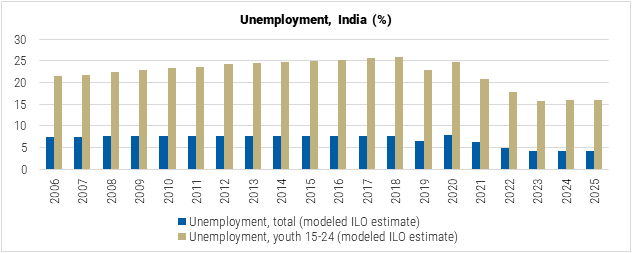
While the ILO estimate for total unemployment in India stood at 4.2% in 2025 (unchanged from the previous year), youth unemployment among people aged 15-24 was estimated much higher at 16.0% (up from 15.7% in 2024). Demonstrating a similar gap, the February 2026 Periodic Labor Force Survey published by the Ministry of Statistics and Program Implementation assessed the nationwide unemployment rate in the current weekly status at 4.9% for all ages and 14.8% for the population aged 15-29. Based on its own high-frequency household survey, the Center for Monitoring Indian Economy (CMIE), an economic think tank, estimated overall unemployment in the country at 6.6% in March 2026.
Aiming to accelerate job creation and improve formalization of the labor market over time, in 2025, India implemented an important structural reform by introducing four new labor codes, which consolidated 29 existing labor laws into a simplified framework covering wages, industrial relations, social security, and workplace safety.
Data Source: World Bank.
Overall, after a period of exceptional growth and low inflation, India’s otherwise strong economic trajectory is now facing new downside risks due to the Middle East conflict. As a major oil importer with strong trade links to the region, the country is being hit through multiple channels: higher oil import costs, rising logistics expenses, weaker exports, and pressure on the national currency.
“While India's relatively robust macroeconomic fundamentals and sustained policy efforts provide resilience, the evolving situation warrants close monitoring and calibrated policy responses,” said the March 2026 monthly economic review from the Ministry of Finance’s Department of Economic Affairs. “The near-term outlook remains uncertain, with external shocks posing downside risks to growth through higher input costs and supply constraints, even as domestic demand may help cushion the impact.”
Sources:
- Reserve Bank of India (RBI)
- All-India House Price Index (HPI) for Q3:2025-26, Press Release: https://rbi.org.in/
- Sectoral Deployment of Bank Credit – February 2026: https://rbidocs.rbi.org.in/
- Resolution of the Monetary Policy Committee December 3 to 5, 2025: https://rbidocs.rbi.org.in/
- Annual Report 2024-25: https://rbidocs.rbi.org.in/
- Database on Indian Economy: https://data.rbi.org.in/
- Ministry of Finance
- Monthly Economic Review, March 2026: https://dea.gov.in/
- Ministry of Housing & Urban Affairs
- Measures to Promote Affordable Housing: https://www.pib.gov.in/
- Ministry of Statistics and Program Implementation
- PLFS Monthly Bulletin February 2026: https://www.mospi.gov.in/
- International Monetary Fund (IMF)
- Country Overview: India: https://www.imf.org/
- 2025 Article IV Staff Report: https://www.imf.org/
- World Economic Outlook Update, January 2026: https://www.imf.org/
- World Bank
- World Development Indicators: https://databank.worldbank.org/
- Organization for Economic Co-operation and Development (OECD)
- OECD Economic Outlook, Interim Report March 2026: https://www.oecd.org/
- OECD Economic Outlook, Volume 2025 Issue 2, India: https://www.oecd.org/
- OECD Data Explorer: https://data-explorer.oecd.org/
- International Labor Organization (ILO)
- India Employment Report 2024: https://www.ilo.org/
- Knight Frank
- India Real Estate Office and Residential Market H2 2025: https://www.knightfrank.co.in/
- JLL
- Residential Market Dynamics, India, Q4 2025: https://www.jll.com/
- Cushman & Wakefield
- India Outlook 2026: https://sch.cushmanwakefield.com/
- S&P Global
- An Overview of India's Residential Mortgage and RMBS Market: https://www.spglobal.com/
- Deloitte
- India Economic Outlook, January 2026: https://www.deloitte.com/
- Fitch Ratings
- Fitch Affirms India at 'BBB-'; Outlook Stable: https://www.fitchratings.com/
- CRIF High Mark
- How India Lends: Credit Landscape in India, February 2026: https://www.crifhighmark.com/
- How India Lends: Credit Landscape in India, FY2025: https://www.crifhighmark.com/
- Centre for Monitoring Indian Economy (CMIE)
- CMIE Economic Outlook: https://economicoutlook.cmie.com/
- Magicbricks Research
- Rental Index October-Dec 2025: https://property.magicbricks.com/
- Clear
- Lowest Home Loan Interest Rates in India 2026: https://cleartax.in/
- PropTiger
- Real Insight: Residential – India Housing Market | Jan–Dec 2025: https://www.aurumproptech.in/
- Reuters
- India’s Luxury Housing Boom to Lift Home Prices…: https://www.reuters.com/
- Reserve Bank of India to Hold Interest Rates Until at Least Mid-2027: Reuters Poll: https://www.reuters.com/
- Rupee Slumps to Record Low…: https://www.reuters.com/
- India Cuts Excise Duties on Petrol, Diesel as Global Oil Prices Surge: https://www.reuters.com/
- The Economic Times
- Good Days for Home Loan Borrowers: EMIs to Drop Further After RBI Cuts Repo Rate: https://economictimes.indiatimes.com/
- Prime City Rents Jump up to 25% in 2025 as Rising Home Prices, RTO Push Employees to Outskirts: https://economictimes.indiatimes.com/
- India’s Residential Rents Cool to 7-9% in H1 2025, but Infrastructure-Driven Micro-Markets See Sharp Hikes: https://economictimes.indiatimes.com/
- Four Labour Codes Implemented in India in one of the Biggest Workforce Reforms: https://economictimes.indiatimes.com/
- Business Standard
- Renting a Home May Not Get Cheaper Even as Demand Slows: Report: https://www.business-standard.com/
- The Wall Street Journal
- Indian Economy Faces Risks on Multiple Fronts From Middle East Conflict: https://www.wsj.com/
- Mint
- Home Loan Interest Rates March 2026…: https://www.livemint.com/