Indonesia's Residential Property Market Analysis 2026
Indonesia’s residential property market remains subdued, marked by limited price appreciation, soft demand, and weak residential construction activity.
This extended overview from the Global Property Guide presents a comprehensive analysis of Indonesia’s housing market, covering its overall structure, price movements, demand and supply dynamics, and regulatory environment, while placing particular emphasis on recent developments and long-term trends shaping the sector.
Table of Contents
- Property Prices and Price Index
- Historic Perspective
- Property Demand Trends
- Property Supply Trends
- Rental Market: Rents and Rental Yields
- Mortgage Market and Interest Rates
- Economic and Social Factors
Property Prices and Price Index
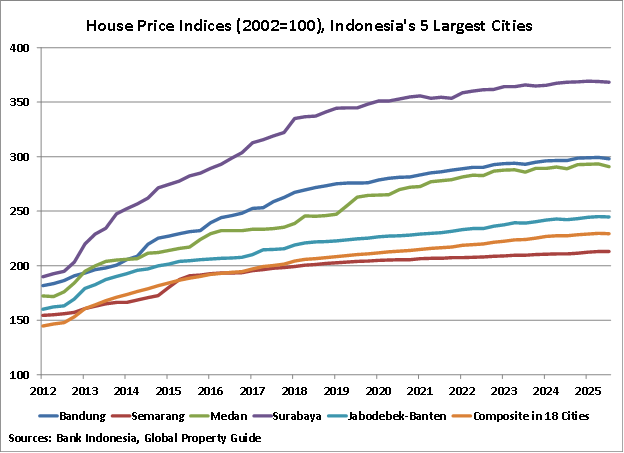
In the third quarter of 2025, the composite-16 property price index increased by a miniscule 0.84% from a year earlier, following year-on-year growth of 0.9% in Q2 2025, 1.07% in Q1 2025, 1.39% in Q4 2024, and 1.46% in Q3 2024, according to the country’s central bank, Bank Indonesia. In fact, it was the lowest growth recorded in recent years.
When adjusted for inflation, nationwide property prices were actually down by an average of 1.57% y-o-y in Q3 2025 – its biggest decline since Q2 2023.
Quarter-on-quarter, nominal residential property prices rose marginally by 0.3% in Q3 2025, with real prices showing little to no movement after inflation adjustment.
“According to the latest Residential Property Price Survey conducted by Bank Indonesia, residential property prices in the primary market experienced moderation in the third quarter of 2025. This was reflected in the Residential Property Price Index (RPPI), as annual growth decelerated slightly to 0.84% (yoy) in the third quarter of 2025 from 0.90% (yoy) in the second quarter of 2025,” said Bank Indonesia’s Residential Property Price Survey for Primary House Q3 2025 report.
“The latest developments were influenced by slower price increases for small and medium residential properties, recorded at 0.71% (yoy) and 1.18% (yoy) in the reporting period, down from 1.04% (yoy) and 1.25% (yoy) in the second quarter of 2025. In contrast, the prices of large residences posted 0.72% (yoy) growth in the third quarter of 2025, which was stable relative to the 0.70% (yoy) recorded in the previous period,” added the central bank report.
Looking at long term trends, the property market has hardly moved, with prices up by just 17.4% from 2016 to 2024. In real terms, prices fell by a cumulative 6% over the same period.
Indonesia's house price annual change:
When inflation is considered, only one of the eighteen major Indonesian cities recorded a minimal house price increase in Q3 2025 as compared to the same period in the prior year.
| RESIDENTIAL PROPERTY PRICES IN INDONESIA’S MAJOR CITIES, Q3 2025 | ||||
| Major Cities | Y-O-Y Change (%) | Q-O-Q Change (%) | ||
| Nominal | Real | Nominal | Real | |
| Bandung | 0.52 | -1.88 | -0.41 | -0.74 |
| Bandar Lampung | 0.02 | -2.37 | -0.87 | -1.19 |
| Banjarmasin | 1.69 | -0.74 | -0.29 | -0.62 |
| Denpasar | 1.08 | -1.33 | 0.82 | 0.50 |
| Palembang | 1.08 | -1.33 | -0.43 | -0.75 |
| Semarang | 1.13 | -1.28 | 0.12 | -0.20 |
| Yogyakarta | 1.92 | -0.51 | -0.20 | -0.52 |
| Padang | 0.53 | -1.87 | -0.38 | -0.70 |
| Medan | 0.61 | -1.79 | -0.90 | -1.22 |
| Makassar | 0.54 | -1.86 | -0.37 | -0.69 |
| Manado | 0.03 | -2.36 | -0.09 | -0.41 |
| Surabaya | -0.02 | -2.41 | -0.21 | -0.53 |
| Pontianak | 3.74 | 1.26 | 5.81 | 5.47 |
| Batam | 1.67 | -0.76 | 0.36 | 0.03 |
| Balikpapan | 0.67 | -1.73 | 0.46 | 0.14 |
| Jabodebek-Banten | 1.08 | -1.33 | -0.20 | -0.52 |
| Pekanbaru | 0.31 | -2.08 | -2.65 | -2.96 |
| Samarinda | 0.11 | -2.28 | 0.64 | 0.31 |
| Composite (18 Cities) | 0.84 | -1.57 | -0.16 | -0.48 |
| Sources: Bank Indonesia, Global Property Guide | ||||
Demand in the residential market remained weak, although the pace of decline has begun to ease. Sales of medium- and large-sized housing units continued to be sluggish, while smaller residential properties saw relatively better demand. Overall, primary market residential sales showed some improvement in the third quarter of 2025, with the year-on-year contraction easing to 1.29%, compared with a sharper 3.80% decline in the previous quarter, based on figures from Bank Indonesia.
By the end of 2025, no new project handovers had been recorded, with some projects slated for delivery during the quarter postponed to 2026. Consequently, around 2,200 apartment units were added in Jakarta in the whole year of 2025, representing a nearly 50% decline from the 2024 level and bringing total supply to approximately 232,000 units.
“Limited project completions toward year-end resulted in total new supply in 2025 reaching only around half of the 2024 level. South Jakarta remained the most prominent submarket, underpinned by sustained demand and stronger underlying market fundamentals,” said Colliers International.
The wider economy remains resilient, despite global headwinds. During 2025, Indonesia’s economy grew by 5.11% during 2025, following annual expansions of 5% annually in 2023 and 2024, 5.3% in 2022, and 3.7% in 2021, and a pandemic-induced contraction of 2.1% in 2020. Yet the latest figures fall short of the government’s 5.2% target, reflecting the impact of natural disasters in three provinces, and leaving room for further policy support.
In 2026, the government expects the economy to expand by 5.4%, driven by domestic demand, investment, and structural reforms. In comparison, the IMF and the World Bank adopt a more conservative stance, projecting growth of 5.1% and 5.0%, respectively, amid persistent external risks and global economic uncertainty.
Historic Perspective:
Jakarta’s apartment prices remain broadly stable
In Jakarta, prices of apartments rose by a meager 0.8% y-o-y to approximately IDR36 million (US$2,144) per sqm in Q3 2025, according to Colliers International. Quarter-on-quarter, apartment prices in the capital city were up slightly by 0.2%.
| AVERAGE APARTMENT PRICES IN JAKARTA, Q3 2025 | ||||
| Area | Average price (IDR/sqm) |
Average price (USD/sqm) |
y-o-y change | q-o-q change |
| CBD | 53,443,446 | 3,183 | 1.0% | 0.4% |
| East Jakarta | 22,047,312 | 1,313 | 1.5% | 0.8% |
| North Jakarta | 27,118,775 | 1,615 | 1.1% | 1.1% |
| Central Jakarta | 36,737,618 | 2,188 | 0.0% | 0.0% |
| West Jakarta | 28,361,773 | 1,689 | 0.2% | -0.1% |
| South Jakarta | 40,735,783 | 2,426 | 0.6% | 0.0% |
| Overall | 35,995,013 | 2,144 | 0.8% | 0.2% |
| Sources: Colliers International, Global Property Guide | ||||
Over the same period:
- In Jakarta CBD, the average price of strata title apartments rose slightly by 1% y-o-y to IDR53.44 million (US$3,183) per sqm in Q3 2025. Quarterly, apartment prices were up by 0.4%.
- In East Jakarta, prices of strata title apartments increased by 1.5% y-o-y to an average of IDR22.05 million (US$1,313) per sqm in Q3 2025. Quarter-on-quarter, prices were up by 0.8%.
- In North Jakarta, the average price of strata title apartments rose by 1.1% y-o-y to IDR27.12 million (US$1,615) per sqm in Q3 2025. Quarter-on-quarter, prices also increased by 1.1%.
- In Central Jakarta, the average price of strata title apartments was unchanged at IDR36.74 million (US$2,188) per sqm over the same period.
- In West Jakarta, prices of strata title apartments increased slightly by 0.2% y-o-y to an average of IDR28.36 million (US$1,689) per sqm in Q3 2025. Yet quarterly, prices declined slightly by 0.1%.
- In South Jakarta, the average price of strata title apartments rose by a meager 0.6% y-o-y to IDR40.74 million (US$2,426) per sqm in Q3 2025. Quarter-on-quarter, prices were steady over the same period.
Property Demand Trends
Demand remains sluggish
Demand continues to fall, but the downward trend is showing signs of slowing. In Q3 2025, residential property sales declined slightly by 1.29% from a year earlier, an improvement from year-on-year contractions of 3.8% in the previous quarter and 7.14% in the same period last year, based on figures from Bank Indonesia. Quarter-on-quarter, sales fell by 5.21% in Q3 2025, a smaller decline as compared to the prior quarter’s 16.72% contraction.
Though there are wide variations in terms of property size:
- Small residential properties: sales were up by 11.6% in Q3 2025 from a year ago, up from a y-o-y increase of 6.7% in the previous quarter and in stark contrast to a contraction of 10.05% in the prior year. Quarterly, sales for small houses dropped 5.66% in Q3 2025, following a huge decline of 26.98% in Q2 2025.
- Medium houses: sales fell by 12.27% y-o-y in Q3 2025, after decreasing by 17.69% in the previous quarter and by 8.8% a year ago. Quarter-on-quarter, sales were up slightly by 0.99% in Q3 2025, after increasing by 10.61% in the previous quarter.
- Large houses: sales were down by a huge 23% y-o-y in Q3 2025, after falling by 14.95% in Q2 2025 and rising by 6.83% in the same period last year. Quarterly, sales dropped by 13.5% in Q3 2025, following a slight q-o-q growth of 1.19% in the prior quarter.
“Consistent with price developments, sales of medium and large residential units remained sluggish in the reporting period amidst positive sales of small residential properties. Overall, sales of residential units in the primary market improved to experience a shallower 1.29% (yoy) contraction in the third quarter of 2025, following a 3.80% (yoy) contraction in the previous period,” said Bank Indonesia.
Accordingly, the key challenges in the residential property market included rising building material costs, licensing and bureaucracy issues, high interest rates on housing loans, large down payment requirements for housing loans, and high taxes.
Previously, demand was buoyed by several market stimulus measures introduced by the government. In 2023, the Ministry of Finance issued regulation PMK 120/2023, extending the value-added tax (VAT) incentive program. The VAT subsidy, which applies to all residential properties priced up to IDR 5 billion (US$296,639), amounts to 11% until June 2024 and 5.5% from June to December 2024. Currently, there are 10,581 units eligible for the incentive.
In addition, the extension of the loan-to-value (LTV) ratio relaxation policy, which expired in 2024, also encouraged increased activity in the housing market.
Moreover, the Omnibus Law introduced two initiatives to attract foreign investors, including the simplification of qualification for property purchases and the upgrade of the type of titles that foreigners can hold, from the previously limited Hak Pakai (Right to Use) to Hak Guna Bangunan (Right to Build).
The average apartment take-up rate in Jakarta has remained broadly stable over the past two years at around 87% to 88%, and is expected to stay largely unchanged over the next three years, according to Colliers International.
“Overall take-up levels remain relatively steady, primarily supported by continued absorption within the middle segment,&rdquo said Colliers in its Q4 2025 Jakarta Apartment Market Report. “By segment, the middle segment continues to record the highest level of unit absorption, reflecting its position as the largest contributor to total supply and its consistently strong sales performance. In contrast, the upper segment remains more limited in scale, resulting in lower absolute take-up volumes despite relatively stable underlying demand.”
Tourism growth to fuel property market expansion
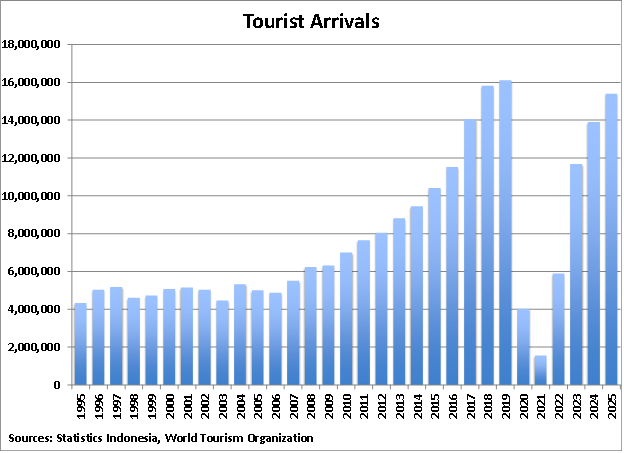
Tourism continues to gain momentum, with the total number of international visitor arrivals increasing strongly by 10.8% to 15.39 million people in 2025 as compared to a year earlier, according to the Ministry of Tourism and Creative Economy. This exceeds the government’s target of 14 million to 15 million arrivals. In fact, it is now the highest level seen in the past six years.
Yet the latest figures remain below the record-high of 16.1 million arrivals registered in 2019 before the Covid-19 pandemic. Arrivals plunged to just 4 million in 2020 and 1.56 million in 2021, mainly due to pandemic-related travel restrictions. Tourism has shown a steady recovery since, rising from 5.89 million in 2022 to 11.68 million in 2023, and reaching 13.9 million in 2024.
In 2025, Indonesia’s inbound tourism was driven largely by regional and Asia-Pacific source markets, with Malaysia remaining the largest contributor, reflecting strong short-haul and cross-border travel within ASEAN. Australia, Singapore, and China ranked among the top markets, with China showing a particularly strong rebound as outbound travel continued to normalize. Japan, Taiwan, the United States, and India also posted year-on-year growth, indicating a broadening recovery across both regional and long-haul markets, while South Korea experienced a slight decline compared with the previous year.
Bali, one of the world’s top tourist destinations, saw its tourist arrivals surge to 6.95 million people in 2025, up by nearly 10% from 6.3 million international tourists in the prior year.
Australia remained Bali’s largest source market last year, with 1.63 million arrivals, accounting for 23.4% of total foreign visitors. It was followed by India (569,260 visitors), China (537,380 visitors), and South Korea (346,680 visitors). Key long-haul markets included the United Kingdom (317,520 visitors), France (279,120 visitors), and the United States (274,610 visitors). Completing the top ten were Malaysia (251,160 visitors), Singapore (211,330 visitors), and Japan (208,620 visitors), reflecting Bali’s strong appeal across both regional and long-haul markets.
The Indonesian government has set a target of 16 million to 17.6 million foreign tourist arrivals in 2026. It is also aiming to generate foreign-exchange earnings of IDR 22 trillion (US$1.31 billion) to IDR 24.7 trillion (US$1.47 billion), with tourism’s contribution to GDP rising to between 4.5% and 4.7%.
The recovering tourism sector, especially in Bali, is expected to provide a boost to the sluggish property market. An estimated 30,000 expatriates live in Bali.
Indonesia adopts more liberal foreign homeownership rules
Recently, Government Regulation No. 18 of 2021 on the Right to Manage, Right over Land, Strata Titles, and Land Registration became effective, amending Government Regulation No. 103 of 2015. The new regulation finally allows foreigners and foreign legal entities to own apartments in Indonesia.
However, foreigners are only able to own apartments in designated special economic zones, free trade zones, industrial estates, and other economic zones. Moreover, the property must be worth more than the minimum threshold, which differs depending on the province where it is located.
Accordingly, under the previous law, foreigners were only able to own land under the Right to Use land title and strata title right to use apartment units or SHPSRS (“sertifikat hak pakai atas satuan rumah susun”). GR 18/21 officially allows foreigners to own strata title rights of ownership of apartment units as well.
“Ownership rights to apartment units are granted to Indonesian citizens; Indonesian legal entities; foreigners who have permits in accordance with the provisions of laws and regulations; foreign legal entities that have representatives in Indonesia; or representatives of foreign countries and international institutions that are or have representatives in Indonesia,” reads the full article 67.
Recently, the qualification for property purchases by foreign buyers was simplified, allowing them to buy property using only a passport and/or visa. Previously, foreigners were required to provide proof of a limited or permanent stay permit (KITAS/KITAP). The type of titles that foreigners can hold was also upgraded from the previously limited Hak Pakai (Right to Use) to Hak Guna Bangunan (Right to Build).
Earlier, in October 2020, the Omnibus Law on Job Creation was passed, which seeks to leverage foreign property investment as one of the pillars to stimulate economic growth after the pandemic.
“The potential of a foreigner being allowed to hold a (right-to-build) title in line with Indonesian citizens is a game changer. If it also allows for foreigners to mortgage in Indonesia, it will open up a much larger market than in the past, when it was all cash-driven,” said Terje Nilsen, CEO of Seven Stones Indonesia. “This will encourage foreigners to choose Indonesia as a first or second home option. Especially now, when more and more people work from home. And they can call Bali and other places in Indonesia home.”
Before the recent measures, the last major liberalization came in December 2015, when GR 103/2015 on House Ownership of Foreigners Residing in Indonesia allowed foreigners to own landed houses in Indonesia for a period of up to 80 years. Under the law, foreigners can purchase a landed house or an apartment under the so-called “right-of-use” (hak pakai) title for an initial period of 30 years. The foreigner can extend the ownership twice, by 20 years and then by another 30 years. However, if the foreigner (or his heir) leaves Indonesia to reside in another country, then he/she needs to release or transfer the ownership rights to another person who meets all requirements.
Property Supply Trends
Limited supply of new apartments in Jakarta last year
In the third quarter of 2025, two apartment projects entered the handover phase, adding a combined 452 units to the market. These included B Residence Grogol in West Jakarta, which delivered 236 mid-segment units, and Adriya Residence in North Jakarta, which contributed 216 units targeting the upper segment. In the fourth quarter of 2025, no new project handovers were recorded, as several developments originally scheduled for delivery were deferred to 2026.
Jakarta’s overall apartment supply reached approximately 232,000 units last year.
| NEWLY FINISHED PROJECTS IN JAKARTA, Q3 2025 | |||||
| Apartment Name | Location | Region | Developer | No. of Units | Class |
| B Residence Grogol | Jl. Daan Mogot 79 | West Jakarta | MGM Propertindo | 236 | Middle |
| Adriya Residence | Jl. Pantai Indah Kapuk Boulevard | North Jakarta | ADR Group | 216 | Upper |
| Source: Colliers International | |||||
“Several projects initially scheduled for completion in Q4 2025 experienced construction delays. As a result, Jakarta added approximately 2,200 apartment units during 2025, nearly 50% lower than the 2024 level, bringing total apartment supply to around 232,000 units,” said Colliers.
After revisions to project timelines, Jakarta is expected to record the handover of at least 3,200 apartment units in 2026 to 2027, according to Colliers. Around 70% of this upcoming supply will be concentrated in South Jakarta, reflecting developers’ focus on the middle- to upper-income market. Meanwhile, apartment development in East and West Jakarta is also expected to gain momentum over the next two to three years, in line with broader residential trends.
| NEW PIPELINE OF STRATA-TITLE APARTMENT PROJECTS | ||||
| Apartment Name | Location | Region | Developer | No. of Units |
| 2026 | ||||
| The Aspen Peak Residence by Rumapadu | Jl. Fatmawati | South Jakarta | Harmas Jalesveva | 320 |
| Asthana Kemang (Sadewa Tower) | Jl. Ampera Raya No.17 | South Jakarta | PT. Synthesis Development | 362 |
| Vittoria Residence (Tower Citrine) | Jl. Daan Mogot | West Jakarta | PT. Duta Indah Kencana | 312 |
| The Belton Residence (was Prajawangsa City) | Jl. Raya Bogor, Cijantung | East Jakarta | Synthesis Development | 192 |
| LRT City Tebet - The Premiere MTH (Orchid Tower) | Jl. MT Haryono | East Jakarta | Adhi Karya | 390 |
| South Quarter Residence (Tower E) | TB Simatupang | South Jakarta | Intiland | 336 |
| Solterra Place (Tower Suites) | Pejaten | South Jakarta | Waskita Realty | 537 |
| 2027 | ||||
| Antasari Place (was 45 Antasari) (Tower 2) | Antasari | South Jakarta | Prospek Duta Sukses | 621 |
| Two Senopati (Tower 1) | Jl Senopati II | South Jakarta | Asiana Group | 112 |
| LRT City Tebet – The Premiere MTH (Lotus Tower) | Jl. MT Haryono | South Jakarta | Adhi Karya | 201 |
| Edensuite Casablanca | Jl. Raya Casablanca | South Jakarta | TCP Internusa | 233 |
| 2028 | ||||
| Two Sudirman | Jl. Karet Pasar Baru Timur | Central Jakarta | Mitsubishi Estate | 339 |
| Source: Colliers International | ||||
Funding boost for Tapera public housing savings program
Five years ago, the government enacted a law on public housing savings (Tabungan Perumahan Rakyat - Tapera) to create a new housing fund (BP Tapera) to help workers finance the purchase, construction, or renovation of their first home. All formal workers and individuals with monthly salaries of at least equal to the minimum wage must contribute 3% of their pay (2.5% from employees and 0.5% from employers). However, the contribution is voluntary for private-sector companies for the first seven years, until 2028.
The new housing fund officially took effect on January 1, 2021.
Participants have the option to withdraw up to 30% of their fund balance for the purchase of a home or up to 10% for construction or improvements. In addition, those who have already made at least 12 consecutive monthly contributions will have the option to take out home loans from BP Tapera at interest rates of no greater than 5% per year.
On May 24, 2024, an amendment took effect, bringing significant changes to how Tapera savings are calculated and how FLPP (Housing Financing Liquidity Facility) funds are allocated and managed.
During 2024, 200,300 housing units were distributed under BP Tapera, which exceeded the target, with a total value of IDR 24.57 trillion (US$1.46 billion). This amount includes the addition of 34,000 FLPP quotas that year. As for the Tapera mortgage financing, the government investment operator facilitated 5,940 housing financing contracts in 2024, amounting to IDR 990.218 billion (US$58.75 million).
BP Tapera Commissioner Heru Pudyo Nugroho stated that since BP Tapera took over the distribution of FLPP funds in 2022 until December 20, 2024, a total of IDR76.04 trillion (US$4.51 billion) has been disbursed, supporting the distribution of 655,300 housing units for low-income families (MBR).
Then in 2025, the budget allocation for FLPP was raised from IDR28.2 trillion (US$1.67 billion) to IDR35.2 trillion (US$2.09 billion) to support the increase in housing quota this year to 350,000 MBR units.
Based on figures released by BP Tapera, the actual number of housing units distributed reached 278,868, the highest level in history but remains below the target initially set. It has a total value of IDR 34.64 trillion (US$2.06 billion).
“The distribution of FLPP financing in 2025 closed at its highest level in history, reaching 278,868 housing units with a total value of Rp34.64 trillion,” said BP Tapera Commissioner Heru Pudyo Nugroho.
West Java remained the largest recipient of FLPP housing assistance nationwide, accounting for 62,591 units or 22.44% of total distribution. This was followed by Central Java with 24,470 units (8.77%), South Sulawesi with 23,255 units (8.34%), Banten with 18,966 units (6.80%), and East Java with 18,361 units (6.58%).
The initiative is part of the government’s 3 Million Housing Program.
Rental Market: Rents and Rental Yields
Rental yields are increasing
Gross rental yields on high-end properties in Indonesia are now increasing, reaching an average of 7.15% in Q3 2025, up from 5.41% in Q2 2025, 6.12% in Q4 2024, and 5.68% in Q1 2024, according to research conducted by the Global Property Guide.
Although the current yields are noticeably increasing, they are significantly lower than the 10% to 13% levels seen a decade ago, as property prices have surged in recent years due to strong demand for high-end apartments.
Gross rental yields - the return earned on the purchase price of a rental property, before taxation, vacancy costs, and other costs - are an important consideration because a high rental yield indicates that the property market is reasonably priced.
By major areas, in Q3 2025:
- In Jakarta, gross rental yields on apartments range from as low as 3.86% to as high as 13.34%, depending on location. The city’s average rental yield stands at 11.17%.
- In South Tangerang, apartment rental yields are relatively low, ranging from 4.12% to 7.15%, with a city average of 5.6%.
- In Surabaya, apartments offer rental returns from 4.36% to 8.88%, with a city average of 7.22%.
- In Tangerang, rental yields range from 4.72% to 6.59%, with a city average of 5.76%.
- In Bali, gross rental yields for villas range from 4.4% to 6.93%, with a city average of 6.02%.
In contrast, figures released by Colliers International showed that apartment rental yields in Jakarta have remained relatively stable over the past three years, averaging around 4%.
“Over the past three years, apartment rental yields have remained largely unchanged, stabilizing at ~4%,” said Colliers.
“From a locational perspective, the CBD has consistently recorded the highest and most stable yields-4.3% over the past three years-supported by corporate tenants, expatriates, and professionals seeking premium amenities in prime locations. East Jakarta delivered the strongest yield growth, increasing from 3.1% in 2022 to 3.4% in 2024. This growth was driven by heightened demand due to the area’s affordability, which enhances its appeal as a residential alternative for cost-conscious tenants, making it an attractive option for middle-income tenants and young professionals,” added Colliers.
Rents increasing gradually, occupancy rates broadly stable
Apartment rents in Jakarta are now showing some improvements. In 2025, the rental rates in the CBD areas increased slightly to around IDR 470,000 (US$27.9) to IDR 480,000 (US$28.5) per square meter per month. Likewise, monthly rents in non-CBD locations also rose modestly to reach about IDR 410,000 (US$24.3) to IDR 420,000 (US$24.9) per sqm over the same period.
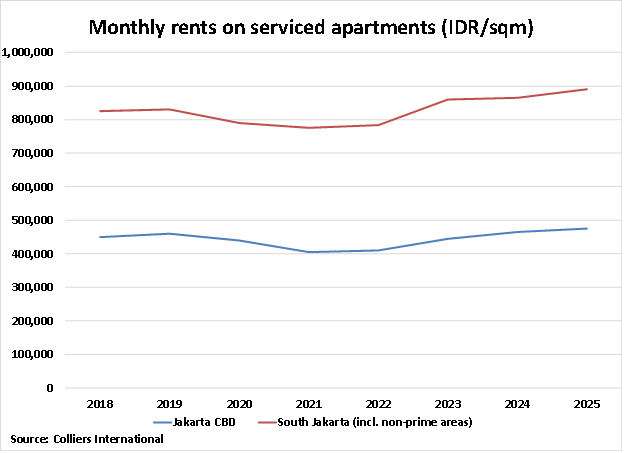
“Rental rates for serviced apartments in Jakarta recorded limited growth in 2025, constrained by fluctuations in occupancy levels throughout the year. This trend indicates that operators continued to prioritise occupancy recovery and rental stability rather than implementing aggressive rental rate increases,” said Colliers International. “Nevertheless, upward pricing adjustments may emerge as the market enters a new rental cycle in 2026.”
“From a location perspective, serviced apartment rental rates continued to trend upward through 2025 within the CBD. This reflects sustained demand for centrally located serviced apartments, supported by corporate, diplomatic, and business-related accommodation needs, allowing operators to gradually firm up the rental rates,” added Colliers.
Occupancy rates for serviced apartments in Jakarta were broadly stable in 2025, ranging from 55% to 65%
“Demand for serviced apartments typically exhibits seasonal volatility in the first semester, as many corporate long-term projects conclude and renewal decisions are often deferred until mid-year. As a result, the average occupancy slightly declined in the first half, largely due to corporate efficiency measures implemented at the beginning of the year. However, overall, the average occupancy levels remained broadly stable throughout 2025,” noted Colliers.
High taxes defer property investment in Indonesia
Despite the high rental yields, property investment is still relatively unattractive for foreigners because of complex legalities and high tax rates on non-resident owners.
- The tax levied on the average annual income on a rental apartment/property in Indonesia is 20%, which is the third highest in Asia, only after Bangladesh (25%) and Malaysia (22.4%).
- A 10% Value-added tax (VAT) is levied on gross rental income.
- Capital gains realized by individuals from the sale of real property in Indonesia are taxed at a flat rate of 5%. The tax base is the transfer value of the property, without any deductions.
- Sales of luxury houses, apartments, townhouses, and condominium units with a selling price above IDR 30 billion (US$1.78 million) are subject to 20% sales tax.
- Property tax is levied at 0.5% on the assessed value of the property. The assessment value of taxable property is determined as a percentage of the deemed fair market value of the property.
The total cost of buying and then reselling a residential property (including registration costs, real estate agent fees, legal fees, sales, and transfer taxes) is one of the highest in the region. However, changes in the law are in process, which should make things much easier.
Mortgage Market and Interest Rates
BI keeps key interest rates unchanged
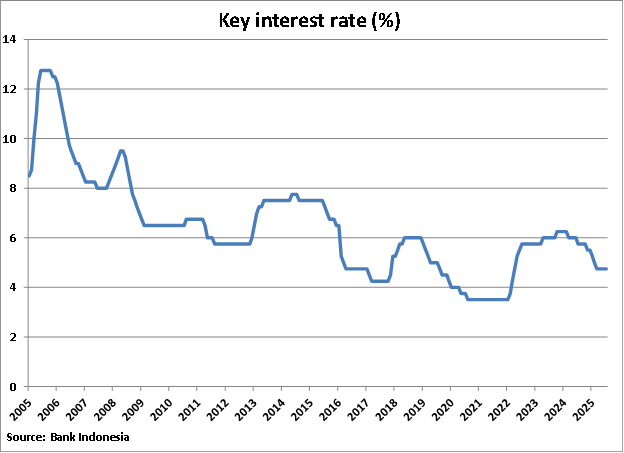
Bank Indonesia kept its key interest rate unchanged at 4.75% during its January 2026 policy meeting. This marked the fourth consecutive meeting at which the central bank kept its key rate unchanged, following six rate cuts between September 2024 and September 2025. Bank Indonesia also kept the overnight deposit facility rate (DF) and the lending facility rate (LF) unchanged at 3.75% and 5.50%, respectively.
The central bank’s recent move seeks to prevent further weakening of the rupiah, even as economic growth shows signs of slowing.
“The decision is consistent with the current policy focus on efforts to maintain Rupiah exchange rate stability against a backdrop of increasing global uncertainty to achieve the inflation target in 2026-2027 and foster economic growth,” said BI in its January 2026 monetary policy decision press release. “Moving forward, Bank Indonesia will continue strengthening the effectiveness of existing accommodative monetary and macroprudential policies, while considering room for further BI-Rate reductions with a manageable inflation forecast in 2026-2027 within the 2.5%±1% target corridor, thereby supporting higher economic growth.”
In the wake of Bank Indonesia’s latest policy decision, mortgage interest rates in Indonesia have shown signs of stabilization, with current rates hovering between 8% and 10%.
With inflation expected to remain manageable this year, Bank Indonesia retains scope to resume interest rate cuts.
Mortgage market continues to grow, albeit at a slower pace
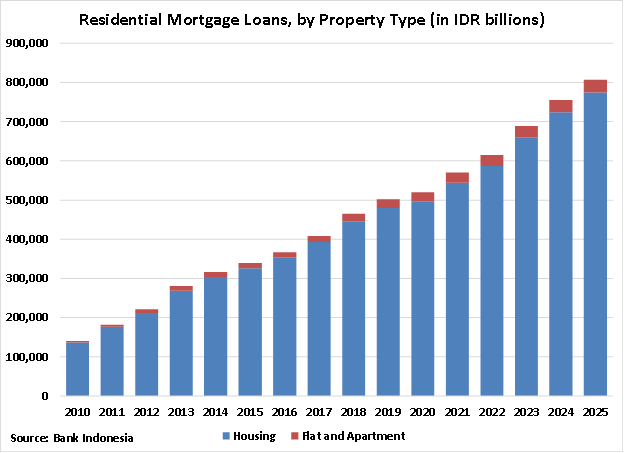
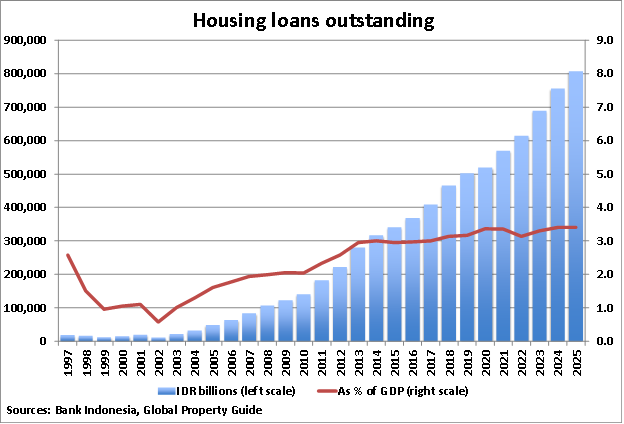
As interest rates stabilize, the total amount of outstanding residential mortgage loans, including loans for housing, flats, and apartments, drawn to households rose by 6.9% y-o-y to IDR 807 trillion (US$47.9 billion) in December 2025, according to figures from Bank Indonesia.
The average annual growth rate of residential mortgage loans dropped significantly - from a robust 35.2% between 2003 and 2013 to just 9.4% per year during the 2014 to 2024 period, and to below 7% last year.
By property type, as of December 2025:
- Houses: IDR774.57 trillion (US$45.95 billion) outstanding loans, up by 7% from a year earlier
- Flats and apartments: IDR32.43 trillion (US$1.92 billion) outstanding loans, up by a modest 3.1% from a year ago
By type of financial institution, as of December 2025:
- State banks: IDR433.2 trillion (US$25.7 billion) residential mortgage loans, down by 1.1% from a year earlier
- Regional government banks: IDR32 trillion (US$1.9 billion), up by a modest 2.6% from the same period last year
- Private national banks: IDR341.66 trillion (US$20.27 billion), up strongly by 19.7% from the previous year
- Foreign banks and joint banks: IDR140 billion (US$8.31 million), down by a huge 77.7% from the prior year
Amid moderating residential mortgage growth, mortgage credit penetration remains limited. During 2025, the ratio of mortgage credits to GDP remains very small, at around 3.4%, barely changed in the past decade, based on figures from the Global Property Guide.
Indonesian developers find financing challenging. Memories of the Asian crisis are still alive. Banks tend to be extremely cautious in extending housing loans to the real estate industry, although Indonesian banks are strong and adequately capitalized. The increased uncertainty brought by the pandemic, Russia’s invasion of Ukraine, and global supply chain disruptions have exacerbated the situation in recent years.
That’s why, as of Q3 2025:
- 77.67% of residential property development projects were financed internally
- Only 16.02% were financed through bank loans
- The remaining 6.31% of projects were financed by consumer payments (pre-selling)
“Based on the sources of finance, most developers continued relying on non-bank financing in the form of internal funds for residential property development, dominating 77.67% of total capital in the third quarter of 2025. On the consumer side, housing loans disbursed by the banking industry remained the preferred source of financing residential property purchases, accounting for 74.41% of total financing,” said Bank Indonesia.
Economic and Social Factors
Domestic economy maintains stability amid global volatility
In the fourth quarter of 2025, Indonesia posted a real GDP growth rate of 5.39% from a year earlier, slightly better than the year-on-year expansions of 5.04% in Q3, 5.12% in Q2, and 4.87% in Q1, primarily buoyed by strong private consumption.
By major component, in Q4 2025:
- Private consumption increased by 5.11% from a year ago, slightly lower than the 4.89% growth in the previous quarter.
- Government spending growth slowed to 4.55% in Q4 2025, following a 5.66% increase in the preceding quarter.
- Fixed investment gained momentum, increasing by 6.12% y-o-y in Q4 2025, after growing by 5.04% in the previous quarter.
- Net trade was a weaker contributor, with export growth easing to 3.25% y-o-y in Q4 2025, as compared to a strong growth of 9.14% in the previous quarter. On the other hand, import growth picked up to 3.96%, as compared to a meager increase of 0.86% in Q3 2025.
Quarter-on-quarter, Indonesia’s economy expanded by 0.86% in Q4 2025, following growth of 1.43% in Q3 and 4.04% in Q2, and a contraction of 0.98% in Q1.
“At home, economic growth in Indonesia remains favourable and requires continuous strengthening to align with economic capacity,” said Bank Indonesia. “By sector, the major economic sectors, namely the manufacturing industry, wholesale and retail trade, as well as information and communication, maintained positive performance. Spatially, robust economic growth has been recorded in the Bali–Nusa Tenggara (Balinusra) region, followed by Java and Kalimantan, driven by increased domestic demand.”
Overall, Indonesia’s economy grew by 5.11% during 2025, following annual expansions of 5% annually in 2023 and 2024, 5.3% in 2022, and 3.7% in 2021, and a pandemic-induced contraction of 2.1% in 2020.
Yet the latest figures fall short of the government’s 5.2% target, reflecting the impact of natural disasters in three provinces, and leaving room for further policy support.
“Indonesia remains a global bright spot, with strong economic growth amid a challenging external environment, and inflation expected to remain comfortably in the target range,” said the International Monetary Fund (IMF). “A well-calibrated policy mix can support the economy; protecting Indonesia’s hard-earned credibility and policy space remains crucial in a world of heightened external uncertainties.”
In 2026, the government expects the economy to expand by 5.4%, driven by domestic demand, investment, and structural reforms. In comparison, the IMF and the World Bank adopt a more conservative stance, projecting growth of 5.1% and 5.0%, respectively, amid persistent external risks and global economic uncertainty.
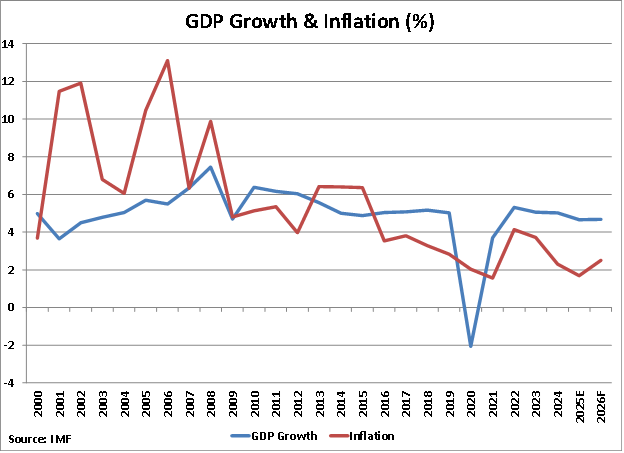
Before the Covid-19 pandemic, the country enjoyed two decades of uninterrupted economic growth. Indonesia’s resilience can be attributed to its very domestically driven economy. It tends to be insulated from global economic shocks. In fact, in recent years, Indonesia has enjoyed robust economic growth despite the global crisis. From 2000 to 2019, the economy expanded by an average of 5.3% per year, based on IMF figures.
Inflation seems to be gradually increasing again. In January 2026, the overall inflation stood at 3.55%, up from 2.92% in the previous month and far higher than the 0.76% recorded in the same period last year, according to figures released by the Bank Indonesia. Despite this, it remains well within the central bank’s target range of 2% to 4%.
From an average of 9.5% from 2001 to 2008, inflation dropped to an annual average of 4.7% from 2009 to 2019 and further to 2% in 2020 and 1.6% in 2021. But it surged again to 4.1% in 2022 and remained elevated at 3.7% in 2023. In 2024, inflation eased to an average of 2.3%.
In Q3 2025, the nationwide unemployment rate was 4.85%, slightly down from 4.91% in the same period last year and one of the lowest levels registered since 1997, according to Statistics Indonesia. The total number of unemployed people in Indonesia remained steady at around 7.46 million. The labor force participation rate was 70.59% in Q3 2025, at par with the previous year’s 70.63%.
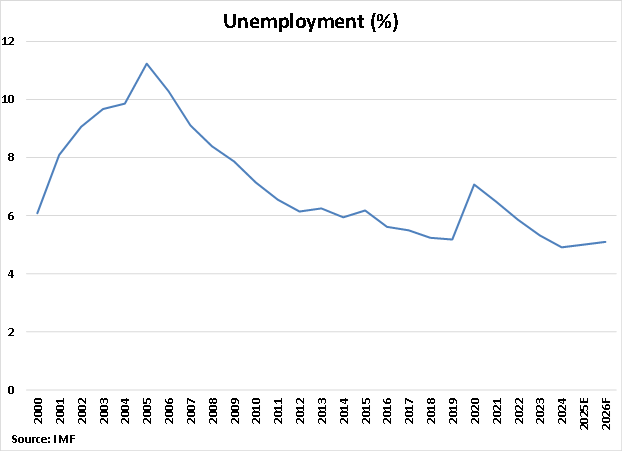
Nationwide unemployment averaged 5.6% in the past decade.
Rupiah weakness persists, fiscal pressures growing
The Indonesian rupiah depreciated by 18.5% since January 2020 to reach an average monthly exchange rate of IDR 16,826 = USD 1 in January 2026. This follows a cumulative 4.4% decline in the value of the rupiah against the U.S. dollar from 2016 to 2019.
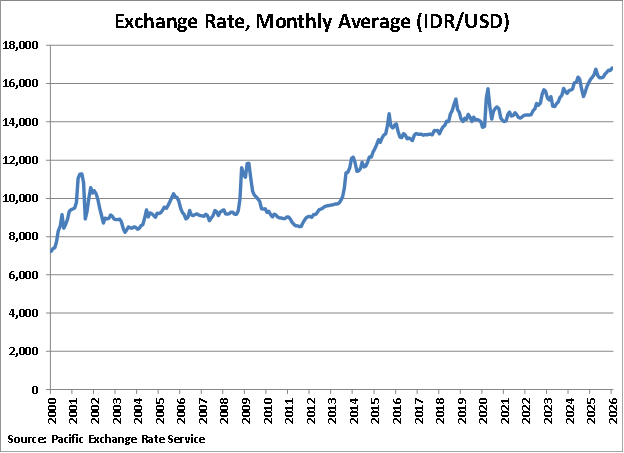
The Indonesian rupiah has weakened significantly due to a mix of global and domestic factors. Rising U.S. tariffs and global uncertainty have triggered capital outflows, while concerns over President Prabowo’s fiscal policies, such as increased spending and widening deficits, have shaken investor confidence. Domestically, a growing current account deficit and heavy import reliance have added pressure.
Bank Indonesia’s efforts to stabilize the rupiah involve the implementation of a pro-market monetary policy through market mechanisms. Despite the central bank’s interventions, the rupiah remains near a 27-year low.
The country’s fiscal deficit amounted to IDR 695.1 trillion (US$41.24 billion) in 2025, which was equivalent to approximately 2.92% of GDP last year, wider than the government’s earlier forecast of 2.76%. In fact, the latest deficit is now the widest since 2005, excluding 2020 and 2021 during the COVID-19 pandemic, according to figures released by the Ministry of Finance.
Despite this, the government emphasized that the shortfall remains “manageable” and still within the legal cap of 3%.
Government revenue reached IDR 2,756.3 trillion (US$163.53 billion), or 91.7% of the target, driven by tax collections of IDR 1,917.6 trillion (US$113.77 billion), customs and excise revenues of IDR 300.3 billion (US$17.82 million), and non-tax state revenues of IDR 534.1 trillion (US$31.69 billion). On the spending side, government outlays amounted to IDR 3,451.4 trillion (US$204.76 billion), or 95.3% of the planned estimate.
Looking ahead, the government aims to keep the budget deficit at 2.68% of GDP in 2026.
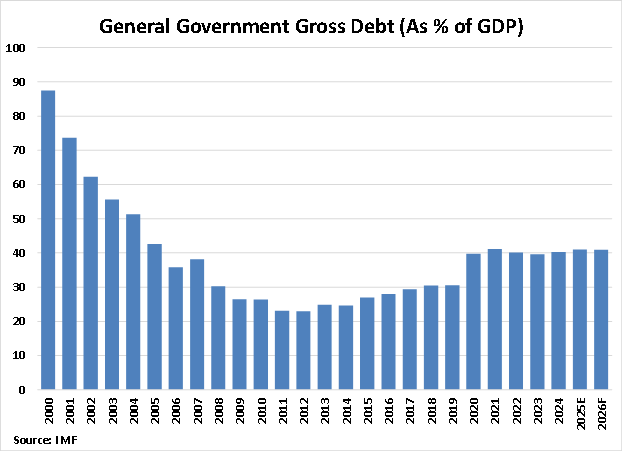
The country’s gross government debt was equivalent to about 38.65% of GDP in 2025, according to the IMF, slightly up from 38.8% of GDP in 2024, 39.2% in 2023, 39.7% in 2022, 41.1% in 2021, and 39.7% in 2020. It is also far higher than the debt level of just about 30.6% of GDP in 2019 before the pandemic.
Former military general Prabowo takes the helm, pledging to sustain Jokowi’s reforms
Joko Widodo (“Jokowi”), the Democratic Party nominee, became president of Indonesia on October 20, 2014. A man of the people, a campaigner for clean government, and a highly successful and popular former mayor of Jakarta, Jokowi was a symbol of the demand for reform.
Jokowi is popular for his ambitious infrastructure program, which includes various projects involving the construction and building of roads, railways, bridges, power stations, oil refining plants, seaports, airports, dams, and more. According to the Coordinating Ministry for Economic Affairs, 190 national strategic projects were completed from 2016 to 2023, with a total project value of IDR 1,515.4 trillion (US$89.91 billion).
Jokowi previously introduced a “Healthy Jakarta card” for health insurance, inaugurated the construction of the Jakarta MRT, and restarted the construction of the green line of the Jakarta Monorail. He also initiated programs aimed towards transparency, such as online taxes, e-budgeting, e-purchasing, and a cash management system.
The government has implemented some land reform, which involves the distribution of land certificates to the poor and offering lower taxes and financial services to buoy small businesses.
Jokowi won a second term in office during the April 2019 elections, beating former lieutenant-general and longtime rival Prabowo Subianto.
However, worrying trends toward corruption and authoritarianism have emerged. Bizarrely, he appointed Prabowo as his defense minister, despite the horrendous reputation of the former lieutenant-general, who was dishonorably discharged from the army for human rights abuses after the Asian crisis and has installed a large number of former regime members of Indonesia’s late dictator Suharto’s regime in his cabinet. There is also a growing tolerance of corrupt links between government and large conglomerates, reminiscent of the Suharto era, while amendments pushed through the Indonesian legislature in September 2019 have crippled Indonesia’s once potent anti-corruption agency. After nine years in office, corruption was still rampant. But Jokowi remained wildly popular.
In the February 2024 elections, Prabowo secured a decisive victory over his rivals, former Jakarta governor Anies Baswedan and former Central Java governor Ganjar Pranowo, largely due to Jokowi’s endorsement.
Prabowo was officially sworn in as Indonesia’s new president in October 2024, together with his running mate Gibran Rakabuming Raka, Jokowi’s eldest son. During his campaign, Prabowo pledged to continue Jokowi’s development and infrastructure-focused policies.
Since taking office, Prabowo has launched several high-impact and controversial policies, including a massive expansion of free school meals, a IDR306 trillion (US$18.15 billion) budget reallocation, and the creation of the Danantara sovereign wealth fund. He also eased import restrictions and offered major trade concessions to the U.S. to avoid tariffs. Additionally, his proposal to shorten mining quotas to one year has drawn criticism from industry groups, while ambitious spending plans have raised concerns over fiscal sustainability and investor confidence.
Prabowo has also pursued an active foreign policy and economic agenda aimed at raising Indonesia’s global profile and stimulating domestic growth. In his first year, he made at least 15 state visits to 24 countries, ending a decade-long absence of an Indonesian head of state at the United Nations General Assembly in September 2025 and strengthening ties with major partners like the United States, China, and the European Union, including negotiating several Comprehensive Economic Partnership Agreements. On February 6, 2026, Indonesia also signed a new security cooperation treaty with Australia, marking a diplomatic milestone in regional defense collaboration.
However, Prabowo’s presidency has also faced significant challenges and public criticism. Economic growth has slowed below government targets, investor sentiment has been mixed due to expansive fiscal policies and uncertainties, highlighted by Moody’s downgrade of Indonesia’s credit outlook to negative in February 2026, and some high-profile populist initiatives have raised fiscal sustainability concerns. Internally, controversial policies such as expanding the military’s role in civilian governance and protests over governance issues have drawn criticism from civil society and rights groups. Despite these headwinds, his approval ratings remained relatively high through late 2025, reflecting enduring public support for his leadership, even as debates over economic management and governance intensify.
Sources:
- Residential Property Price Survey for Primary House Quarter III-2025 (Bank Indonesia): https://www.bi.go.id/
- Jakarta apartment market finds stability amid limited new supply (Colliers International): https://marcom.colliers365.com/
- Momentum builds in Jakarta’s apartment market as buyers flock to ready units (Colliers International): https://marcom.colliers365.com/
- Indonesia’s Omnibus Law: Relaxed Foreign Ownership Laws on Real Estate (ASEAN Briefing): https://www.aseanbriefing.com/
- New regulation expands strata title rights for foreign citizens and legal entities (UN Trade and Development): https://investmentpolicy.unctad.org/
- Indonesia eases foreign home ownership, but only for high earners (Asia News Network): https://asianews.network/
- Indonesia Tourist Arrivals Expand 14.4% YoY (Trading Economics): https://tradingeconomics.com/
- Indonesia exceeds 2025 tourism target with 15.39 million visitors (Antara News): https://en.antaranews.com/
- Bali’s foreign tourist arrivals rise nearly 10 pct in 2025, BPS says (Antara News): https://en.antaranews.com/
- Gross rental yields in Indonesia: Jakarta and 4 other cities (Global Property Guide): https://www.globalpropertyguide.com/
- Jokowi signs regulation on Tapera public housing savings program (Jakarta Post): https://www.thejakartapost.com/
- Revamping Public Housing Savings: New Regulatory Changes Unveiled (Lexology): https://www.lexology.com/
- Indonesia’s FLPP housing financing hits record in 2025 (Antara News): https://en.antaranews.com/
- Indonesian Economic and Financial Statistics (SEKI) (Bank Indonesia): https://www.bi.go.id/
- Monetary Policy Report – Quarter IV 2025 (Bank Indonesia): https://www.bi.go.id/
- Indonesia GDP Grows 5.11% in 2025, Missing Government Target (Jakarta Globe): https://jakartaglobe.id/
- IMF Executive Board Concludes 2025 Article IV Consultation with Indonesia (International Monetary Fund): https://www.imf.org/
- Indonesia GDP Annual Growth Rate (Trading Economics): https://tradingeconomics.com/
- Indonesia’s Economic Growth in 2025 was 5.11 Percent (BPS-Statistics Indonesia): https://www.bps.go.id/
- Inflation Data (Bank Indonesia): https://www.bi.go.id/
- Indonesia Government Budget (Trading Economics): https://tradingeconomics.com/
- Indonesia (International Monetary Fund): https://www.imf.org/
- Indonesia’s Economy Maintains Resilience Amid Global Uncertainty (World Bank): https://www.worldbank.org/
- Indonesia country profile (BBC): https://www.bbc.com/
- Jokowi’s 190 Strategic Projects Completed Throughout 2016-2023 (Tempo English): https://en.tempo.co/
- Who is Prabowo Subianto, the former general who became Indonesia’s new president? (Associated Press): https://apnews.com/
- One year on, Prabowo puts Indonesia in the global spotlight (Antara News): https://en.antaranews.com/
- Australia and Indonesia sign historic security treaty (Minister of Foreign Affairs, Australia): https://www.foreignminister.gov.au/
- Moody’s cuts Indonesia outlook to negative on governance concerns (Reuters): https://www.reuters.com/
- President Prabowo’s approval steady at 78% despite challenges (The Jakarta Post): https://www.thejakartapost.com/