Pakistan's Residential Property Market Analysis 2026
Pakistan’s residential property market remains resilient, driven by strong domestic demand and growing foreign interest. Prices continue to rise in double digits, reflecting limited supply and high buyer interest. While rapid urban population growth fuels long-term demand, actual market activity is constrained by weak purchasing power, rising property costs, and limited financing options, challenging many prospective homebuyers.
This extended overview from the Global Property Guide provides a detailed assessment of Pakistan’s housing market, focusing on recent developments and long-term structural trends.
Table of Contents
- Property Prices and Price Index
- Residential Hotspots
- Property Supply and Demand Trends
- Rental Market: Rents and Rental Yields
- Mortgage Market and Interest Rates
- Economic and Social Factors
Property Prices and Price Index
Pakistan’s residential property market continues to expand rapidly, posting double-digit price growth. In February 2026, the residential property price index for houses in Karachi, Pakistan’s largest and most urbanized city and historically the country’s leading real estate market, surged by a huge 20.44% year-on-year (14.05% in inflation-adjusted terms), according to data from the property portal Zameen.
On the other hand, the index for apartments recorded a more moderate increase of 8.87% (3.10% inflation-adjusted).
Pakistan's house price annual change:
Graph: Pakistan (Karachi) House Price Index / Monthly.
Source: Zameen.
Though residential property price trends differ across the country’s major cities and property types.
In Pakistan’s other major cities, as of February 2026:
- In Islamabad, the house price index increased slightly by 1.92% (but declined by 3.49% in real terms. Apartments, on the other hand, saw strong price growth of 15.38% (9.27% inflation-adjusted).
- In Lahore, the price index for houses fell by 7.05% y-o-y (-11.98% inflation-adjusted) while the apartment index increased by 6.16% (0.53% inflation-adjusted).
- In Rawalpindi, the house price index dropped -16.73% y-o-y (-21.15% inflation-adjusted) while apartments experienced a more moderate price fall of 5.38% (-10.4% inflation-adjusted).
- In Faisalabad, house prices were up by 6.09% (0.47% inflation-adjusted) y-o-y in February 2026. Likewise, apartment prices also increased by 4.86% (fell slightly by 0.7% in inflation-adjusted terms).
- In Gujranwala, house prices increased by an average of 9.9% y-o-y (4.07% inflation-adjusted) in February 2026.
- In Multan, the house price index rose by 9.16% y-o-y (3.37% inflation-adjusted) while the apartment index soared by 25.17% (18.53% inflation-adjusted).
In the housing segment, Islamabad recorded the highest average house price in Pakistan at PKR 83.6 million (US$299,949) in February 2026, based on figures from Zameen. This was followed by Karachi, where the average house price stood at PKR 77.7 million (US$278,780), and Lahore, with an average of PKR 52.1 million (US$186,930).
In the apartment segment, Karachi posted the highest average price in February 2026 at PKR 27.0 million (US$96,873), followed by Islamabad at PKR 25.5 million (US$91,491) and Lahore at PKR 23.8 million (US$85,392).
| AVERAGE RESIDENTIAL PROPERTY PRICES, MAJOR CITIES, FEBRUARY 2026 | ||||
| Major Cities | Houses | Apartments | ||
| PKR | USD | PKR | USD | |
| Islamabad | 83,600,000 | 299,949 | 25,500,000 | 91,491 |
| Karachi | 77,700,000 | 278,780 | 27,000,000 | 96,873 |
| Lahore | 52,100,000 | 186,930 | 23,800,000 | 85,392 |
| Multan | 41,700,000 | 149,615 | 11,100,000 | 39,825 |
| Rawalpindi | 35,000,000 | 125,577 | 12,100,000 | 43,414 |
| Faisalabad | 34,700,000 | 124,500 | 7,825,000 | 28,075 |
| Gujranwala | 29,000,000 | 104,049 | 19,600,000 | 70,323 |
| Data Sources: Zameen, Global Property Guide | ||||
Residential property demand in Pakistan’s major cities remains strong through 2025 and early 2026, driven by population growth, urbanization, and rising household formation. Karachi, Lahore, and Islamabad continue to see active interest in apartments, villas, and gated community homes, while secondary cities like Rawalpindi and Gujranwala are also attracting buyers due to improved infrastructure and services.
Investor activity further supports property demand, with local investors and overseas Pakistanis seeking long-term capital appreciation. Despite affordability challenges for some buyers, structural demand for residential real estate in urban centers remains resilient and expanding, signaling continued growth in Pakistan’s property market.
Though Pakistan’s economy continues to face volatility after years of macroeconomic instability. The International Monetary Fund (IMF) estimates GDP growth at around 2.7% in 2025, constrained by weak investment, tight fiscal policy, and fragile domestic demand. This marks only a slight improvement from previous years, when the economy grappled with high inflation, external imbalances, and financing pressures. Growth has been uneven in recent years: 2.5% in 2024, a contraction of 0.2% in 2023, strong rebounds of 6.2% in 2022 and 5.8% in 2021, following a pandemic-related decline of 0.9% in 2020.
The IMF expects Pakistan’s economy to grow by a moderate 3.2% this year. This is a bit higher than the World Bank ’s forecast of a 3% expansion.
Residential Hotspots:
Increasing popularity of high-rise residential projects in first-tier cities
Vertical housing is becoming an increasingly important segment of Pakistan’s real estate market, driven by rapid urbanization, rising land prices, and changing lifestyle preferences. While horizontal developments have historically dominated the country’s housing landscape, growing population densities and land constraints have intensified the demand for high-rise residential options. This shift is most pronounced in major urban centers, where apartment living is gaining traction due to its efficiency, convenience, and access to modern amenities.
Karachi, Islamabad, and Lahore, Pakistan’s largest and most developed real estate markets, serve as the focal points for vertical housing developments, offering high-quality apartment options that cater to a diverse range of buyers, from local professionals and families to overseas Pakistanis. As urban congestion increases, centrally located projects with premium finishes in these Tier-1 cities are expected to attract growing interest, reinforcing the long-term investment potential of apartment living.
Karachi
Karachi, Pakistan’s largest and most populous city, has an estimated population of 20.3 million and covers roughly 3,527 square kilometers. The city’s real estate market is shaped by its diverse demographics, strategic coastal location, and economic significance. Housing demand is fueled by a growing middle class seeking affordability, high-net-worth individuals investing in luxury properties, and a sizable expatriate community.
Rapid population growth, combined with sustained rural-urban migration, continues to place pressure on housing supply. This has resulted in outward expansion along major corridors such as the Super Highway and Northern Bypass, while vertical residential developments are increasingly concentrated in established urban districts, including Clifton, Defence (DHA), PECHS, and parts of Gulshan-e-Iqbal. Rising land prices in central locations are further encouraging developers to shift toward apartment-based projects.
Karachi had approximately 1,552 Grade B apartments, with an additional 2,404 Grade A and B units expected to be delivered over the next five years, according to Savills. This 55% increase in supply reflects developer confidence in long-term demand, despite economic headwinds such as inflation-driven construction costs and import restrictions affecting furnishing expenses.
As of early 2026, average apartment prices in Karachi reached around PKR 27 million (US$96,000), making it one of the most expensive apartment markets in the country. Meanwhile, prices for existing Grade B apartments ranged from PKR 25,000 (US$90) to PKR 35,000 (US$126) per square foot. Although Grade A inventory remains limited, upcoming high-rise developments in prime areas are expected to gradually upgrade the city’s vertical housing stock.
Islamabad
Islamabad, Pakistan’s capital city, is renowned for its planned urban layout, political stability, and high-quality infrastructure. The city attracts government officials, diplomats, corporate professionals, and expatriates, contributing to steady and resilient growth in its real estate market. Its well-defined zoning and modern infrastructure have also positioned Islamabad as a key business hub, drawing skilled and semi-skilled labor from across the country.
Apartment development activity has accelerated in Islamabad and its twin city, Rawalpindi, with southern expansion leading to the emergence of new residential communities. The market remains investor-driven, with increasing demand for high-end residential units.
According to Savills, Islamabad had an existing supply of over 1,600 Grade A and B apartment units, with occupancy rates exceeding 80%. An additional around 800 Grade A units are expected to be delivered in the next few years, primarily in DHA, New Blue Area, and Bahria Town, where infrastructure, amenities, and security support premium residential developments.
As of early 2026, apartment prices in Islamabad remain among the highest in the country. Grade A apartment prices in Islamabad ranged from PKR 35,000 (US$126) to PKR 50,000 (US$179) per square foot, while Grade B units were priced between PKR 25,000 (US$90) and PKR 35,000 (US$126) per square foot.
Lahore
Lahore, Pakistan’s second-largest city and a major cultural and historical hub, continues to experience strong real estate demand. Population growth, urbanization, and ongoing infrastructure improvements have reinforced the city’s position as a prime investment destination, even amid broader economic uncertainties.
The city’s residential market offers a diverse mix of traditional and contemporary housing, catering to a wide spectrum of buyers with varying budgets and lifestyle preferences. While bungalow-style developments have historically dominated Lahore’s housing sector, there is an increasing shift toward mid-rise and high-rise apartment living, driven by the convenience of centrally located residences, modern amenities, secure parking, and lower maintenance costs.
According to Savills, Lahore’s existing supply of Grade A and B apartment units stood at 1,447, primarily concentrated in Gulberg, DHA, and Bahria Town. By 2028, the total inventory is expected to increase to 4,265 units, representing a five-year compound annual growth rate (CAGR) of 24%, reflecting developer confidence in long-term demand for vertical housing.
As of early 2026, apartment prices in Lahore remain competitive yet are showing steady growth. Grade A units are priced between PKR 35,000 (US$126) and PKR 45,000 (US$161) per square foot, while Grade B apartments range from PKR 23,000 (US$83) to PKR 28,000 (US$100) per square foot, reflecting both location and quality of construction. The combination of limited prime land availability and growing investor interest is expected to support continued upward price momentum for high-quality residential projects in key urban districts.
Property Supply and Demand Trends
Rapid population growth fuels domestic housing demand
Pakistan’s booming population and accelerating urbanization remain the principal drivers of residential housing demand. According to the latest national census, the country’s population reached 241.5 million in 2023, reflecting an addition of 33.82 million people since 2017 and an average annual growth rate of approximately 2.55% over the period. This demographic expansion has been accompanied by a significant rise in households – a key determinant of housing needs – which increased by 19% to 38,340,566 households.
While comprehensive official data on the country’s total housing stock remains unavailable, a collaborative study by the Pakistan Mortgage Refinance Company (PMRC) and Akademos used a GIS‑based methodology across a sample of 13 districts to estimate national housing supply. Scaling these findings nationally, the estimated total residential housing stock in Pakistan stood at approximately 36.24 million units.
Housing gap in 13 districts surveyed by PMRC and Akademos:
| PAKISTAN’S HOUSING GAP | |||
| Major Cities | Total Housing Supply | Number of Households | Housing Surplus/ Shortage |
| Islamabad | 529,972 | 411,518 | 118,454 |
| Lahore | 1,954,762 | 2,012,526 | -57,764 |
| Rawalpindi | 1,119,961 | 999,347 | 120,614 |
| Faisalabad | 1,375,302 | 1,384,668 | -9,366 |
| Multan | 697,045 | 887,304 | -190,259 |
| Sargodha | 672,488 | 684,799 | -12,311 |
| Gujranwala | 948,761 | 849,524 | 99,237 |
| Karachi | 3,279,651 | 3,439,220 | -159,569 |
| Hyderabad | 349,877 | 448,479 | -98,602 |
| Sukkur | 296,212 | 268,755 | 27,457 |
| Peshawar | 704,660 | 691,505 | 13,155 |
| Abbottabad | 293,431 | 237,020 | 56,411 |
| Quetta | 142,340 | 288,690 | -146,350 |
| Gilgit | 75,008 | n/a | n/a |
| Data Sources: PBK, PMRC, Akademos, Remote Sensing of Satellite Imagery | |||
Under the assumption of one housing unit per household, PMRC’s analysis suggests a basic housing shortage of around 2.10 million units. This shortfall is most acute in highly urbanized districts where urban populations exceed 80% and in the least urbanized areas with urban shares below 35%. In major metropolitan centers such as Karachi, Lahore, and Islamabad, rapid population growth has consistently outpaced real estate development, resulting in chronic undersupply and upward pressure on prices and rents.
In contrast, many less urbanized regions with limited real estate activity have struggled to respond to rising urbanization due to weaker market dynamics and insufficient investment critical mass. These markets face both limited supply and constrained construction activity despite growing demand.
Interestingly, a number of moderately urbanized districts, including secondary cities such as Gujranwala and Rawalpindi, have recorded temporary housing surpluses. In these areas, relatively strong real estate activity and rapid urban expansion have spurred development that, at times, has outpaced immediate household formation. However, experts caution that these surpluses are likely to be absorbed over time as continued population growth and emerging land constraints drive future housing demand upward.
Beyond the numerical shortage, Pakistan faces substantial qualitative deficiencies in its housing stock. PMRC estimates a broader housing deficit of 15 to 27 million units, encompassing overcrowded conditions, substandard construction, and cost-burdened households grappling with affordability. This indicates that while units may exist, many do not meet the functional or financial requirements of modern urban living.
Overall, Pakistan’s demographic trajectory points to sustained demand for housing across the urban-rural spectrum. At the same time, persistent supply gaps in major urban centers underscore the need for targeted public and private sector strategies to accelerate housing delivery, expand affordable options, and support balanced regional development.
Currency advantage attracts foreign homebuyers
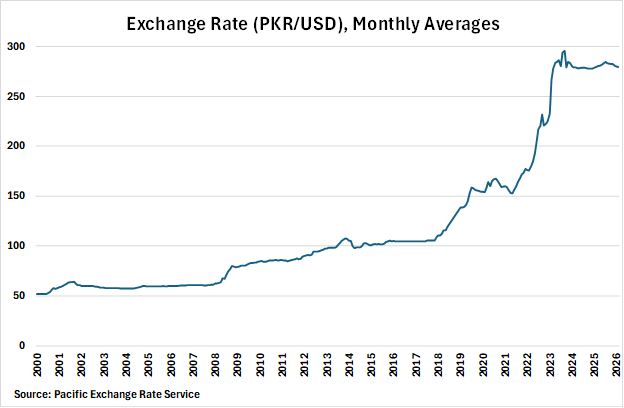
Pakistan’s residential real estate market has become increasingly attractive to foreign buyers and investors, largely due to favorable exchange rate dynamics. As of February 2026, the Pakistani rupee (PKR) averaged PKR 279.56 per USD, reflecting a depreciation of approximately 62.5% compared to PKR 104.71 per USD a decade ago. This significant currency shift has enhanced the purchasing power of overseas Pakistanis and international investors, allowing them to acquire high-quality residential properties at comparatively lower costs.
This trend has boosted demand in major urban centers such as Karachi, Lahore, and Islamabad, particularly for premium apartments, villas, and gated community developments. Lower relative prices, combined with the potential for capital appreciation, make Pakistan an appealing destination for foreign real estate investment.
Foreign nationals working or residing in Pakistan are permitted to buy or rent property, but the government requires completion of specific legal formalities through the Board of Investment and the Trade Development Authority of Pakistan.
In addition, property investment serves as a hedge against currency fluctuations, allowing overseas Pakistanis and international investors to convert foreign earnings into tangible assets. Together, these factors continue to drive foreign inflows, support high-end residential development, and enhance market liquidity in Pakistan’s housing sector.
Rental Market: Rents and Rental Yields
Rental yields are moderately good
Pakistan offers attractive gross rental yields. In Q3 2025, apartment yields across the country ranged from a modest 3.16% to a robust 12.9%, averaging 6.53% nationally, according to a recent study conducted by the Global Property Guide. This was higher than the average yields of 6.24% observed in Q1 2025.
By major areas:
- In Karachi, apartments registered gross rental yields ranging from 3.88% to 8.68% in Q3 2025, with a city average of 6.5%.
- In Lahore, gross rental yields ranged from 4.14% to 12.9% in Q3 2025, with a city average of 5.87%.
- In Islamabad, apartments earn gross rental yields from 3.16% to 9.02%, with a city average of 7.01%.
- In Rawalpindi, rental yields for apartments ranged from 3.4% to 10.06% in Q3 2025, with an area average of 6.73%.
Rising rents highlight persistent housing affordability challenges
The relative size of Pakistan’s rental market has remained broadly stable in recent years, but affordability pressures have intensified as rents continue to rise faster than incomes. According to the 2023 census published by the Pakistan Bureau of Statistics, 11.9% of households live in rented dwellings, only slightly higher than 11.5% recorded in 2017. The share of tenants is substantially higher in urban areas (23.8%) than in rural areas (4.2%), reflecting the growing reliance on rental housing in cities where homeownership has become increasingly difficult.
Pakistan's rent price index:
Note: Pakistan's Rent Price Index, % change 1 yr
Data Source: Pakistan Bureau of Statistics.
Housing conditions vary significantly across provinces and regions due to differences in population density, affordability, and household structure. Balochistan, characterized by low density and a predominantly rural population, records the highest homeownership rate of 85.8% and one of the lowest tenancy rates, at 6.2%. In contrast, the highly urbanized Islamabad Capital Territory reports a tenancy rate of 36.4%, with only 53.3% of households owning their homes. In Punjab, Sindh, and Khyber Pakhtunkhwa, tenants account for roughly 10% to 16% of households.
In absolute terms, around 4.5 million households nationwide are renters, of which approximately 3.6 million are concentrated in urban centers.
Rising demand for rental accommodation, coupled with declining affordability of homeownership, has placed upward pressure on rents in major cities. Market reports indicate that rents in key urban centers such as Islamabad, Karachi, and Lahore have been increasing by around 10% annually, driven by inflation, high construction costs, and limited housing supply.
Though residential rent movements still vary depending on location and property type. Based on figures from Zameen, one of the leading property portals in Pakistan, as of March 2026:
- In Karachi, the average rent for houses surged by 19% y-o-y to PKR 654,000 (US$2,346) and apartment rents soared by 25% y-o-y to PKR 155,000 (US$556).
- In Islamabad, rents for houses rose by a huge 30% y-o-y to reach an average of PKR 278,000 (US$997) while apartment rents also surged by 27% to PKR 724,000 (US$2,597).
- In Lahore, house rents increased by a modest 4% y-o-y to an average of PKR 288,000 (US$1,033). On the other hand, apartment rents fell by 6% y-o-y to PKR 209,000 (US$750).
- In Rawalpindi, the average rent for houses fell by 4% y-o-y to PKR 182,000 (US$653) while apartment rents increased by 5% to PKR 78,370 (US$281).
The pressure on tenants is further compounded by structural shortages in housing supply. Estimates suggest that Pakistan’s housing deficit may reach as much as 13 million units by 2026, which is expected to sustain strong rental demand and keep rents elevated, particularly in large metropolitan areas. Meanwhile, government policy adjustments have also reflected market realities, with rental ceilings for official accommodations in major cities revised upward in late 2025 to align with prevailing market rates.
As a result, renting has become increasingly burdensome for households. A study by the House Building Finance Corporation (HBFC) found that the national rent burden ratio stood at 14% in 2024, with urban households facing nearly double the burden of rural households (19% vs. 9%). Limited savings capacity, high interest rates, and down payment requirements of around 30% create a “rental trap,” particularly for low- and middle-income households in urban centers.
Overall, the continued escalation of rents, combined with constrained homeownership opportunities, has intensified housing affordability pressures in Pakistan’s urban areas, making rental housing a necessity rather than a transitional solution for a growing share of households.
Mortgage Market and Interest Rates
Key rates unchanged but housing loan interest rates remain high
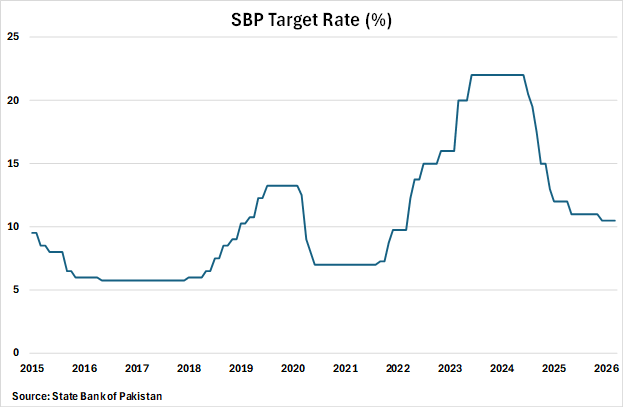
The State Bank of Pakistan (SBP) kept its benchmark policy rate unchanged at 10.5% in March 2026, extending its pause in the easing cycle. The decision reflected heightened economic uncertainty, particularly as rising oil prices amid escalating tensions in the Middle East increase inflation risks. Pakistan is especially vulnerable to higher energy costs due to its reliance on imported fuel, while a prolonged oil price shock could also put pressure on the rupee and complicate commitments under the IMF stabilization program.
“The MPC noted that the conflict in the Middle East has led to a sharp increase in global fuel prices as well as freight and insurance costs, while also affecting cross-border trade and travel. Given the evolving nature of events, the MPC observed that the intensity and duration of the conflict will both be important determinants of the impact on the domestic economy,” noted the SBP’s March 2026 Monetary Policy Statement. “In this regard, the Committee acknowledged the important role of the prudent monetary and fiscal policies in increasing the economy’s resilience to shocks.”
In line with the central bank’s decision, the weighted average lending rate of Pakistan’s scheduled banks stood at 10.59% in February 2026, nearly unchanged from the prior month’s 10.63% but sharply down from the previous year’s 12.31%.
For housing loan interest rates in Pakistan, as of March 2026:
- The government-linked House Building Finance Company (HBFC) offers home financing priced at 1-year KIBOR plus 3.0% for salaried borrowers and around 1-year KIBOR plus 3.5% for self-employed applicants, with rates repriced annually.
- Habib Bank Limited (HBL), the country’s largest bank, advertises Islamic home finance products linked to 1-year KIBOR plus 3.0% to 4.2%, depending on borrower profile, with floating profit rates reset periodically.
- BankIslami introduced a home financing product priced at 1-year KIBOR plus 1.0% for an initial fixed period of three years, after which standard spreads of around KIBOR plus 2% to 3% apply.
- Government-supported housing programs also provide subsidized options, with borrower rates typically ranging from 5% to 8% fixed for qualifying households before transitioning to market-linked pricing.
Housing loans continue to grow, yet residential mortgage market remains underdeveloped
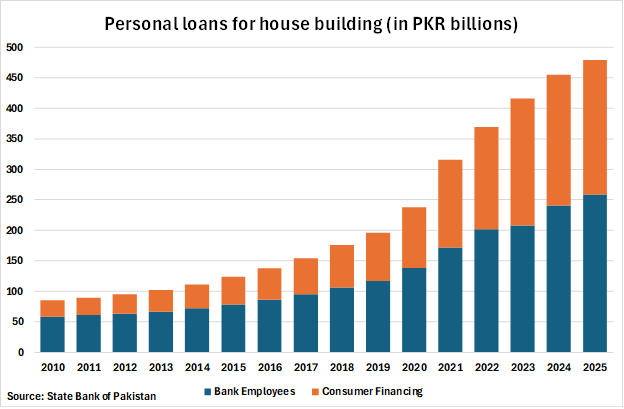
Housing loans continue to record robust double-digit growth, reflecting sustained demand for home financing. As of February 2026:
- Bank employees: outstanding loans for house building reached PKR296.82 billion (US$1.06 billion), up strongly by 16.4% from a year earlier.
- Consumer financing: outstanding loans for house building totaled PKR 223.77 billion (US$802.85 million), up by 12.1% from the same period last year.
Despite this, Pakistan’s residential mortgage market remains underdeveloped, with its size equivalent to just about 0.5% of GDP in 2025, reflecting limited access to formal housing finance, high borrowing costs, low penetration of long-term lending products, and structural constraints such as stringent collateral requirements and insufficient foreclosure frameworks.
According to a study recently published by the Pakistan Mortgage Refinance Company (PMRC), only 6.6% of consumers in Pakistan previously obtained housing finance, and only 16% are interested in obtaining it in the future due to limited loan options, complex application and qualification processes, and high interest rates.
At the same time, private banks in the country are reluctant to finance individual housing projects as mid- and low-income buyers typically lack good credit scores, increasing the risk of non-repayment. The situation is exacerbated by the informal nature of most real estate transactions and the lack of clear property titles in Pakistan. The existing legal framework does not adequately protect lenders in case borrowers default, discouraging the banks from developing new long-term credit products and growing their home loan portfolios.
Economic and Social Factors
Modest economic growth, increasing inflation
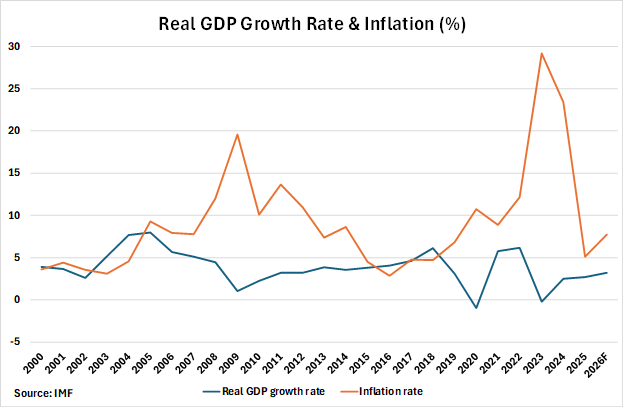
Pakistan’s economy showed modest recovery in 2025 following a period of macroeconomic instability, but growth remained subdued. The International Monetary Fund (IMF) estimated Pakistan’s GDP growth at around 2.7% in 2025, reflecting weak investment, tight fiscal policy, and still-fragile domestic demand. This marked only a slight improvement from the sluggish expansion recorded in preceding years, when the economy struggled with high inflation, external imbalances, and financing constraints.
Historically, Pakistan’s economic performance has been volatile. Prior to the pandemic, growth had already slowed from 5.8% in 2018 to about 1.9% in 2019, reflecting fiscal tightening, currency depreciation, and stabilization measures under an IMF-supported program. During the COVID-19 pandemic, the economy contracted by approximately -0.9% in 2020, as lockdowns disrupted industrial activity, services, and trade. A rebound followed in 2021, with growth accelerating to around 5.7%, supported by fiscal stimulus, improved remittances, and recovery in manufacturing and agriculture. However, the post-pandemic recovery proved uneven, with growth strengthening to around 6.2% in 2022 before contracting again by 0.2% in 2023 amid severe floods, high inflation, and tightening financial conditions.
By 2024, economic activity remained weak, with a real GDP growth rate of 2.5%, as stabilization policies continued and inflation surged, limiting domestic demand. In 2025, easing price pressures and improved macroeconomic conditions supported a gradual recovery, though output expansion remained modest compared with long-term averages.
The IMF expects Pakistan’s economy to grow by a moderate 3.2% this year. This is a bit higher than the World Bank ’s forecast of a 3% expansion.
“Pakistan’s recent floods have imposed significant human costs and economic losses, dampening growth prospects, and adding pressure on macroeconomic stability,” said Bolormaa Amgaabazar , World Bank Country Director for Pakistan. “Staying the course on reforms and accelerating job creation is critical to maintaining growth along with strengthening social safety nets and infrastructure that protects the most vulnerable citizens, and that will help ensure sustainable development and economic resilience for all.”
Inflationary pressures are rising again. In February 2026, nationwide inflation accelerated to 7%, up from 5.8% in the previous month and from 1.5% in the same period last year, according to PBS.
From an annual average of 4.7% between 2015 and 2019, inflation accelerated to 10.7% in 2020, mainly driven by pandemic-related supply disruptions and higher food and energy prices. Inflation remained elevated at 8.9% in 2021 and 12.2% in 2022, before surging to a record high of 29.2% in 2023 amid severe flooding, sharp exchange rate depreciation, rising global commodity prices, and domestic energy tariff adjustments. Consumer prices continued to increase sharply by 23.4% in 2024, before easing significantly to 5.1% in 2025 as monetary tightening, improved supply conditions, and base effects helped moderate inflation.
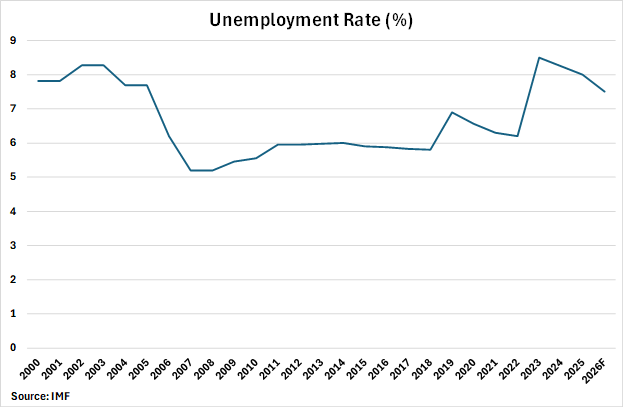
Labor market conditions remain challenging, reflecting the economy’s limited job-creation capacity. Unemployment is estimated at around 8% in 2025, slightly down from 8.25% in 2024 and 8.5% in 2023, based on IMF figures. Despite this, employment generation remains insufficient relative to population growth, keeping underemployment pressures elevated.
Unemployment averaged 5.9% from 2010 to 2018 before rising to 6.5% from 2019 to 2022. The jobless rate increased further to above 8% in the past three years due to slower economic growth, high inflation, and weak job creation.
On the fiscal side, Pakistan’s fiscal position has shown gradual improvement in recent years, although budgetary pressures persist. The fiscal deficit is estimated at around 5.4% of GDP in 2025, down from 6.9% of GDP in 2024, 7.8% in 2023, and 7.9% in 2022, as revenues increase and expenditures are restrained under ongoing reform measures. However, public finances remain constrained by high debt servicing costs and limited fiscal space.
Public debt remains elevated, though, underscoring ongoing fiscal vulnerabilities. Pakistan’s public debt was equivalent to around 83% of GDP in 2025, up from 81% of GDP in 2024 but down from 92% of GDP in 2023.
Sources:
- Price trends of houses in Karachi (Zameen): https://www.zameen.com/
- Pakistan Annual Real Estate Market Overview 2024 (Savills): https://www.savills.pk/
- Gross rental yields in Pakistan: Karachi and 3 other cities (Global Property Guide): https://www.globalpropertyguide.com/
- Why owning a home is out of the question (Dawn): https://www.dawn.com/
- The State of Housing Affordability in Pakistan (House Building Finance Company Limited): https://hbfc.com.pk/
- Monetary Policy Statement (State Bank of Pakistan): https://www.sbp.org.pk/
- Overall Weighted Average Lending and Deposit Rates (State Bank of Pakistan): https://www.sbp.org.pk/
- A Comprehensive Analysis of Pakistan’s Housing Market (Pakistan Mortgage Refinance Company Limited): https://pmrc.com.pk/
- 7th Population and Housing Census of Pakistan – 2023 (Pakistan Bureau of Statistics): https://census23.pbos.gov.pk/
- Pakistan (International Monetary Fund): https://www.imf.org/
- PAKISTAN: Sustained Reforms Needed for Inclusive Growth, Economic Stability, and Flood Recovery (World Bank): https://www.worldbank.org/
- Pakistan’s economy needs more than stabilisation (East Asia Forum): https://eastasiaforum.org/
- 2026: Pakistan must choose growth (The Express Tribune): https://tribune.com.pk/
- Monthly CPI (Pakistan Bureau of Statistics): https://www.pbs.gov.pk/
- Pakistan Government Budget (Trading Economics): https://tradingeconomics.com/
- Pakistan Government Debt to GDP (Trading Economics): https://tradingeconomics.com/