Is The Dominican Republic a Good Country to Buy Property?
The Dominican Republic is one of the Caribbean’s most dynamic property markets, attracting both lifestyle buyers and yield-focused investors. Foreigners have the same ownership rights as Dominican citizens, including the ability to purchase land and real estate without restriction. Investment is concentrated in tourism-driven areas such as Punta Cana, Puerto Plata, La Romana, and the capital, Santo Domingo, where strong urban demand supports rental income and long-term appreciation. With prices generally lower than much of Latin America and some of the region’s strongest rental yields, the country offers an attractive entry point for investors seeking growth and income.
In recent years, the residential market has seen double-digit price growth, driven by tourism recovery, steady economic expansion, and increased investor confidence. Although landlord-tenant laws favor tenants and mortgage rates are high, most transactions are completed in cash. The economic environment remains supportive, with solid GDP growth and controlled inflation. Buyers who are prepared to manage due diligence, transaction costs, and a limited mortgage market will find a fast-growing real estate sector with strong potential for returns.
Table of Contents
- Can Foreigners Buy Property in the Dominican Republic
- Best Cities and Regions to Invest
- Square Meter / Square Foot Prices
- Median Asking Prices
- Rental Yields and Rents
- Market Performance (Past and Present)
- Landlord and Tenant Laws
- Property Related Taxes
- Buying (and Selling) Costs
- Mortgage and Financing Options
1) Can Foreigners Buy Property in the Dominican Republic?
Yes. As a foreigner, you enjoy the same property ownership rights as Dominican citizens, meaning you can freely purchase and own real estate in the Dominican Republic, including land.
2) Best Regions and Cities to Invest
Punta Cana
Known for its stunning beaches and luxury resorts, Punta Cana is one of the most popular real estate destinations in the Dominican Republic. It attracts both tourists and investors due to its strong rental market, especially for vacation homes, condos, and beachfront villas. Areas like Cap Cana and Bavaro are particularly desirable for their high-end properties and proximity to golf courses and marinas.
Santo Domingo
As the capital and largest city, Santo Domingo is the economic and cultural hub of the country. Real estate in neighborhoods such as Piantini, Naco, and Gazcue offers modern apartments, luxury condos, and commercial spaces. Santo Domingo is ideal for investors looking for urban properties with strong rental potential and opportunities for capital growth.
Las Terrenas
Located on the Samaná Peninsula, Las Terrenas is a hidden gem for those seeking a more laid-back lifestyle. The area has become increasingly popular with expatriates, offering a mix of beachfront villas, boutique hotels, and charming homes. It’s a prime spot for those looking for investment opportunities in vacation rentals or personal retreats, surrounded by natural beauty.
Puerto Plata
With its scenic coastline and historic appeal, Puerto Plata is another key destination for real estate investors. The area offers a variety of properties, from affordable homes to luxury beachfront estates. Cabarete and Sosúa, nearby towns, are popular with expats and retirees, offering vibrant communities, water sports activities, and a steady demand for vacation rentals.
La Romana
La Romana, known for the world-renowned Casa de Campo resort, is a luxury destination that attracts high-end buyers. It features exclusive villas, golf courses, and a marina, making it an ideal location for those seeking luxury real estate. La Romana is perfect for investors interested in premium vacation homes and rental properties in a secure, upscale environment.
3) Square Meter / Square Foot Prices
Square-meter prices in the Dominican Republic are on the lower end when compared to the rest of Latin America.
As of January 2026, square meter prices were as follows in the Dominican Republic:
- Santo Domingo - $2,281
- Punta Cana - $2,522
4) Median Asking Prices
The Dominican Republic has a significantly higher median asking price than other Latin American countries. As of September 2025, one-bedroom apartments ranged from $150,000 to $166,000.
One-bedroom prices as of September 2025 were as follows:
- Santo Domingo - $166,000
- Punta Cana - $150,000
5) Rental Yields and Rents
The Dominican Republic’s rental yields are very good, with an overall rating of 7.78%.
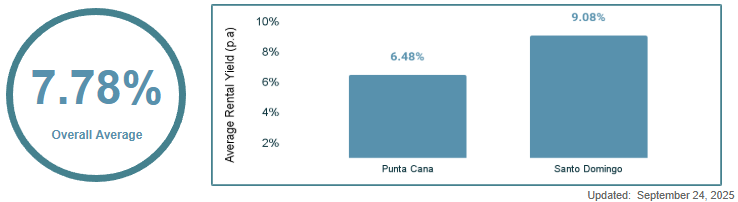
As of September 2025, average yields for one-bedroom apartments across the Dominican Republic are as follows:
- Santo Domingo - 9.08%
- Punta Cana - 6.48%
The Dominican Republic's rent price index:
Data Source: Banco Central de la República Dominicana.
6) Market Performance (Past and Present)
The Dominican Republic’s residential property market has experienced strong price growth, rebounding from the pandemic and regaining momentum by 2024 and into 2025. National data show apartment prices rose 10.7 percent year-on-year in May 2025, reaching DOP 130,932 (about USD 2,202) per square meter. House prices increased by 11.6 percent, supported by robust demand and sustained activity following the tourism-led recovery. Inflation-adjusted prices also rose, highlighting continued market dynamism as both local and foreign buyers returned.
Long-term trends indicate steady residential value appreciation, with price indices showing significant nominal gains over several years. Recent quarters reflect ongoing upward pressure on housing values. As of mid-2025, the market remains vibrant, driven by strong tourism demand and investor confidence. Projections suggest residential prices will continue to rise through the remainder of 2025. These trends highlight the market’s resilience and its appeal to buyers seeking growth opportunities in Caribbean real estate.
The Dominican Republic's house price annual change:
Data Source: Properstar.
7) Landlord and Tenant Laws
Dominican Republic landlord-tenant laws are judged by the Global Property Guide to be pro-tenant. Landlords retain legal rights such as seeking damages, enforcing contract terms, and pursuing eviction. However, strong tenant protections in the legal framework often make it challenging for landlords to exercise these rights promptly or efficiently.
8) Property Related Taxes
Property tax is based on the cadastral value of the property as determined by the government, usually at a much lower rate than the market value. It is levied annually at a rate of 1% on the property’s cadastral value exceeding DOP 7,710,158.20 (US$140,623). Properties with values below the threshold amount are not taxed.
9) Buying (and Selling) Costs
Purchasing property in the Dominican Republic requires thorough due diligence to confirm clear ownership, absence of liens or disputes, and compliance with local regulations. Engaging a local attorney or notary is strongly recommended. The transaction is formalized through the Contrato de Promesa de Venta, a legally binding agreement specifying the price, payment terms, and property details. Buyers should budget for transaction costs, including legal, notary, registration, tax, and agent fees. The transfer tax is 3% of the property value, notary fees typically range from 0.25% to 1%, legal fees are about 1%, and real estate agent commissions are usually negotiable between 2% and 3% of the purchase price.
Here's a full breakdown:
| Transaction Costs | ||
| Who Pays? | ||
| Property Transfer Tax | 3.00% | buyer |
| Legal Fees | 1.00% | buyer |
| Notary Fees | 0.25% - 1.00% | buyer |
| Real Estate Agent Fee | 2.00% - 3.00% | seller |
| Costs Paid by Buyer | 4.25% - 5.00% | |
| Costs Paid by Seller | 2.00% - 3.00% | |
| Round-trip Transaction Costs | 6.25% - 8.00% | |
| Source: Global Property Guide, KPMG | ||
10) Mortgage and Financing Options
Mortgage interest rates in the Dominican Republic remain high, despite policy rate cuts totaling 125 basis points since late 2024. The central bank maintained its benchmark rate at 5.75% in May 2025, citing global uncertainty and stable domestic inflation. Housing loan rates have seen little change, with peso-denominated mortgages averaging 12.14% and foreign currency loans at 8.97%, both largely unchanged or slightly higher year over year. Despite elevated borrowing costs, the mortgage market is expanding. Total housing loans reached DOP 427.11 billion in May 2025, a 13.5% increase from the previous year. However, the sector remains underdeveloped, accounting for only 5.5% of GDP, and most property transactions are still conducted in cash, even after reforms to improve mortgage availability and increase loan-to-value ratios up to 70%.
The broThe broader economic environment remains supportive, with GDP growth of 5% in 2024 and a projected 4% in 2025, driven by strong consumption, investment, and structural reforms. Inflation has eased from its 2021–2022 peaks and was 3.84% in May 2025, within the central bank’s target range. Unemployment is just over 5%. Fiscal indicators reflect manageable deficits and declining public debt as a share of GDP. Overall, the Dominican Republic demonstrates solid economic growth and stable inflation, but the mortgage market remains small and is limited by high lending rates.
The Dominican Republic's mortgage loan interest rates:
Data Source: Banco Central de la República Dominicana.
Need Help?
Buying property in a foreign country can feel overwhelming, but we're here to help.
At Global Property Guide, we offer:
- Data-backed insights on property prices, rental yields, and taxes
- Country-specific legal and tax guidance through our partner network
- Pre-screened investment properties, including income-generating Airbnb units
- 1-on-1 consultations with real estate experts focused on international buyers
- Step-by-step buyer support, from due diligence to closing
Whether you're looking for your first investment in the Dominican Republic or expanding your international portfolio, we can help you make smart, secure decisions.
Contact our team or book a free consultation to get started.