USVI’s property market gathering pace
The US Virgin Islands’ housing market is heating up, buoyed by strong demand and improving economic conditions, as the world eases pandemic-related travel restrictions.
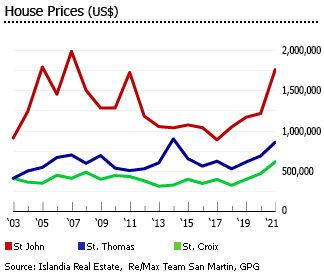
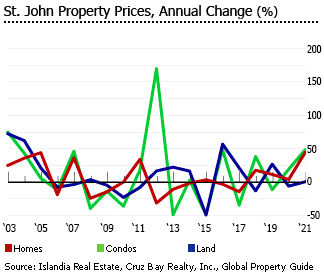
In St. John, the heartland of luxury residential properties, average home sales prices surged 44.5% y-o-y in 2021, to US$1,757,411, according to Cruz Bay Realty, Inc. – following y-o-y increases of 4% in 2020, 11.5% in 2019, and 17.7% in 2018. In 2017, house prices fell 14.4% due to the devastation brought by the Hurricanes Maria and Irma to properties in the area during the year.
Condo prices in St. John increased slightly by 0.5% y-o-y to US$718,583 in 2021, an improvement from the previous year’s 6% fall.
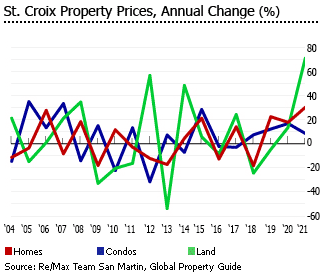
In St. Croix, the largest of the U.S. Virgin Islands, the average home sales price rose strongly by 30.3% y-o-y to US$618,943 in 2021, following annual increases of 17.8% in 2020 and 22.5% in 2019, according to figures from Re/Max Team San Martin. Condo prices in St. Croix were up 8.6% y-o-y to US$279,013 last year.
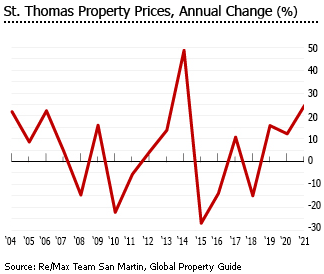
In St. Thomas, where the USVI’s capital Charlotte Amalie is located, the average home sales price rose by 24.5% y-o-y in 2021 to US$861,503, an acceleration from annual increases of 12.2% in 2020 and 15.8% in 2019.
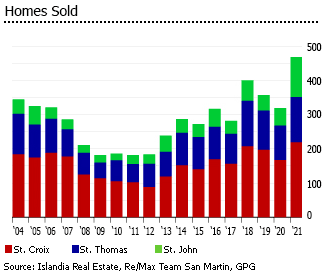
Demand is surging. In St. John, the number of homes sold soared more than 129% y-o-y to 117 units in 2021, following a 13.3% increase in 2020, according to Cruz Bay Realty, Inc. In terms of value, total home sales in St. John more than tripled in 2021 to US$ 205.62 million. Likewise, the number of condominium units sold more than doubled to 24 units with a total value of US$ 17.25 million.
In St. Croix, home sales rose by more than 31% to 219 units in 2021 from a year earlier, in contrast to a 15.2% decline in 2020, according to Re/Max Team San Martin. Condo sales in St. Croix also doubled to 162 units y-o-y in 2021.
In St. Thomas, home sales increased 30.7% y-o-y to 132 units, in contrast to a 12.2% fall in 2020.
As a result, residential construction is rising again. During 2021, the value of private residential construction permits in the US Virgin Islands rose by 26.6% y-o-y to US$ 206.2 million, in contrast to a 6.1% fall in 2020, according to the USVI Bureau of Economic Research.
Tourism is rising. In 2021, the total number of visitor arrivals in the territory rose by 22.4% y-o-y to 1,047,816 people, in sharp contrast to an almost 59% decline in 2020, though it remained far below the annual average of almost 2.5 million visitors from 2003 to 2019. Visitors are expected to increase in coming months after the government dropped pre-arrival testing for vaccinated domestic travelers in March 2022, making it easier for tourists to visit.
There are no restrictions on foreign property ownership. Owning a property in the US Virgin Islands is “fee simple”.
Land price variations
St. John continues to have the most expensive land in the territory, with land prices surging by 48.5% y-o-y in 2021, to an average of US$ 440,308 per transaction, according to Cruz Bay Realty, Inc. Despite the increase, it remains below the average land price per transaction from 2004 to 2008 of US$551,000.
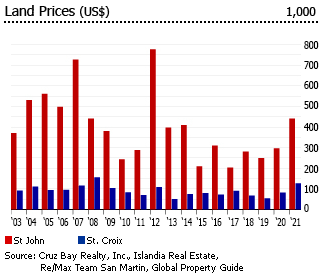
Similarly, land prices in St. Croix skyrocketed by 54.4% y-o-y in 2021 to an average of US$ 126,491 per transaction, according to RE/MAX Team San Martin, exceeding the average per-transaction price between 2003 and 2009 of US$110,000.
In St. Thomas, the average land price soared almost 71% y-o-y to US$183,522 per transaction in the first eight months of 2021, in sharp contrast to a y-o-y decline of 37.7% over the same period in 2020.
House price boom and bust
The U.S. Virgin Islands saw a housing boom from 2000 to 2007, with nationwide home sales prices surging by 90.1%, according to the USVI Bureau of Economic Research. The condominium market experienced even bigger price rises, with an average price rise of 133.8% over the same period.
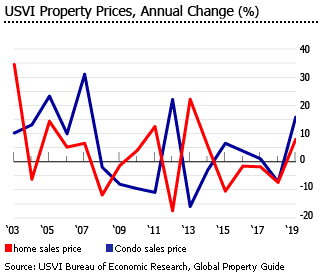
However in 2008, home prices fell 11.8% while condominium prices fell by 2%. Home prices in St. John/St. Thomas saw the biggest decline, of 28.5%.
In 2013 and 2014, home prices began to recover, increasing by 22.1% and 5.6%, respectively, while condominium prices continued to fall (by 15.9% and 3%).
The situation was reversed in 2015, as home prices fell by 10.5%, while condo prices increased by 6.5%. The trend of declining home prices and rising condo prices has continued for the next two years. But in 2018, both home and condo prices fell by 7.4% and 9.7%, respectively.
Then in 2019, both markets bounced back strongly, with home prices rising by 7.9% and condo prices increasing by 15.8%.
The housing market remained resilient despite the pandemic, with average home sales prices in St. John rising by 4% y-o-y in 2020, by 12.2% in St. Thomas, and by 17.8% in St. Croix. Then 2021, house price rises accelerated further as economic activity returns to pre-pandemic levels.
PROPERTY PRICE CHANGE (2000-2019) |
||||||||
| Home Price Change (%) | Condo Price Change (%) | |||||||
| 2000-2007 | 2007-2012 | 2012-2014 | 2014-2019 | 2000-2007 | 2007-2012 | 2012-2014 | 2014-2019 | |
| St. John/St. Thomas | 146.8 | -39.1 | 62.1 | -18.0 | 161.7 | -11.9 | -2.4 | 10.0 |
| St. Croix | 57.6 | 7.4 | -17.7 | 11.8 | 94.2 | -37.3 | -4.2 | 35.3 |
| US Virgin Islands | 90.1 | -16.0 | 28.9 | -13.5 | 133.8 | -11.4 | -18.4 | 19.9 |
| Sources: USVI Bureau of Economic Research, Global Property Guide | ||||||||
Residential construction rising again
The value of private residential construction permits rose 26.6% to US$ 206.2 million during 2021, according to the USVI Bureau of Economic Research.
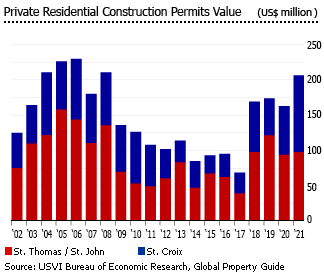
In the major islands:
- In St. Thomas/St. John, private residential permits value rose by 4.2% y-o-y to US$ 97.55 million in 2021, after falling by almost 23% in 2020.
- In St. Croix, the value of private residential permits surged 57% y-o-y to US$ 108.65 million in 2021, following a 32.5% growth in the prior year.
The rental market
St. John has the most expensive rental houses and villas. Monthly rents for one-bedroom apartments range from US$1,000 to US$2,500. Three to four-bedroom beach houses can cost from US$2,500 to US$7,000 per month. Recently, more condominiums have been built near hotels and resorts in St Thomas and St Croix.
Long-term rents in USVI are usually not advertised, except to locals. Most landlords only put a “for rent” signage in front of these rental apartments, which are often part of a larger house, with the landlord living next door.
Affordable housing
The Virgin Islands Housing Authority (VIHA) is responsible for planning, financing, constructing, maintaining and managing public housing developments, mostly on St. Thomas and St. Croix, and manages around 15% of USVI’s total housing stock. VIHA provides rental assistance to low-income families, elderly and disabled persons, with rentals based on the highest of three methods:
- Income-based: tenant pays the greater of 30% of the monthly-adjusted income Total Tenant Payment (TTP) or 10% of gross monthly income
- Flat rent, which reflects the age, size, location, condition, and amenities of each of VIHA’s developments
- Minimum rent of US$50
As of 2021, VIHA operates a total of about 3,000 units in 12 Asset Management Projects (AMPs) – 5 of which are located in the district of St. Thomas/St. John and 7 are in the district of St. Croix. VIHA directly operates 10 AMPs, and the other two, Louis E. Brown Villas I and Louis E. Brown Villas II, are privately managed.
Aside from the low income public housing, VIHA’s other two major programs include the Capital Fund Program, used to maintain the public housing inventory, and the Housing Choice Voucher Program, which provides housing assistance to low-income households.
HUD Funding FY 2021 |
|
| Low Income Public Housing | US$ 19,211,174 |
| Capital Fund Grant Program | US$ 9,516,052 |
| Housing Choice Voucher Program | US$ 14,147,600 |
| Housing Choice Voucher Administrative Fees | US$ 1,641,930 |
| CARES Act Legislation | US$ 1,799,800 |
| Resident Opportunity & Family Self Sufficiency | US$ 69,380 |
| TOTAL FEDERAL FUNDS | US$ 46,385,936 |
| Source: Legislature of the Virgin Islands | |
VIHA has recently embarked into renewing its entire public housing portfolio – half with new developments and half with complete renovations – thanks to funds from the Community Development Block Grant Disaster Recovery Funds (CDBG-DR) Program and U.S. Housing and Urban Development (HUD). The undertaking will cost US$1.1 billion over the next 8-10 years.
Tourism gradually improving
Tourism is the US Virgin Islands’ main industry, usually generating more than 2 million visitors every year, accounting for 80% of GDP. In 2021, the total number of visitor arrivals in the territory rose by 22.4% y-o-y to 1,047,816 people, in sharp contrast to an almost 59% decline in 2020 - far below, of course, the annual average of almost 2.5 million visitors from 2003 to 2019.
However, U.S. Virgin Islands airport checkpoints received 14% more passengers in February 2022 as compared to its pre-pandemic level in February 2019, according to Transportation Security Administration.
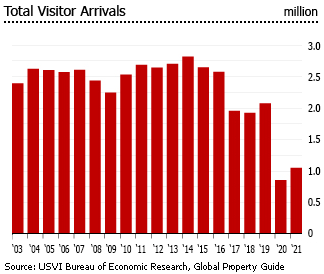
Visitors are expected to increase further now that pre-arrival testing for vaccinated domestic travelers has been dropped, making it easier for tourists to visit.
Construction of large-scale resorts is also gaining momentum. Marriott is expected to unveil a brand-new property - the Noni Beach Resort – this year. The property includes 94 guest rooms, a beachfront infinity pool and a bar. Later this summer, Marriott’s Frenchman’s Reef Beach Resort & Spa is also expected to reopen following a US$250 million reconstruction.
The U.S. Virgin Islands has received the “Innovative Destination of the Year” and the “Yachting Destination of the Year” awards during the Caribbean Travel Awards 2022 by Caribbean Journal, a leading digital travel news publication.
GDP figures for 2021 are still unavailable. But it is expected that, like most nations around the world, the tourism-reliant economy of the U.S. Virgin Islands improved last year due to improving global conditions. In 2020, USVI’s economy contracted by 2.2%, following growth of 2.8% in 2019 and 1.5% in 2018, mainly due to pandemic-related restrictions, according to the U.S. Bureau of Economic Analysis.
But even before the Covid-19 pandemic, the past decade has not been kind to the USVI. USVI’s GDP dipped 6.6% in 2009. After a short-lived recovery in 2010 (GDP up 0.9%), GDP plunged again by 8.2% in 2011, and then fell by a huge 15% in 2012, by 5.8% in 2013, and by 1% in 2014, mainly because of the closure of the HOVENSA refinery in 2012, which caused the layoff of around 1,200 employees. The economy has been sluggish since, posting miniscule growth of 0.3% in 2015 and 0.9% in 2016 and a slight contraction of 0.6% in 2017.
In January 2022, unemployment inched down to 8.2%. In St. Thomas/St. John, the jobless rate dropped to 6.9% in January 2022, from 9.7% a year ago. However in St. Croix, the jobless rate actually rose to 9.7%, from 8.2%.
What attracts people to USVI?
St. John, the “Love City”
St. John is known for its well-preserved natural beauty and picturesque hills dotted with lavish villas. Unlike the overdeveloped St. Thomas, real estate developments in St. John are restricted. The island is the wealthiest and most expensive of the US Virgin Islands.
“St. John has always been the most expensive island of all three,” said Belton E. Jennings III, the CEO of the Virgin Islands Territorial Association of Realtors. “It holds its value because it is preferred by well-heeled buyers.”
St John is home to the territory’s National Park, which protects more than half of St John’s land area. The National Park includes some of the best beaches and coral reefs in the world.
Some of the condominium developments in St. John offer full ownership while others operate as timeshares or run on fractional ownership. Most of these residential projects are located in Cruz Bay. Some existing condominium developments include:
- Pastory Estates: located on the hillside just five minutes from Cruz Bay, it has four buildings with thirteen one and two bedroom condos. One-bedroom units are currently priced at around US$340,000 while two-bedroom units are offered for about US$425,000.
- Grande Bay Resort & Residence Club: situated hillside overlooking Cruz Bay, this waterfront condominium offers overnight rentals and fractional ownership. One-bedroom residences are for sale for US$1,025,000.
- Pond Bay Club: located in Chocolate Hole just three miles from Cruz Bay, it is an exclusive 15-acre fractional time-share development consisting of 50 furnished three-bedroom cottages and villas and other recreational facilities.
- The Lumberyard: located just above the Cruz Bay ferry landing, this unique mixed-use development on the west coast of St. John offers four 2-3 storey buildings.
- Sunset Ridge: located in Cruz Bay, time-share and condo units are available starting from US$575,000. Weekly time shares from US$7,500 to US$15,000.
St. Thomas, the “Rock City”
Mountainous St. Thomas is an ocean lover’s paradise. Hillside houses usually have magnificent views of the ocean. Snorkeling, scuba diving and windsurfing are popular tourist activities. St Thomas is home to USVI’s capital and largest city, Charlotte Amalie.
Some residential developments in St. Thomas include:
- Jumeirah Botany Bay Resort: formerly known as The Preserve at Botany Bay, a 400-acre resort, which include an 84-room five-star boutique hotel, 30 fractional residences, 30 villas, and up to 20 grand estates.
- Marriott Frenchman’s Cove: Marriott Vacation Club International’s first timeshare resort overlooking Pacquereau Bay, which comprises of 220 two- and three-level vacation homes within seven buildings.
- Yacht Haven Grande: located in Long Bay Harbor, this mixed-use luxury development features a marina, an extensive retail and office space, four restaurants, and 12 three-bedroom condominiums.
- Dolphin Cove: a luxury community situated on St. Thomas’ “Gold Coast”; with around 20 acres of oceanfront property, the Dolphin Cove development includes at least 4 oceanfront bungalows, 64 villas, and 36 luxury flats offering views of Nazareth Bay and St Croix and the channel between St. Thomas and St. John.
- Pineapple Village: situated on the east end of St. Thomas, this community is home to 40 condominium units, each designed to enjoy the property’s many courtyards.
- The Anchorage: located on the beautiful Cowpet Bay, this development consists of 75 units of two-bedroom condos. It offers a fitness center, a pool, and tennis courts.
St. Croix, the “Twin City”
St. Croix is the largest island in the US Virgin Islands, but is more laid back than the other two islands. Unlike St. Thomas and St. John’s mountainous landscape, one of St. Croix’s charms lies in its varied topography, which goes from uncrowded white-sand beaches to rolling hills to rain forests.
St Croix is nicknamed the Twin City because of its two main towns: Christiansted and Frederiksted. Out of the two, Christiansted is more developed featuring shops and superb restaurants with a modern setting. This town is also known for architectural and historic richness, present in its 18th-century Danish-style buildings constructed by African slaves. Meanwhile, Frederiksted, with its historic landmark Fort Frederik, has been the main port for cruise ships in St. Croix.
Some notable attractions in St. Croix include the Buck Island Reef National Monument, the renowned Cane Bay Wall, St. George Village Botanical Gardens and the Cruzan Rum Distillery. St. Croix is also the only island in the US Virgin Islands that has a casino, the Divi Carina Bay Casino.
Some residential developments in St. Croix include:
- Carden Beach: situated on the east end of St. Croix, this upscale, gated condominium complex offers scenic water views and a short walk to a natural beach. It offers various amenities such as tennis court, swimming pool, and a fitness room. Prices of condo units range from US$810,000 to US$1,690,000.
- Sweet Lime Villas: nestled in the beautiful hills of St. Croix’s premiere Carambola Golf Community, this residential development offers various amenities such as tennis courts, pools, and scenic grounds for walking. Two-bedroom units are priced at US$340,000 while three-bedroom units are offered for US$600,000.
- The Pelican Cove Beach Condo Resort: this gated beachfront complex consists of two- and three-bedroom large condos of five buildings with a total of 47 vacation condos on grounds. Condo prices start at US$399,000.
- The Reef Condos: this beautiful residential community located on the eastern end of St. Croix consists of 101 tiered villas. Amenities include a 9-hole golf course, tennis and pickleball courts, a huge pool and cabana area. Prices range from US$260,000 to US$415,000.
Sources:
- St. John MLS Sales History (Cruz Bay Realty, Inc.): https://www.cruzbayrealty.com/st-john-sales-history/
- Home Sales St Thomas vs St Croix An 18 Year Look (Team San Martin): http://www.american-virgin-islands.com/Team_Times_Market_Report.htm
- U.S. Virgin Islands Annual Tourism Indicators (USVI Bureau of Economic Research): http://usviber.org/wp-content/uploads/2021/11/TOUR20-revised.pdf
- U.S. Virgin Islands Tourism Statistics (USVI Bureau of Economic Research): http://usviber.org/
- Buying costs are moderate in the US Virgin Islands (Global Property Guide): https://www.globalpropertyguide.com/Caribbean/US-Virgin-Is/Buying-Guide
- U.S. Virgin Islands Annual Economic Indicators (USVI Bureau of Economic Research): http://usviber.org/wp-content/uploads/2016/11/ECON19.pdf
- House Hunting on St. John: A Mountain Perch for $1.65 Million (The New York Times): https://www.nytimes.com/2020/03/04/realestate/house-hunting-on-st-john-a-mountain-perch-for-1-65-million.html
- Gross Domestic Product for the U.S. Virgin Islands, 2020 (U.S. Bureau of Economic Analysis): https://www.bea.gov/news/2022/gross-domestic-product-us-virgin-islands-2020
- Unemployment Rates (USVI Bureau of Economic Research): http://usviber.org/wp-content/uploads/2016/11/UNE22-JAN.pdf
- Total Construction Permit Value - U.S. Virgin Islands (USVI Bureau of Economic Research): http://usviber.org/wp-content/uploads/2016/11/BP22-FEB.pdf
- FY2022 Annual Plans – Public Notice (Virgin Islands Housing Authority): https://vihousing.org/viha-fy2021-annual-plans/
- VIHA Breaks Ground on $57.7M Donoe Redevelopment Housing Project (USVI Office of Disaster Recovery): https://www.usviodr.com/viha-breaks-ground-on-57-7m-donoe-redevelopment-housing-project/
- Virgin Islands Housing Authority Budget Presentation Fiscal Year 2022 (Legislature of the Virgin Islands): http://www.legvi.org/CommitteeMeetings/Committe%20on%20Finance/Budget%20Hearings/Fiscal%20Year%202022%20Budget%20Hearings/08-18-21%20ESVI,%20EDA,%20VIHA/VIHA/VIHA%20FY%202022%20Budget%20Testimony.pdf
- These Caribbean Destinations Just Dropped the Pre-arrival Testing Requirement for Vaccinated Travelers (Travel + Leisure): https://www.travelandleisure.com/travel-news/us-virgin-islands-curacao-ease-travel-requirements
- The US Virgin Islands sees surge in tourism (The Points Guy): https://thepointsguy.com/news/us-virgin-islands-surging-popularity/
- The Caribbean Travel Awards 2022 (Caribbean Journal): https://www.caribjournal.com/2021/12/14/the-caribbean-travel-awards-2022/14/