France's Residential Property Market Analysis 2026
After a period of correction, the French housing market has entered a clearer stabilization phase with modest nominal sales price increases supported by recovering demand from owner-occupiers, while investor activity remains weak.
This extended overview from Global Property Guide covers key aspects of the French housing market and takes a closer look at its most recent developments and long-term trends.
Table of Contents
- Property Prices and Price Index
- Historic Perspective
- Property Demand Trends
- Property Supply Trends
- Rental Market: Rents and Rental Yields
- Mortgage Market and Interest Rates
- Economic and Social Factors
Property Prices and Price Index
Throughout 2025, the French housing market moved into a clearer stabilization phase, with nominal price dynamics turning modestly positive after the earlier correction. According to provisional figures from the National Institute for Statistical and Economic Studies (INSEE), in Q4 2025, the Notaires–INSEE index for second-hand dwellings in Metropolitan France (excluding Mayotte) rose by 0.47% quarter-on-quarter and by 1.11% year-on-year, confirming a continued improvement through late-2025. In real terms, price growth remained marginal, at 1.02% quarter-on-quarter and 0.23% year-on-year.
France's house price annual change:
In line with the national pattern, Île-de-France also saw easing downward pressure on prices. INSEE reports that second-hand dwelling prices in the region increased by 0.7% year-on-year in Q4 2025, while Notaries of Greater Paris similarly characterize late-2025 as a period of price stabilization. On the Notaires–INSEE valuation basis, second-hand apartment prices in Île-de-France averaged EUR 6,160 (USD 7,167) per square meter, with Paris at EUR 9,600 (USD 11,169) per square meter, consistent with a market that is regaining pricing visibility but remains in a normalization phase rather than a new upswing.
Price dynamics of second-hand apartments sold in the Île-de-France region:
| Price per sqm (EUR), Q4 2025 |
Price per sqm (USD), Q4 2025 |
YoY, % | |
| Île-de-France | EUR 6,160 | USD 7,167 | 1.2% |
| - Paris | EUR 9,600 | USD 11,169 | 1.4% |
| - Petite Couronne | EUR 4,930 | USD 5,736 | 1.2% |
| - Hauts-de-Seine | EUR 5,990 | USD 6,969 | 1.5% |
| - Grande Couronne | EUR 3,210 | USD 3,735 | 0.7% |
| Note: Index-derived price per sqm. Exchange rate as of Q4 2025, EUR 1 = USD 1.1634. | |||
| Data Source: Notaries of Greater Paris. | |||
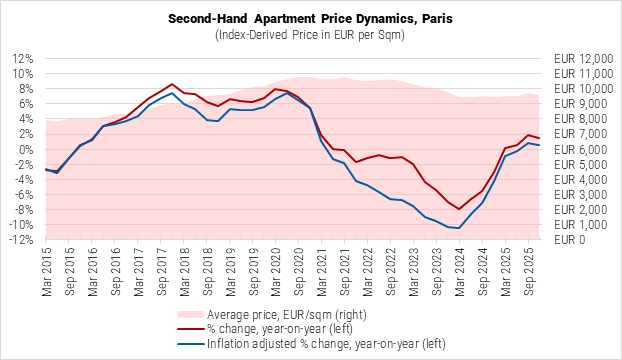
Data Source: Notaries of Greater Paris.
A notable feature of the current pricing environment is the shift in bargaining conditions. The market has become more favorable to buyers, with price negotiations playing a larger role, especially for homes requiring improvements. At the same time, price dispersion is widening by property quality, as higher renovation costs and energy-performance considerations are translating into larger discounts for “capex-heavy” assets, reinforcing a more selective price discovery process across the existing stock.
Looking ahead, Notaries of Greater Paris expect 2026 to extend market stabilization, describing it as “a year without any particular surge in enthusiasm,” with moderate movements in prices and improved visibility. National Real Estate Federation of France’s (FNAIM) latest benchmark points to similarly contained dynamics: as of 1 January 2026, its national average price stood at EUR 3,005 (USD 3,496) per square meter, up 0.8% year-on-year, and the federation expects prices in 2026 to remain oriented upward but in a contained manner (+1% to +2%).
Historic Perspective:
Market Cycles Responsive to Global Economic Conditions and Government Measures
After the post-1990s recovery, France entered a prolonged upswing that culminated in the mid-2000s. Price growth accelerated into 2006–2007, underpinned by favorable credit conditions, improving household confidence, and a policy environment that actively supported investment demand and new development, allowing the market to absorb rising volumes without immediate price fatigue.
The global financial crisis marked a clear turning point. From late 2008, tighter financial conditions and weaker sentiment triggered a correction in transaction pricing, while construction activity retrenched as developers reassessed risk and feasibility. A short, cyclical recovery followed through 2010–2011, supported by the broader economic rebound and initially accommodative financing conditions.
From 2012 to 2015, the market moved into a softer phase, reflecting weaker demand momentum and a less supportive investment backdrop, including reduced fiscal incentives and a more cautious credit environment. Prices drifted down gradually rather than sharply, consistent with a slow adjustment in a relatively resilient owner-occupier market.
From 2016, the cycle shifted back to expansion. Price growth resumed and remained firm through the pandemic period, when demand proved unusually resilient while supply remained constrained, reinforcing upward pressure in much of the existing stock. The cycle turned again from 2022 as the rapid tightening in monetary conditions coincided with a high-inflation environment: nominal price gains faded, real prices declined, and the adjustment deepened through 2023–2024 as affordability constraints intensified and market liquidity weakened.
By 2025, the market had moved into a clearer stabilization phase. Prices returned to modest nominal growth with broadly flat real dynamics, signaling a normalization of conditions rather than a renewed upswing. On the supply side, the post-2022 environment was associated with a pronounced deterioration in development activity, reflecting higher financing and construction costs and more challenging project economics, leaving the pipeline tight and limiting the scope for a rapid, supply-led rebalancing.
20-year annual house price change (based on the end-of-year price index of second-hand dwellings), Metropolitan France:
| Year | Nominal house prices (%) |
Inflation-adjusted house prices (%) |
Year | Nominal house prices (%) |
Inflation-adjusted house prices (%) |
|
| 2006 | 9.91% | 8.49% | 2016 | 1.50% | 0.99% | |
| 2007 | 5.47% | 3.05% | 2017 | 3.25% | 2.09% | |
| 2008 | -3.75% | -5.41% | 2018 | 3.24% | 1.32% | |
| 2009 | -4.09% | -4.44% | 2019 | 3.79% | 2.68% | |
| 2010 | 7.60% | 5.85% | 2020 | 6.41% | 6.32% | |
| 2011 | 3.68% | 1.21% | 2021 | 7.02% | 4.19% | |
| 2012 | -1.96% | -3.44% | 2022 | 4.61% | -1.38% | |
| 2013 | -1.81% | -2.45% | 2023 | -3.88% | -7.33% | |
| 2014 | -2.52% | -2.78% | 2024 | -2.18% | -3.40% | |
| 2015 | -0.50% | -0.60% | 2025 | 1.11% | 0.23% | |
| Data Sources: INSEE, OECD, Global Property Guide. | ||||||
20-year construction activity dynamic (authorized and started housing units), France:
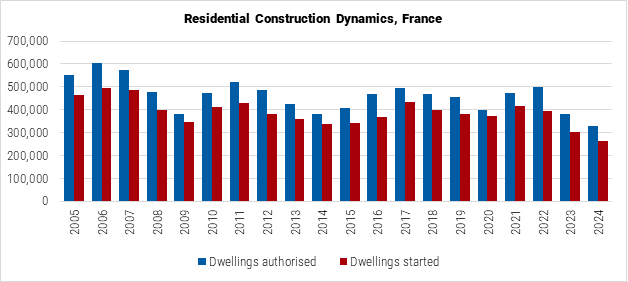
Data Source: INSEE.
Property Demand Trends
Owner-Occupier Demand Supports Recovery While Investor Activity Stays Weak
Housing demand in France showed a modest recovery in 2025, led by the existing-home segment, but the rebound remained gradual rather than broad-based. According to the Inspectorate-General for the Environment and Sustainable Development (IGEDD), the 12-month volume of existing-home transactions over the twelve months to December 2025 reached 945,000, up 11.83% year-on-year and marking the tenth consecutive month of increase. Despite this improvement, market activity remains well below the highs of the previous cycle, with transaction volumes still around one-quarter below the peak recorded in 2021.
The Superior Council of Notaries (CSN) frames the current phase as a recovery in activity, but at a slower pace and closer to normalization than a full cyclical restart. Demand is increasingly driven by owner-occupiers, who are gradually returning to the market, while private investors remain markedly more cautious. The notaries emphasize that housing continues to be perceived by households as a long-term safe-haven asset; however, rental investment demand remains constrained by a regulatory and tax environment widely viewed as unstable and insufficiently supportive.
Looking ahead, FNAIM expects the recovery in the existing-home market to continue in 2026, with transactions projected at 960,000-980,000, stressing fragility and dependency on policy clarity, particularly with respect to taxation and the broader housing agenda. As noted by the President of FNAIM, Loïc Cantin, the market is showing signs of improvement, but without political stability and a coherent long-term housing strategy, it may not be strong enough to reverse the sector’s deeper structural pressures.
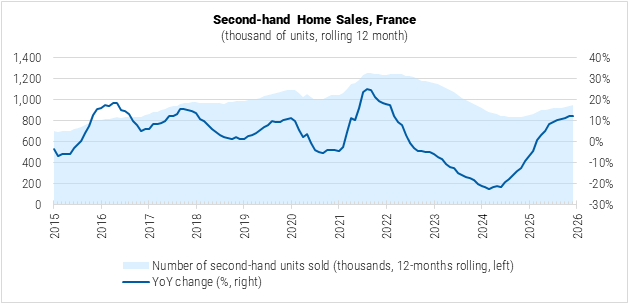
Data Source: IGEDD.
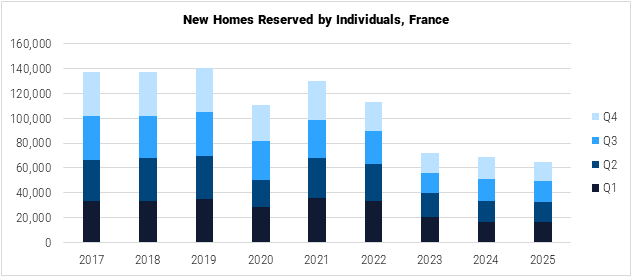
By contrast, demand in the new-build segment has yet to stabilize on a sustained positive trajectory. According to the Statistical Data and Studies Department (SDES), new-home reservations by individual buyers totaled 64,867 units in 2025 (seasonally and working-day adjusted), down 6.07% year on year. The Federation of Real Estate Developers (FPI) describes 2025 as a difficult year for new collective housing, citing three main headwinds: international uncertainty, persistent domestic political uncertainty, and the end of the Pinel scheme, which significantly reduced private-investor demand.
Data Source: SDES.
Regional dynamics, however, were not uniformly weak. Reservations by individual buyers increased in three of France’s 13 regions, with the strongest gains recorded in Grand Est (+13.89%) and Corsica (+13.03%). Île-de-France remained broadly stable, with 19,132 reservations (-0.41% year on year), and continued to account for roughly 30% of national demand. Overall, this regional dispersion suggests that owner-occupier demand is recovering selectively, but not yet strongly enough to offset the structural weakness in investor-led absorption at the national level.
New homes reserved by individuals by region, Metropolitan France:
| Region | Number of dwellings reserved, 2025 |
YoY, % |
| Auvergne-Rhône-Alpes | 10,648 | -1.40% |
| Bourgogne-Franche-Comté | 1,107 | -8.59% |
| Brittany | 3,736 | -2.28% |
| Centre-Val de Loire | 1,253 | -26.68% |
| Corsica | 694 | 13.03% |
| Grand Est | 4,772 | 13.89% |
| Hauts-de-France | 2,629 | -23.29% |
| Île-de-France | 19,132 | -0.41% |
| Normandy | 2,380 | -15.15% |
| Nouvelle-Aquitaine | 4,619 | 0.83% |
| Occitania | 5,434 | -26.66% |
| Pays de la Loire | 3,358 | -11.45% |
| Provence-Alpes-Côte d'Azur | 5,080 | -7.55% |
| Data Source: SDES. | ||
Property Supply Trends
Permit Growth Returned, Though Production Pace Remains Fragile
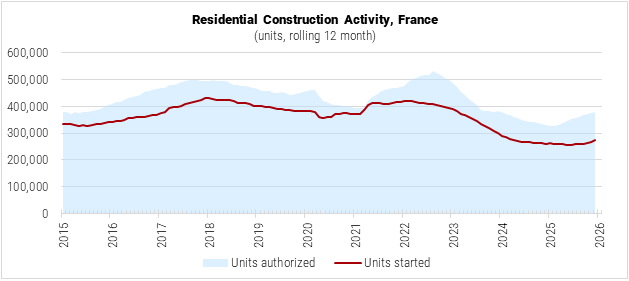
France’s residential supply indicators improved in 2025, but the recovery remained uneven and still below a normalized production pace. According to SDES, housing authorizations rose to 379,222 dwellings in 2025, up 15.02% year on year, while remaining 8.8% below the average level of the previous five years. Housing starts also increased, but more moderately, to 274,611 dwellings (+5.40% year on year), indicating that the rebound in permits is only gradually feeding through into actual construction activity.
Banque des Territoires noted that real estate conditions were “resilient” but still at “reduced activity levels” in a context of high uncertainty, while the French Building Federation (FFB) stressed that the improvement seen in 2025 was only relative and primarily served to “limit the damage,” rather than signal a return to normal production levels.
Data Source: SDES.
Île-de-France remained the largest residential construction market in Metropolitan France in 2025, with 63,444 dwellings authorized and 46,926 dwellings started, equivalent to around 17% and 18% of the metropolitan totals, respectively. Regionally, the recovery was broad but uneven: eight of the 13 metropolitan regions recorded year-on-year growth in both authorizations and starts, while several others showed a stronger rebound in permits than in actual starts, pointing to a still-gradual conversion of pipeline gains into construction activity.
Residential construction activity by region, Metropolitan France:
| Region | Number of dwellings authorized, 2025 |
YoY, % | Number of dwellings started, 2025 |
YoY, % |
| Auvergne-Rhône-Alpes | 51,516 | 18.75% | 32,685 | -0.08% |
| Bourgogne-Franche-Comté | 10,043 | 25.96% | 7,060 | -3.45% |
| Brittany | 29,843 | 26.46% | 22,459 | 10.76% |
| Centre-Val de Loire | 9,916 | 0.63% | 8,365 | 12.31% |
| Corsica | 3,757 | -1.21% | 1,936 | -0.77% |
| Grand Est | 24,937 | 7.70% | 18,280 | 1.90% |
| Hauts-de-France | 24,987 | 7.03% | 18,077 | -5.11% |
| Île-de-France | 63,444 | 18.52% | 46,926 | 13.53% |
| Normandy | 17,703 | 15.25% | 11,872 | 8.42% |
| Nouvelle-Aquitaine | 38,510 | 10.24% | 28,092 | 15.79% |
| Occitanie | 39,135 | 20.16% | 27,249 | -1.24% |
| Pays de la Loire | 26,363 | 33.25% | 20,461 | 8.97% |
| Provence-Alpes-Côte d'Azur | 27,173 | 7.25% | 20,305 | 1.69% |
| Data Source: SDES. | ||||
Looking ahead, the supply outlook for 2026 remains positive but conditional. In its 2026 forecasts, the FFB projects a “slight rebound without a real recovery” for the broader building sector and expects new-housing activity to improve, with housing starts rising to around 296,000 units in 2026. At the same time, the Federation stresses that this scenario is conditional on policy implementation, particularly the definitive adoption and rollout of private landlord status within the 2026 finance framework, as well as a stable macro-financial environment. FPI similarly argues that the market is “ready to restart,” but that a broader recovery still depends on a supportive investor framework.
Rental Market: Rents and Rental Yields
Slower Rental Growth in the Private Sector and Tightening Supply
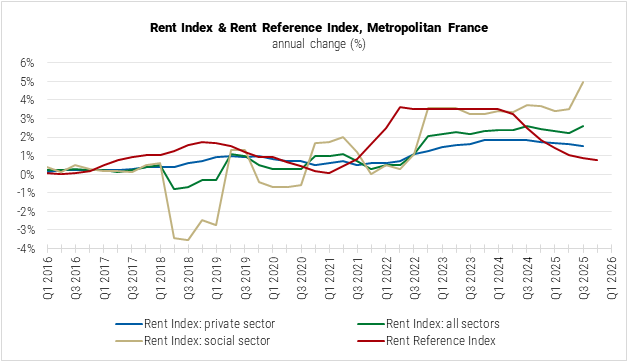
In the third quarter of 2025, rental inflation in Metropolitan France, measured by the INSEE rent index, demonstrated diverging trajectories for private and social rental sectors. The social sector continued to demonstrate a more pronounced and accelerating growth of 5.0% year-on-year (up from 3.5% in Q2 and 3.4% in Q1), while growth in the private sector actually slowed somewhat to 1.5% year-on-year (compared to 1.6% in Q2 and 1.7% in Q1). As a result, the overall rent index accelerated from previous quarters and registered a 2.6% year-on-year increase, returning to its peak growth level previously observed in 2023.
France's rent price index:
Rental growth in the Paris conurbation in Q3 2025 reflected the nationwide trends, the index recording a 2.6% year-on-year increase for both sectors combined, 1.2% for the private sector, and 4.8% for the social sector.
In parallel, the INSEE rent reference index (a forward-looking indicator based on the overall consumer price inflation trend in the country and used to determine the allowed rent increases under existing contracts in the private sector) continued to decelerate after being released from the 3.5% annual growth cap previously established by the government for Q3 2022 — Q1 2024, dropping to 0.79% in Q4 2025.
“The year 2025 marks a turning point in the French private rental market,” Journal de l’Agence wrote on recent developments. “After several years of intense pressure, rental tension is easing <…> and rent increases are slowing, suggesting a still fragile but noticeable lull.”
Data Source: INSEE.
In nominal terms, according to the real estate investment firm Catella, in Q3 2025, the average asking rents per square meter of apartment on offer reached EUR 31.50 (USD 36.80) in Paris, EUR 20.10 (USD 23.48) in Nice, and EUR 17.80 (USD 20.79) in Toulouse, while other major French cities such as Marseille, Lyon, Bordeaux, Montpellier, and Nantes remained more affordable with average apartment rents about EUR 15-17 per square meter. Prime yields in key French submarkets are estimated by Catella within the range from 3.9% in Paris to 5.1% in Lyon.
Moderate Rental Yields
The research conducted by Global Property Guide in December 2025 showed gross rental yields for residential units in France at the average level of 4.84%, up from 4.63% previously reported in June and 4.70% in December 2024. The highest potential performance among the surveyed submarkets was estimated for rental properties in Marseille (5.45%), Paris (5.24%), and Nantes (5.00%), while the lowest yields were recorded in Lyon (4.41%).
Average asking rents in selected submarkets:
| Average apartment rent, EUR/sqm Q3 2025 |
Average apartment rent, USD/sqm Q3 2025 |
YoY, Q3 2025 vs Q3 2024 |
|
| Paris | EUR 31.50 | USD 36.80 | 2.9% |
| Toulouse | EUR 17.80 | USD 20.79 | 1.7% |
| Bordeaux | EUR 15.75 | USD 18.40 | 7.9% |
| Marseille | EUR 16.50 | USD 19.27 | 8.2% |
| Nice | EUR 20.10 | USD 23.48 | 0.0% |
| Lyon | EUR 17.10 | USD 19.97 | 5.6% |
| Montpellier | EUR 15.50 | USD 18.11 | 10.7% |
| Nantes | EUR 15.35 | USD 17.93 | 8.9% |
| Note: Exchange rate as of Q3 2025, EUR 1 = USD 1.1681. | |||
| Data Source: Catella. | |||
Overall, the heavily regulated French rental market continues to tighten, supply not catching up to a large and expanding pool of renters (38.3% of households as of 2024, according to Eurostat figures). Local experts indicate structural issues constraining new development and shrinking the existing supply.
“Rental investment continues to suffer from an unstable, opaque, and deliberately unincentivizing regulatory and fiscal framework,” said the latest analysis from CSN.
“Rental supply is falling, particularly in major cities, with a rise in long-term furnished accommodation at the expense of unfurnished rentals,” FNAIM noted earlier last year.
In their 2025 annual report, Foncia, a large rental management company, highlighted a “staggering” 7% decline in the stock of available rental properties over just twelve months. The trend is attributed to landlords withdrawing their properties from the market in favor of selling them due to regulatory constraints and declining profitability.
Among other substantial factors impacting rental housing stock in France are the issue of energy standards compliance (starting from 2025, homes rated G in the Energy Performance Diagnostic (DPE) can no longer be rented, with F-rated properties to follow in 2028, and E-rated by 2034), the end of the tax reduction scheme for rental property investments under the Pinel law (no longer available since January 2025), and the growing number of short-term rental properties across France (now under stricter regulation under the so-called Le Meur law).
Mortgage Market and Interest Rates
Interest Rates Stabilize, Recovery in Loan Production Continues
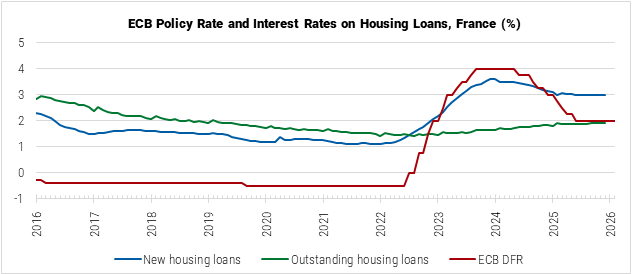
Interest rates on housing loans in France remained relatively stable in the second half of 2025, reflecting the stabilization of the European Central Bank’s (ECB) monetary policy in recent months, with key rates on hold since June 2025 and no further moves announced at the February 2026 meeting of the Governing Council.
France's mortgage loan interest rates:
As of December 2025, the average interest rate on loans to households for house purchase in France stood at 2.99% for new loans and 1.93% for outstanding loans, the indicator for both credit categories showing only marginal movement over the last six months. With the European regulator likely to keep its rates on hold at least until the end of the year, the broader consensus among local experts is that dramatic mortgage rate swings are unlikely in 2026 absent a significant economic shock. However, other factors beyond the ECB’s monetary policy, such as the dynamics in the 10-year French government bond and competition among lenders, could impact mortgage rates in the market, which is primarily focused on fixed-rate loans.
“The current stability of interest rates could give way to a slight increase by the end of [2025], continuing into 2026. Aware of the deteriorating economic and financial environment, a growing number of French consumers now consider an interest rate above 3% acceptable,” noted the economists from the BPCE banking group in their recent review of the housing market.
Similarly, the mortgage broker Pretto expects no sharp increases in the upcoming months, but stipulates that “moderate adjustments remain possible depending on the economic and political climate”.
At the same time, the mortgage market monitoring platform Crédit Logement/CSA Observatory offers a more pessimistic forecast, anticipating a continued rise in interest rates in the next two years against the backdrop of a weaker economic environment in France.
Data Source: ECB.
Average interest rates on loans to households for house purchase:
| Dec 2025 | YoY | Dec 2024 | YoY | Dec 2023 | |
| New housing loans | 2.99% | ↓ | 3.14% | ↓ | 3.60% |
| - Floating rate and IRF up to 1 year | 3.47% | ↓ | 3.82% | ↑ | 3.75% |
| - IRF of over 1 and up to 5 years | 3.26% | ↓ | 3.40% | ↓ | 3.79% |
| - IRF of over 5 and up to 10 years | 2.32% | ↓ | 2.73% | ↓ | 2.94% |
| - IRF of over 10 years | 3.00% | ↓ | 3.12% | ↓ | 3.62% |
| Outstanding housing loans | 1.93% | ↑ | 1.82% | ↑ | 1.63% |
| - Original maturity up to 1 year | 3.06% | ↓ | 3.35% | ↑ | 2.60% |
| - Original maturity over 1 and up to 5 years | 2.72% | = | 2.72% | ↑ | 2.18% |
| - Original maturity of over 5 years | 1.93% | ↑ | 1.81% | ↑ | 1.63% |
| Data Source: ECB. | |||||
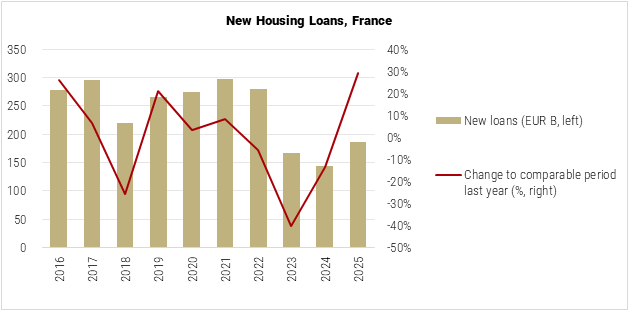
The easing from 2023-2024 peak levels and consequent stabilization of interest rates continued to support a revival in pure new lending and the overall new loan production in France. After three years of declines, the total value of new loans to households for house purchase in the country demonstrated positive development in 2025, reaching EUR 186.9 billion (USD 211.2 billion), which was still substantially below the pre-2022 baseline but a solid 29.3% increase compared to 2024.
“This rebound reflects a much more favorable environment for borrowers <…> and the recovery in property transactions. The survey of banks on credit distribution confirms an increase in demand for home loans from households, coinciding with a relaxation of mortgage lending criteria by credit institutions,” the Bank of France commented in its latest overview of household housing loans.
Data Source: ECB.
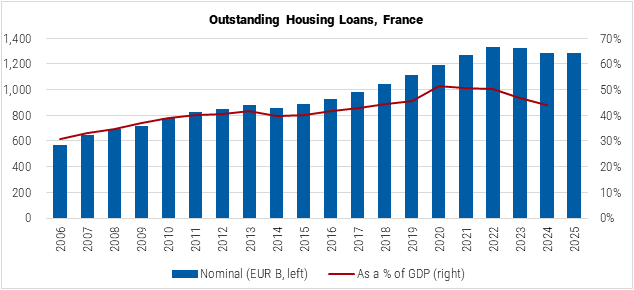
A pick-up in new lending in 2025 appears to have also halted the declines in the overall size of the mortgage stock in France observed in the previous two years. Based on the ECB figures, at the end of 2025, the total value of outstanding housing loans showed virtually no annual variation compared to the end of 2024, standing at EUR 1.29 trillion (USD 1.46 trillion).
In the meantime, the relative size of the French housing loan market, measured by the credit stock-to-GDP ratio, fell from its peak of an estimated 51.4% of GDP at current prices in 2020 to an estimated 44.1% in 2024. “The ratio of outstanding household housing loans to GDP has been declining in France since mid-2022,” the Bank of France noted. ”While this decline is slightly more pronounced in France than in the eurozone average <…>, the ratio remains significantly higher than that of our main European neighbors.”
According to the latest figures from Eurostat, 31.2% of French households are homeowners with an outstanding mortgage or housing loan.
Data Source: ECB.
Economic and Social Factors
Slow-Paced Growth Amid Elevated Domestic Uncertainty
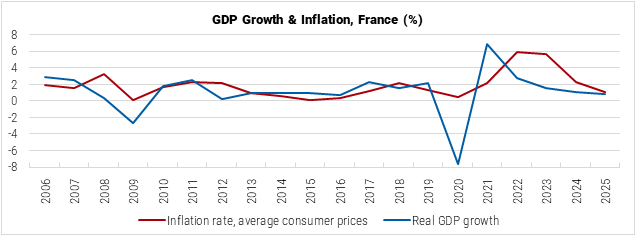
Elevated domestic uncertainty, marked by two Prime Ministerial resignations, as well as fiscal adjustment, subdued the French economy in 2025, with real GDP growth slowing further from 1.1% in 2024 to an estimated 0.8% in 2025. As these factors are expected to continue weighing on growth, the European Commission projects only slight acceleration over the next two years, with the economy expanding by 0.9% in 2026 and 1.1% in 2027.
Consumer price index (CPI) inflation in the country eased from an average annual level of 2.3% in 2024 to 1.1% in 2025 and was most recently reported by the INSEE at just 0.3% in January 2026.
On the back of higher agricultural and food prices, as well as the anticipated entry into force of ETS2, which would lift energy prices, inflation is expected to re-accelerate to 1.3% in 2026 and 1.8% in 2027, according to the European Commission.
Data Source: IMF.
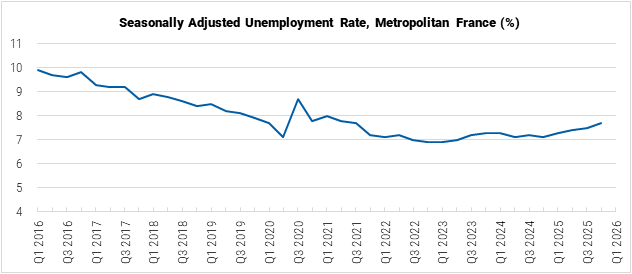
The French labor market has shown overall resilience amid successive shocks in recent years, “bending but not breaking”, as described by the Bank of France, despite signs of softening emerging in 2025, with employment growth moderating and unemployment rate trending upwards. Most recently, the seasonally adjusted ILO unemployment rate in Metropolitan France was reported by the INSEE at 7.7% in Q4 2025, up from 7.1% in Q4 2024. The European Commission expects the unemployment rate to continue increasing in the next two years, reaching 8.2% in 2027.
In public finances, the French government’s revenue-increasing and expenditure-decreasing measures facilitated the decline in the general government deficit from 5.8% of GDP in 2024 to 5.5% in 2025 and projected 4.9% in 2026. At the same time, driven by high primary deficits and rising interest payments, the country’s gross public debt is projected to keep increasing over the forecast horizon, reaching 120% of GDP by 2027.
Data Source: INSEE.
Overall, while the French economy continues growing, deepening geoeconomic fragmentation and domestic policy uncertainty continue to pose significant downside risks to the outlook. “At the international level, US trade policy remains a source of uncertainty, even if it has diminished. Added to this is the risk of a correction in the valuations of US companies linked to artificial intelligence (AI), which could spread to European markets. <…> At the domestic level, political and fiscal uncertainty remains high, raising questions about France’s fiscal and tax trajectory and its ability to stabilize the public debt ratio,” said the Bank of France in the latest edition of its macroeconomic projections.
Based on a high and rising debt ratio and elevated risks to budgetary consolidation due to political fragmentation, among other factors, in September 2025, Fitch Ratings downgraded France’s sovereign credit rating from ‘AA-’ to ‘A+’ with a stable outlook. Similarly, S&P lowered France’s rating to ‘A+’ in October 2025.
Sources:
- National Institute of Statistics and Economic Studies (INSEE)
- In Q4 2025, Prices Of Second-Hand Dwellings Went Up (+0.5%): https://www.insee.fr/
- House Prices in France: Property Price Index, French Real Estate Market Trends in the Long Run: https://www.igedd.developpement-durable.gouv.fr/
- Between July and October 2025, Rents Increased by 0.7%: https://www.insee.fr/
- In Q4 2025, the Housing Rent Reference Index Increased by 0.79% Over a Year: https://www.insee.fr/
- In January 2026, Consumer Prices Rose by 0.3% Year on Year: https://www.insee.fr/
- In Q4 2025, the Unemployment Rate Stood at 7.9%…: https://www.insee.fr/
- European Central Bank (ECB)
- ECB Data Portal: https://data.ecb.europa.eu/
- Key ECB Interest Rates: https://www.ecb.europa.eu/
- Monetary Policy Decisions, 5 February 2025: https://www.ecb.europa.eu/
- Bank of France
- Bank of France Data Portal: https://webstat.banque-france.fr/
- Loans to Individuals, France 2025-12: https://www.banque-france.fr/
- Overview of Household Housing Loans – October 2025: https://www.banque-france.fr/
- Macroeconomic Projections – December 2025: https://www.banque-france.fr/
- Legal and Administrative Information Department
- Real Estate Rental (FR): https://www.service-public.fr/
- Rent Reference Index (IRL) (FR): https://www.service-public.fr/
- Rental Investment Schemes (FR): https://www.service-public.fr/
- Real Estate Diagnostics: Energy Performance Diagnostics (EPD) (FR): https://www.service-public.fr/
- Legifrance
- Law no. 2024-1039 of November 19, 2024, Aimed at Strengthening the Regulatory Tools for Furnished Tourist Accommodation at the Local Level (FR): https://www.legifrance.gouv.fr/
- Statistical Data and Studies Department (SDES)
- Housing Construction. Results at the end of December 2025: https://www.statistiques.developpement-durable.gouv.fr/
- Marketing Of New Housing - Sale To Individuals in the 4th Quarter of 2025 (FR): https://www.statistiques.developpement-durable.gouv.fr/
- Inspectorate-General for the Environment and Sustainable Development (IGEDD)
- House Prices in France: Property Price Index, French Real Estate Market Trends in the Long Run: https://www.igedd.developpement-durable.gouv.fr/
- International Monetary Fund (IMF)
- Country Overview: France: https://www.imf.org/
- 2025 Article IV Staff Report: https://www.imf.org/
- World Economic Outlook Update, January 2026: https://www.imf.org/
- European Commission
- Economic Forecast for France: https://economy-finance.ec.europa.eu/
- Distribution of Population by Tenure Status, Type of Household, and Income Group: https://ec.europa.eu/
- Superior Council of Notaries (CSN)
- Real Estate Market Outlook for January 2026 and Q3 2025 (FR): https://www.notaires.fr/
- Notaries of Greater Paris
- The Greater Paris Real Estate Market: 2025 Review, Q4 and Outlook (FR): https://notairesdugrandparis.fr/
- French Building Federation (FFB)
- 2025 Review and 2026 Forecast… (FR): https://www.ffbatiment.fr/
- National Real Estate Federation of France (FNAIM)
- Fragile Market Recovery, Political Inertia and a Supply Crisis… (FR): https://www.fnaim.fr/
- Housing Market: Recovery Subject to Conditions (FR): https://www.fnaim.fr/
- BPCE Group
- 2025 Review and 2026 Outlook for Residential Real Estate in France (FR): https://www.groupebpce.com/
- Pretto
- Mortgage Rates: What to Expect by Summer (FR): https://www.pretto.fr/
- Crédit Logement/CSA Observatory
- Q4 2025 Report (FR): https://www.lobservatoirecreditlogement.fr/
- Foncia
- Real Estate Market 2025… (FR): https://pressroom.foncia.com/
- Journal de l’Agence
- Rental Market: First Lull in Six Years According to the 2026 LocService Observatory (FR): https://www.journaldelagence.com/
- Federation of Real Estate Developers (FPI)
- Press Release: Chin Up! (FR): https://fpifrance.fr/
- Banque des Territoires
- Real Estate Market Outlook for Q3 2025 (FR): https://www.banquedesterritoires.fr/
- Fitch Ratings
- Fitch Downgrades France to 'A+'; Outlook Stable: https://www.fitchratings.com/
- S&P Global
- France Ratings Lowered…: https://www.spglobal.com/
- Catella
- European Residential Market Overview Q3/2025: https://www.catella.com/
- Les Echos
- Rental Property: Why Landlords no Longer Believe in It (FR): https://www.lesechos.fr/
- Le Monde
- French Parliament Passes Law to Tighten Airbnb Regulation: https://www.lemonde.fr/