Germany's Residential Property Market Analysis 2026
After a previous period of sharp correction, sales prices in the German housing market returned to moderate, selective growth against the background of weak new construction, rising financing costs, and affordability constraints.
This extended overview from Global Property Guide covers key aspects of the German housing market and takes a closer look at its most recent developments and long-term trends.
Table of Contents
- Property Prices and Price Index
- Historic Perspective
- Property Demand Trends
- Rental Market: Rents and Rental Yields
- Mortgage Market and Interest Rates
- Economic and Social Factors
Property Prices and Price Index
Germany’s residential sales prices returned to growth in 2025 after the sharp correction of 2022–2024, but the rebound remained moderate and increasingly selective. Price support came mainly from weak new construction and persistently high replacement costs, while affordability pressures and still-elevated financing costs continued to restrain stronger price acceleration.
According to preliminary results by the Federal Statistical Office (Destatis), the House Price Index rose by 3.0% year-on-year in Q4 2025, marking the fifth consecutive quarter of annual growth. For 2025 as a whole, residential property prices increased by 3.2%, marking the first full-year rise since 2022.
Germany's house price annual change:
More recent GREIX data, however, suggest that the recovery also became less uniform. In Q1 2026, apartment prices were only 0.5% higher year-on-year, while single-family homes increased by a stronger 3.2%. GREIX Project Lead Jonas Zdrzalek described the market as divided, noting that price momentum for apartments is “losing steam noticeably,” while single-family homes remain on a growth path. The figures point to a shift from the broad stabilization seen in 2025 toward a more segmented market in 2026, where price performance increasingly depends on property type, location, affordability, and asset quality.
Listing-based data from VALUE Marktdatenbank also indicates a market that is still moving upward, but with less consistent momentum across segments and locations. VALUE described the start of 2026 as a market with “tailwind — but without clear direction,” noting that price levels remained stable to rising after the 2025 recovery, while divergence between submarkets became more visible. In Q1 2026, the nationwide median asking price for existing apartments reached EUR 3,532 (USD 4,133) per square meter, up 3.9% year-on-year, while new-build apartments stood at EUR 5,683 (USD 6,651) per square meter, up 3.4%. Quarterly growth was more restrained, at 0.3% for existing apartments and 0.5% for new builds, reinforcing the view that prices are rising again, but without strong short-term acceleration.
Median asking price in the ten largest cities:
| Existing Apartments, Q1 2026, EUR/sqm |
Existing Apartments, Q1 2026, USD/sqm |
YoY, % | Newly Built Apartments, Q1 2026, EUR/sqm |
Newly Built Apartments, Q1 2026, USD/sqm |
YoY, % | |
| Berlin | EUR 5,533 | USD 6,475 | 1.6% | EUR 8,300 | USD 9,713 | -0.6% |
| Hamburg | EUR 5,918 | USD 6,926 | 6.4% | EUR 8,656 | USD 10,130 | 0.3% |
| Munich | EUR 8,588 | USD 10,051 | 1.2% | EUR 11,237 | USD 13,151 | -2.3% |
| Cologne | EUR 4,980 | USD 5,828 | 3.4% | EUR 7,090 | USD 8,297 | 2.7% |
| Frankfurt | EUR 6,167 | USD 7,217 | 1.3% | EUR 8,185 | USD 9,579 | 0.2% |
| Stuttgart | EUR 4,582 | USD 5,362 | 1.2% | EUR 8,449 | USD 9,888 | 1.6% |
| Dusseldorf | EUR 4,884 | USD 5,716 | 6.2% | EUR 7,444 | USD 8,712 | -3.9% |
| Dortmund | EUR 2,500 | USD 2,926 | 2.9% | EUR 4,119 | USD 4,820 | -1.5% |
| Essen | EUR 2,592 | USD 3,033 | 6.3% | EUR 5,427 | USD 6,351 | 1.9% |
| Leipzig | EUR 3,038 | USD 3,555 | 1.5% | EUR 5,300 | USD 6,203 | 2.0% |
| Nationwide | EUR 3,532 | USD 4,133 | 3.9% | EUR 5,683 | USD 6,651 | 3.4% |
| Note: Exchange rate as of Q1 2026, EUR 1 = USD 1.1703. | ||||||
| Data Source: VALUE Marktdatenbank. | ||||||
The supply-side backdrop remains an important stabilizing factor for sales prices. New construction continues to be constrained by high building costs, weak project economics, and subdued development activity. VALUE noted that many new-build projects are still being calculated close to the threshold of economic viability, helping to explain why new-build prices have remained relatively firm despite weaker affordability conditions. At the same time, price formation is becoming more quality-sensitive, with energy-efficient and well-located properties proving more resilient, while older or less efficient stock remains more exposed to discounts as buyers factor in renovation costs and future energy-performance requirements.
The outlook remains positive but moderate. In the latest Reuters poll, analysts expected German home prices to rise by 3.3% in 2026, followed by increases of around 3.0% in both 2027 and 2028. ING’s Carsten Brzeski described the recovery as likely to continue but still “shaky,” citing cautious consumers, policy and geopolitical uncertainty, rising unemployment, and slower wage growth. At the same time, the structural housing shortage is seen to remain an important source of price support. LBBW’s Benedikt Horwedel noted that a noticeable easing is unlikely for several years, as completions in larger cities continue to fall well short of required levels.
Historic Perspective
From Long Stability to Rate-Driven Correction and Selective Recovery
In the 2000s, Germany was one of Europe’s least volatile housing markets. Prices moved only modestly for much of the decade, as conservative mortgage lending, a large rental sector, moderate wage growth, and the lingering effects of post-reunification overbuilding kept speculative pressure low. As a result, Germany avoided both the pre-2008 housing boom seen in several other European markets and the sharp correction that followed the global financial crisis.
The market began to change after 2010. Stronger labour-market conditions, urban population growth, and exceptionally favourable financing conditions gradually lifted demand, while housing supply adjusted only slowly. What began as a catch-up phase after years of stagnation developed into a sustained period of price growth, increasingly concentrated in large cities and economically strong regions.
Price upswing continued through the late 2010s and early 2020s, supported by very low interest rates and demand from both owner-occupiers and investors. By 2021–2022, however, affordability had become increasingly stretched, especially in the largest cities. When inflation accelerated and interest rates rose sharply, market momentum quickly weakened. Although annual average prices were still higher in 2022, the cycle had already turned by the end of the year, with residential property prices falling year-on-year in Q4 2022 for the first time since 2010.
The correction deepened in 2023, when Germany recorded the sharpest annual fall in residential property prices since the Destatis house price index series began. The adjustment was driven by the rapid repricing of debt: higher mortgage rates reduced purchasing power, investor demand weakened, and price expectations shifted after years of rapid appreciation. The decline continued into 2024 on an annual average basis, but the pace of correction eased as buyers and sellers adjusted to the new interest-rate environment.
By late 2024, prices had started to stabilize, and in 2025 the market returned to nominal growth. However, the current recovery is not a return to the previous boom: weak new construction and high replacement costs are supporting prices, while affordability constraints and still-elevated financing costs continue to keep growth moderate.
20-year annual house price change (based on end-of-year house price index and consumer price index):
| Year | Nominal house prices (%) | Inflation-adjusted house prices (%) | Year | Nominal house prices (%) | Inflation-adjusted house prices (%) | |
| 2006 | 1.22% | -0.07% | 2016 | 8.45% | 7.25% | |
| 2007 | -1.69% | -4.62% | 2017 | 6.25% | 5.04% | |
| 2008 | 0.25% | -1.35% | 2018 | 6.22% | 4.16% | |
| 2009 | 2.93% | 2.52% | 2019 | 6.50% | 5.19% | |
| 2010 | -0.48% | -1.83% | 2020 | 8.74% | 9.29% | |
| 2011 | 4.18% | 1.91% | 2021 | 12.61% | 7.55% | |
| 2012 | 4.93% | 2.86% | 2022 | -2.46% | -10.17% | |
| 2013 | 1.53% | 0.19% | 2023 | -7.63% | -10.80% | |
| 2014 | 3.44% | 2.92% | 2024 | 1.91% | -0.37% | |
| 2015 | 5.82% | 5.49% | 2025 | 3.02% | 0.83% | |
| Data Sources: Destatis, OECD, Global Property Guide. | ||||||
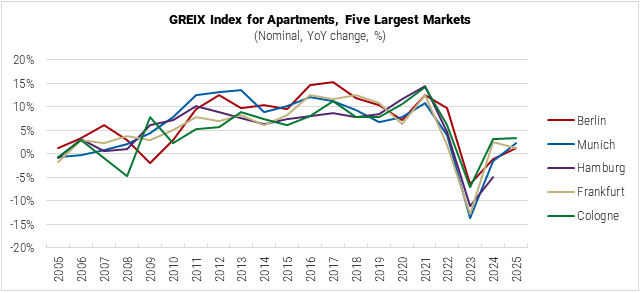
Note: Hamburg is shown through 2024 only, as 2025 GREIX apartment price data for the city were not available at the time of preparation.
Data Source: Kiel Institute for the World Economy.
Property Supply and Demand Trends
Housing Shortage Deepens Despite Signs of Pipeline Stabilization
Germany’s housing shortage deepened further in 2025, as the earlier collapse in building permits, high construction costs, and restrictive financing conditions increasingly translated into weaker housing delivery. According to Destatis, 206,600 dwellings were completed in 2025, down 18.0% year-on-year, following a 14.4% decline in 2024 and marking the lowest level since 2012. The weakness was not only the result of fewer projects entering the pipeline, but also of slower project execution: the average period between permit approval and completion lengthened to 27 months, compared with 20 months in 2020. At the same time, the construction backlog remained large, with 760,700 approved but not yet completed dwellings at the end of 2025, including 307,200 units already under construction.
Building permit activity has started to improve, but from a low base and with limited near-term impact on completed supply. The number of approved dwellings rose by 10.6% in 2025 to 238,100 units, exceeding completions but still falling well short of estimated housing need. The upward trend continued into early 2026, with 63,500 dwellings approved in January–March 2026, up 14.6% year-on-year. CBRE experts, however, note that developers continue to face elevated construction costs, restrictive financing conditions, and macroeconomic uncertainty, which helps explain why the improvement in permits has not yet translated into a recovery in actual delivery.
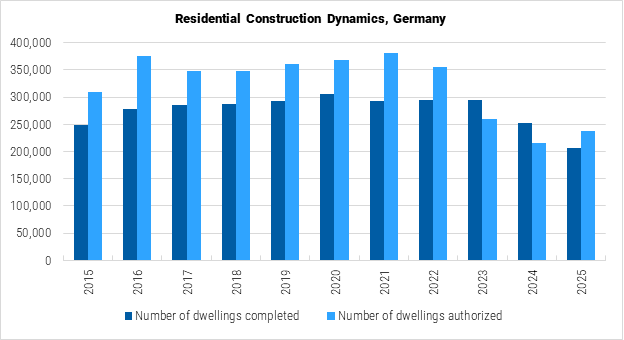
Note: Data includes dwellings in residential and non-residential buildings.
Data Source: Destatis.
At the same time, underlying housing need remains substantial, supported by household formation, replacement needs, accumulated undersupply, and the concentration of demand in economically strong urban markets. According to Destatis, Germany’s population declined slightly to around 83.5 million at end-2025, as lower net migration was no longer sufficient to offset the natural population decline. However, this has not materially eased housing pressure in the main urban markets.
The latest housing need forecast from the Federal Institute for Research on Building, Urban Affairs, and Spatial Development (BBSR) estimates that Germany will need around 320,000 new dwellings per year between 2023 and 2030, with a large part of the requirement driven by rising household numbers, replacement needs, and catch-up demand from earlier underbuilding. On this basis, 2025 completions covered only about two-thirds of the estimated annual need.
The shortage remains especially acute in large cities, where demand is more resilient and new supply remains structurally insufficient. BBSR estimates that the seven largest cities, including Berlin, Munich, Hamburg, Frankfurt, Stuttgart, Cologne, and Düsseldorf, require around 60,000 new dwellings per year, or roughly one-fifth of national housing need. Around 70% of the national new-build requirement is also expected to be in multi-family housing, underlining the importance of urban and rental-oriented supply.
This pressure is also reflected in rental-market vacancy indicators, which point to very limited available supply in the most constrained locations. BNP Paribas Real Estate’s rental housing analysis shows that Germany’s nationwide vacancy rate fell to 2.2% in 2024, below the 3% fluctuation reserve generally considered necessary for a functioning housing market, with vacancy in the Top-7 cities well below that level. CBRE similarly notes that market-active vacancy is often below 2% in metropolitan regions and in southern and western Germany, with rental housing supply remaining significantly constrained.
The near-term outlook for the supply-demand imbalance remains subdued. According to ifo/Euroconstruct, housing completions in Germany are expected to fall further to about 185,000 units in 2026, before recovering modestly to 205,000 in 2027 and 215,000 in 2028, still around 15% below 2024 levels. The federal government’s “construction turbo” (Wohnungsbau-Turbo), in force since 30 October 2025, may help accelerate approvals by allowing municipalities to approve additional housing more quickly, including in some cases without drawing up or amending a development plan. However, faster approvals alone are unlikely to resolve the main bottleneck: the weak financial viability of many residential projects under current cost and financing conditions. As a result, Germany’s supply-demand gap is expected to persist, particularly in large urban markets and in the rental-oriented multi-family segment.
Rental Market: Rents and Rental Yields
Continued Albeit Slower Growth in Rents, Regional Dynamics Vary
According to Eurostat figures, there are more tenants than homeowners in Germany, with the share of the population living in rented rather than owned residences up from 48.1% in 2015 to 52.8% in 2025. The consistently strong demand in the rental market continues to support rent increases nationwide, although the pace of growth has slowed.
Germany's rent price index:
The nationwide transaction-weighted annual apartment rent index published by the Deutsche Bundesbank (DB), based on data from the real estate research company Bulwiengesa, showed a more moderate 3.4% growth in 2025, compared to 3.7% in 2024 and 5.0% in 2023. For the 7 major cities (Berlin, Düsseldorf, Frankfurt, Hamburg, Cologne, Munich, and Stuttgart), the index recorded an even more notable slowdown from a 5.8% increase in 2023 to 3.4% in 2024 and 2.4% in 2024.
Rental inflation for existing contracts (as measured by the annual change in actual rentals for the housing component of the consumer price index) has been relatively stable over the past three years, most recently reported at 2.10% in April 2026.
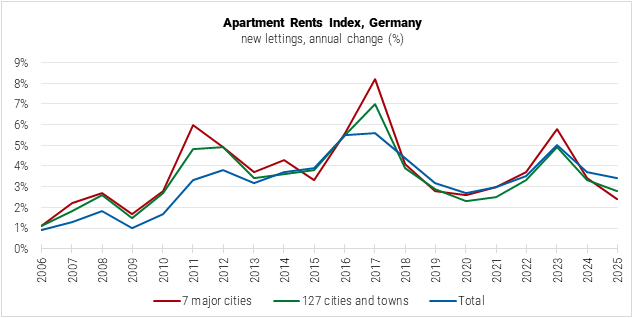
Data Source: Deutsche Bundesbank, based on data provided by Bulwiengesa.
The H2 2025 housing market overview from JLL also noted that there was a “clear weakening of market dynamics” in the country’s largest cities, compared to the previous year. At the same time, the report indicates significant regional differences observed across major cities. The strongest increase in rents was recorded in Hamburg, while Berlin still showed sideways movement, reflecting continued stabilization of the previously particularly dynamic submarket, as well as significant discrepancy in price dynamics between property categories, with rents for newly built apartments in notable decline and rents for existing apartments growing.
In nominal terms, Munich remained the most expensive among the major cities, with the median asking apartment rent reaching EUR 24.65 (USD 28.68) per square meter in H2 2025, according to JLL. Berlin followed with EUR 19.27 (USD 22.42) per square meter, while Leipzig recorded the most affordable median rent at EUR 11.00 (USD 12.80) per square meter.
Against this background, Global Property Guide research conducted in March 2026 found gross rental yields for apartments in Germany at an average of 3.42%, down from 3.83% reported a year earlier. Among the monitored regional submarkets, the highest potential performance was observed in Leipzig (4.99%), Berlin (4.76%), and Stuttgart (4.49%).
Median asking apartment rent in key submarkets:
| City | EUR/sqm, H2 2025 |
USD/sqm, H2 2025 |
YoY, % H2 2025 vs H2 2024 |
| Berlin | EUR 19.27 | USD 22.42 | 0.2% |
| Munich | EUR 24.65 | USD 28.68 | 5.7% |
| Hamburg | EUR 18.12 | 21.08 | 9.0% |
| Cologne | EUR 16.39 | 19.07 | 5.8% |
| Frankfurt | EUR 19.06 | 22.17 | 4.0% |
| Stuttgart | EUR 17.07 | 19.86 | 3.5% |
| Dusseldorf | EUR 15.48 | 18.01 | 6.7% |
| Leipzig | EUR 11.00 | 12.80 | 5.3% |
| Note: Exchange rate as of Q4 2025, EUR 1 = USD 1.1634. | |||
| Data Sources: JLL, VALUE Marktdaten. | |||
Looking ahead, rents in major German cities are expected to keep growing, with the dynamic in each submarket determined by the local demand-supply landscape.
“Demand for rental apartments remains high across Germany’s metropolitan regions, while new construction activity continues to lag behind requirements. Rental housing supply remains constrained, particularly in the affordable segment. <…> Rental growth momentum is expected to continue in 2026, as a noticeable supply expansion is not anticipated before 2027,” CBRE experts summarized in their Q1 2026 market overview.
To combat housing affordability issues, the new government that took office in Germany after the federal elections in early 2025 previously extended rent control measures for the major cities by another four years. The extension will maintain the cap for new contract rates in urban centers at 10% above the comparable rents in the area through 2029. The Ministry for Housing, Urban Development, and Building has also been reportedly considering additional measures, such as stricter rules on index-linked rents and curbs on furnished lets often used to bypass existing rent caps.
Mortgage Market and Interest Rates
Lending Activity Grows Despite Climbing Interest Rates
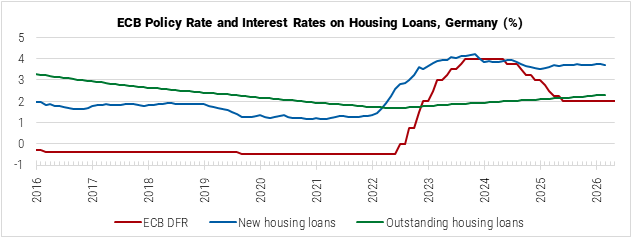
According to the European Central Bank (ECB), the average interest rate on new loans to households for house purchase in Germany reached 3.72% in March 2026, up from 3.60% during the same period last year. For outstanding housing loans, the average interest rate stood at 2.30%, also up from the comparable period in 2025.
Germany's mortgage loan interest rates:
The shift in rates dynamic that began in 2025 was attributed to the German government's landmark decision to reform the debt brake, which loosened the country’s borrowing limits and allowed for new investments in defense, infrastructure, and climate change mitigation. The consequent surge in the capital market interest rates, driven by rising expectations of government debt and improving growth prospects, in turn led to an upward fluctuation in mortgage rates.
More recently, against the background of higher inflation due to the ongoing conflict in the Middle East, capital markets began pricing in possible ECB hikes later this year, which put additional pressure on mortgage rates in the country.
The ECB has kept its key rates unchanged since June 2025, making no moves at the latest meeting of the monetary policy committee in April 2026. However, in a post-decision press statement, the regulator noted that upside risks to inflation and downside risks to growth have intensified, as the war in the Middle East has led to a sharp increase in energy prices, pushing up inflation and weighing on economic sentiment. Most economists polled by Reuters in May agreed that the ECB is likely to raise rates in June and possibly once more later in 2026 due to war-driven inflation pressures.
Data Source: ECB.
The general consensus among specialists is that mortgage interest rates in Germany are unlikely to return to pre-2022 levels any time soon. "We have to expect that, due to the increased issuance of government debt - and here we see a Europe-wide trend - yields on the bond markets will rise. As a result, mortgage interest rates in this country are likely to remain in a range between 3 and 4 percent," said Rainer Eichwede of the building society Bausparkasse Schwäbisch Hall, as cited by Berliner Morgenpost earlier last year.
The majority of experts on the mortgage broker’s Interhyp banking panel in May 2026 stated they expect rates to remain stable in the short term, but in the long term, rising mortgage rates are anticipated: “In the longer term, higher government bond yields and thus rising mortgage rates are likely due to the debt policies of states".
Average interest rates on loans to households for house purchase:
| Mar 2026 | YoY | Mar 2025 | YoY | Mar 2024 | |
| New housing loans | 3.72% | ↑ | 3.60% | ↓ | 3.83% |
| - Floating rate and IRF up to 1 year | 4.07% | ↓ | 4.41% | ↓ | 5.28% |
| - IRF of over 1 and up to 5 years | 3.63% | ↑ | 3.62% | ↓ | 4.09% |
| - IRF of over 5 and up to 10 years | 3.60% | ↑ | 3.39% | ↓ | 3.55% |
| - IRF of over 10 years | 3.74% | ↑ | 3.54% | ↓ | 3.61% |
| Outstanding housing loans | 2.30% | ↑ | 2.11% | ↑ | 1.96% |
| - Original maturity up to 1 year | 4.19% | ↓ | 4.63% | ↓ | 5.68% |
| - Original maturity over 1 and up to 5 years | 3.92% | ↑ | 3.89% | ↑ | 3.75% |
| - Original maturity of over 5 years | 2.27% | ↑ | 2.08% | ↑ | 1.93% |
| Data Source: ECB. | |||||
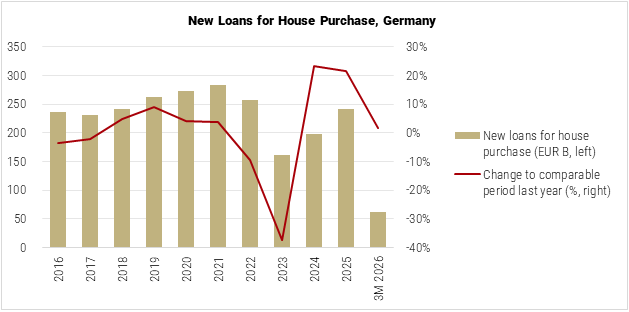
Even with somewhat higher interest rates, lending activity in Germany showed substantial rebound growth in 2025. Between January and December of last year, the total value of new housing loans issued by German banks reached EUR 240.9 billion (USD 272.2 billion), which was 21.4% more than during the same period in 2024, although still below pre-2022 levels. In early 2026, growth continued, although at a slower pace, with the value of new loans produced in the first three months of the year (EUR 61.9 billion / USD 71.5 billion) up 1.5% year-on-year. Of the total new business reported for the period, 80.4% was made up by pure new loans and 19.6% by renegotiations.
Data Source: ECB.
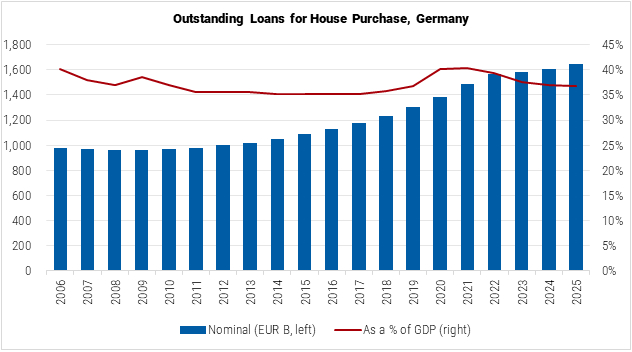
With lending activity in recovery, the expansion of Germany’s housing loan stock in the country re-accelerated, registering a 1.3% year-on-year growth in 2024 and 2.5% growth in 2025. As of March 2026, the total value of outstanding loans for house purchase maintained by German monetary financial institutions stood at EUR 1.65 trillion (USD 1.91 trillion), a further 0.3% increase since the beginning of the year.
The relative size of the market, represented by the ratio of outstanding loans to GDP at current prices, was most recently estimated at 36.1% in 2025, down from a decade peak of 40.4% in 2021. Based on Eurostat figures, 24.0% of the country’s population are homeowners with an outstanding mortgage or housing loan.
Data Source: ECB.
Economic and Social Factors
Weak Recovery Amid Renewed Inflation and Structural Pressures
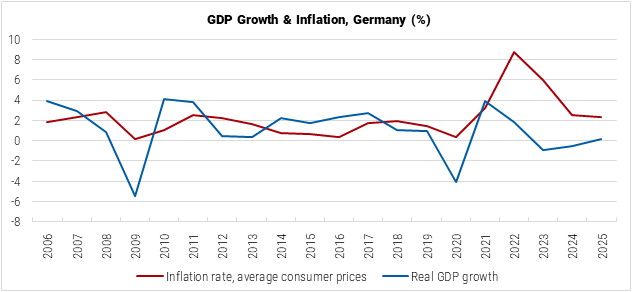
The German economy moved back into modest growth in 2025, but the recovery remains weak and uneven. After two consecutive annual contractions of 0.9% in 2023 and 0.5% in 2024, real GDP growth reached 0.2% in 2025, driven mainly by higher household and government consumption. Exports declined for the third consecutive year, while investment remained weak, particularly in machinery and equipment and construction. The European Commission’s spring forecast expects growth to strengthen only gradually, to 0.6% in 2026 and 0.9% in 2027, with higher public spending providing some momentum, while weak external demand and structural challenges continue to limit the recovery.
The consumer price index (CPI) inflation has moderated significantly from its 2022 peak, but renewed energy-price pressures have slowed the disinflation process. According to the IMF, Germany’s average consumer price inflation decelerated from 8.7% in 2022 to 2.3% in 2025, but is forecast to rise again to 2.7% in 2026. The most recent Destatis report showed the indicator at 2.9% in April 2026, up from 2.7% in March and 1.9% in February.
Data Source: IMF.
The period of weak economic growth is also increasingly visible in the labor market. According to the European Commission, lower labor demand is weighing on employment growth, with job losses in manufacturing expected to be only partly offset by gains in public services, education, and health. In March 2026, Destatis reported a nationwide seasonally adjusted unemployment rate at 4.0%. The Commission expects the indicator to remain around this level in 2026 before easing slightly to 3.9% in 2027, although population ageing is set to keep the labor force structurally tight.
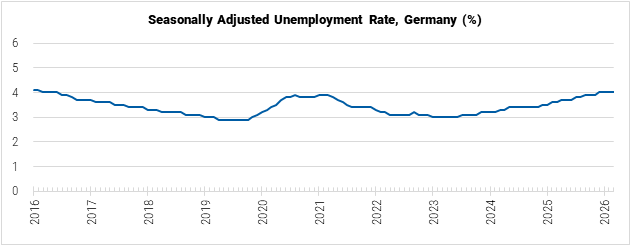
Data Source: Destatis.
Overall, Germany continues to face significant growth headwinds, including weaker manufacturing competitiveness, high energy and labor costs, rising competition from China, and the impact of US tariffs. Despite these pressures, the country’s credit profile remains very strong: Fitch Ratings affirmed Germany’s ‘AAA’ rating with a stable outlook in May 2026, citing its large, wealthy, and diversified economy, as well as exceptional financing flexibility.
Policy efforts are increasingly focused on restoring competitiveness and modernizing the state. Under Chancellor Friedrich Merz, the federal government has advanced a modernization agenda aimed at reducing bureaucracy, expanding digital public services, and strengthening Germany’s position in high-tech sectors, including artificial intelligence, quantum technology, biotechnology, microelectronics, fusion, and climate-neutral energy generation.
Sources:
- Federal Statistical Office (Destatis)
- Prices of Residential Property in the 4th Quarter of 2025… (Preliminary): https://www.destatis.de/
- 18.0% Fewer Completed Apartments in 2025 (DE): https://www.destatis.de/
- Building Permits for Apartments in March 2026 (DE): https://www.destatis.de/
- Germany’s Population Will Decrease by Around 100,000 People in 2025 (DE): https://www.destatis.de/
- Gross Domestic Product up 0.2% in 2025: https://www.destatis.de/
- Inflation Rate at +2.9% in April 2026: https://www.destatis.de/
- Employment in March 2026 Down on the Previous Month After Seasonal Adjustment: https://www.destatis.de/
- Deutsche Bundesbank (DB)
- System of Indicators for the German Residential Property Market: https://www.bundesbank.de/
- Press and Information Office of the Federal Government
- Rent Cap Extended (DE): https://www.bundesregierung.de/
- Federal Ministry of Housing, Urban Development, and Building Policies
- Cabinet Approves “Construction Boost” (DE): https://www.bmwsb.bund.de/
- Federal Ministry of Research, Technology, and Space
- Developing New Technologies: High-Tech Agenda Germany: https://www.bmftr.bund.de/
- Federal Institute for Research on Building, Urban Affairs and Spatial Development (BBSR)
- Housing Demand Forecast by 2030 (DE): https://www.bbsr.bund.de/
- European Central Bank (ECB)
- ECB Data Portal: https://data.ecb.europa.eu/
- Key ECB Interest Rates: https://www.ecb.europa.eu/
- Monetary Policy Decisions, 30 April 2026: https://www.ecb.europa.eu/
- European Commission
- Economic Forecast for Germany: https://economy-finance.ec.europa.eu/
- Distribution of Population by Tenure Status, Type of Household, and Income group: https://ec.europa.eu/
- International Monetary Fund (IMF)
- Country Overview: Germany: https://www.imf.org/
- 2025 Article IV Staff Report: https://www.imf.org/
- Kiel Institute for the World Economy
- GREIX Index: https://www.greix.de/
- Divergent Price Dynamics and Longer Listings Duration: https://www.kielinstitut.de/
- Ifo Institute for Economic Research
- European Residential Construction Recovering – Germany Lagging Behind: https://www.ifo.de/
- VALUE Marktdatenbank
- Real Estate Market Data, Update Q1-2026 (DE): https://www.value-marktdaten.de/
- BNP Paribas
- Residential Report, Germany, H2 2025: https://www.realestate.bnpparibas.de/
- Bulwiengesa
- Bulwiengesa Property Market Index, 1975-2024: https://bulwiengesa.de/
- Interhyp
- Current Mortgage Rates: Interest Rate Trends for Real Estate Loans (DE): https://www.interhyp.de/
- CBRE
- Germany Residential Market Q1 2026: https://www.cbre.de/
- JLL
- Housing Market Overview H2 2025: https://www.jll.com/
- ING
- German Housing Market: Affordability Pillars Show Signs of Strain: https://think.ing.com/
- Fitch Ratings
- Fitch Affirms Germany at 'AAA'; Outlook Stable: https://www.fitchratings.com/
- Reuters
- German Homes to Get 3% Pricier Each Year Round Through 2028, Squeezing Affordability: https://www.reuters.com/
- ECB to Hike Rates in June and at Least Once More on War-Led Inflation Spike: Reuters Poll: https://www.reuters.com/
- DW
- Germany's Bundestag Votes in Favor of Reforming 'Debt Brake': https://www.dw.com/
- Refire
- New Building Minister Hubertz Signals Shift in Housing Policy: https://www.refire-online.com/
- Berliner Morgenpost
- Will Mortgage Interest Rates Fall or Rise? Forecast & Development for 2025 (DE): https://www.morgenpost.de/