Ireland’s Residential Property Market Analysis 2026
Driven by still-constrained supply and improved financing conditions, the pricing momentum in the sales segment of the Irish housing market remains strong but is expected to moderate, while inflation in the rental segment has already eased from peak levels.
This extended overview from Global Property Guide covers key aspects of the Irish housing market and takes a closer look at its most recent developments and long-term trends.
Table of Contents
- Property Prices and Price Index
- Historic Perspective
- Property Demand Trends
- Property Supply Trends
- Rental Market: Rents and Rental Yields
- Mortgage Market and Interest Rates
- Economic and Social Factors
Property Prices and Price Index
Ireland’s residential pricing cycle remained strong at the end of 2025, with annual price growth still elevated but showing early signs of easing from the faster pace seen in 2024. According to the Central Statistics Office (CSO), the nationwide Residential Property Price Index (RPPI) increased by 6.95% year on year in December 2025 (4.08% when adjusted for inflation), with price growth remaining stronger outside Dublin (+8.11%) than in the capital (+5.60%). By property type, apartment prices continued to outperform houses at the national level, rising by 8.51% year on year (5.59% inflation-adjusted), compared with 6.70% for houses (3.83% inflation-adjusted).
Ireland's house price annual change:
Market evidence from private-sector sources is consistent with the official picture: pricing momentum remains firm, but the underlying driver is still constrained supply rather than a broad-based improvement in affordability. Property website Daft.ie reports the median price of a newly built home in the year to December 2025 at EUR 375,000 (USD 436,275), up 10% on the previous year, while its matched transaction-price series points to a 7.4% annual increase in 2025 (down from 8.7% in 2024), indicating that house price inflation is easing only gradually from very elevated levels.
Daft’s commentary notes that “the price dynamics <…> are merely a reflection <…> of the interaction between underlying demand and supply,” and stresses that “without supply, healthier conditions – more stable prices – will still be out of reach.” This is further reinforced by tight resale-market conditions, with low turnover in the second-hand market continuing to amplify pricing pressure.
Median price of a newly built home in key submarkets:
| Asking Price (EUR), Q4 2025 |
Asking Price (USD), Q4 2025 |
|
| Dublin City Center | EUR 416,500 | USD 484,556 |
| Dublin North City | EUR 460,000 | USD 535,164 |
| Dublin South City | EUR 545,000 | USD 634,053 |
| Dubin North County | EUR 475,000 | USD 552,615 |
| Dublin South County | EUR 645,000 | USD 750,393 |
| West Dublin | EUR 450,000 | USD 523,530 |
| Cork City | EUR 361,500 | USD 420,569 |
| Galway City | EUR 385,000 | USD 447,909 |
| Limerick City | EUR 310,000 | USD 360,654 |
| Waterford City | EUR 230,000 | USD 267,582 |
| Note: Exchange rate as of Q4 2025, EUR 1 = USD 1.1634. | ||
| Data Source: Daft.ie. | ||
Looking ahead, Bank of Ireland forecasts RPPI inflation of 4% in 2026, linking the expected slowdown to stretched affordability and signs that the recent rise in first-time-buyer leverage has largely run its course, even as market tightness persists. The 2026 market monitor from the Society of Chartered Surveyors Ireland (SCSI) points in a similar direction, with agents also expecting average national price growth of 4% this year; as the SCSI President Gerard O’Toole notes, “constrained supply is driving sustained house price growth and mounting affordability pressures,” although most agents now expect the rate of increase to moderate.
On the supply side, Bank of Ireland expects completions to remain elevated, which should help temper price inflation over time, but the Banking & Payments Federation Ireland (BPFI) cautions that weak commencements and persistent skills shortages could still limit how quickly supply catches up. Overall, the pricing outlook remains one of positive but moderating growth, with the pace of deceleration dependent on whether higher completions translate into a broader improvement in available stock, especially in the second-hand market.
Historic Perspective:
Longer Market Cycles with Sharp Fluctuations
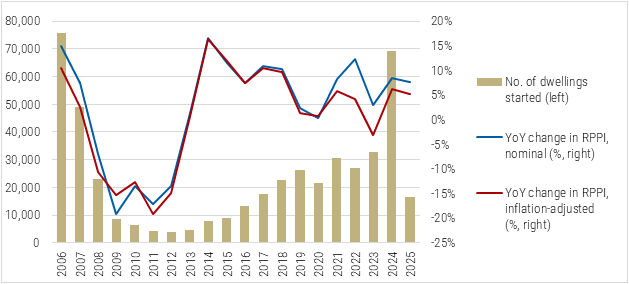
Over the past two decades, Ireland’s housing market has experienced a full boom-bust-recovery cycle, shaped by rapid economic expansion, a deep post-crisis correction, and a prolonged supply-constrained rebound. During the “Celtic Tiger” period, housing prices rose rapidly alongside strong economic growth, rising incomes, easier credit, and expanding construction activity. That cycle reversed sharply after the global financial crisis, when Ireland recorded one of Europe’s deepest residential downturns. Prices declined for several consecutive years, while construction activity collapsed and remained well below boom-era levels.
A gradual recovery began in the early 2010s and strengthened as macroeconomic conditions improved. Price growth accelerated quickly, then remained solid for several years before easing toward the end of the decade, as tighter mortgage lending rules and Brexit-related uncertainty weighed on momentum. During the pandemic, the market proved relatively resilient: price growth softened only briefly before re-accelerating as demand recovered faster than supply. This renewed imbalance between buyer demand and available stock supported another strong pricing phase in 2021–2022, before the market cooled in real terms in 2023 amid higher inflation and financing costs.
In 2024, price growth strengthened again as supply constraints reasserted themselves, particularly in the second-hand market. In 2025, the market remained in a firm upward pricing phase, with both nominal and inflation-adjusted prices continuing to rise, although at a slightly slower pace than in 2024. In effect, pricing pressure remained elevated, but the cycle showed early signs of moving into a more moderate phase rather than accelerating further. The underlying dynamic remained unchanged: demand stayed resilient, while limited effective supply continued to support prices despite mounting affordability pressures.
20-year residential market activity dynamic (house prices based on the annual residential property price index and the number of housing units started):
Data Sources: CSO, OECD, Global Property Guide.
Property Demand Trends
Resilient Buyer Interest Continues, but Low Stock Keeps Transaction Growth Gradual
Residential demand in Ireland remained resilient in 2025, supported by strong underlying fundamentals, including continued population growth, a robust labor market, and rising household incomes. At the same time, persistent supply shortages continued to constrain market activity, limiting the pace of expansion despite sustained buyer interest.
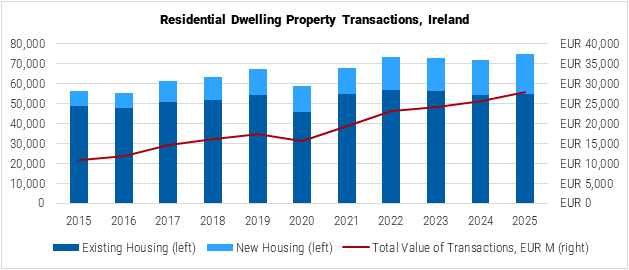
According to CSO data, a total of 74,781 residential property transactions were recorded in Ireland in 2025, representing a 4.12% year-on-year increase. The total value of properties transacted rose by 8.97% to EUR 27.9 billion (USD 32.51 billion), indicating that demand remained firm even as higher price levels continued to shape market access. Transaction dynamics varied across segments: the number of new homes transacted increased by 13.74% year on year, while sales of existing homes were broadly flat, rising by just 0.95%.
Industry commentary suggests that the pace of transaction growth is being limited by low market liquidity rather than weak buyer appetite. Bank of Ireland’s January 2026 housing update describes the market as facing “limited stock for sale” despite “robust demand,” underscoring that the main constraint is turnover capacity rather than any deterioration in underlying demand. This is particularly evident in the second-hand segment, where limited resale availability continues to suppress chain transactions and restrict mover activity. Many homeowners remain reluctant to list properties in a market where replacement options are scarce, reinforcing a pattern in which demand is present but cannot fully translate into stronger transaction volumes.
Data Source: CSO.
Regionally, residential transactions increased in 16 of Ireland’s 26 counties, with the strongest growth recorded in Louth, Sligo, and Monaghan, while Offaly, Leitrim, and Roscommon posted the largest year-on-year declines. Dublin remained the dominant market, accounting for 34% of all residential transactions, with 25,104 properties sold in 2025, up 5.66% year on year. Overall, the county-level pattern points to a broad-based demand backdrop, although local transaction outcomes are increasingly shaped by stock availability and turnover conditions rather than demand strength alone.
Counties with the largest number of transactions registered in 2025:
| County | No. Of Transactions, 2025 |
YoY, % | Total Value of Transactions, EUR M 2025 |
YoY, % |
| Dublin | 25,104 | 5.66% | 13,033 | 6.33% |
| Cork | 8,044 | -1.46% | 2,681 | 5.43% |
| Kildare | 3,963 | 8.99% | 1,575 | 15.14% |
| Galway | 3,212 | 4.63% | 1,020 | 13.23% |
| Meath | 3,133 | 2.35% | 1,151 | 11.29% |
| Data Source: CSO. | ||||
Looking ahead to 2026, the demand outlook remains positive in underlying terms, but transaction growth is likely to remain gradual. Industry commentary continues to highlight the same central dynamic: strong household demand on one side and limited supply release on the other. The SCSI’s 2026 market outlook emphasizes that low stock levels and weak new supply continue to weigh on market activity, while leaving significant “pent-up and ongoing accommodation demands” in place. In this context, transaction volumes are likely to increase only modestly in 2026, with performance heavily dependent on how much additional stock comes to market and how quickly new supply converts into completed, saleable homes. Over the medium term, the BPFI’s warning that materially increasing housing output after 2026 “looks challenging” further supports the view that Ireland’s transaction market is likely to remain structurally supply-constrained, even as underlying demand fundamentals stay supportive.
Property Supply Trends
Record Completions, but Execution Risks Persist as the Pipeline Rebalances
Ireland has faced persistent difficulty meeting the housing needs of its expanding population since residential construction fell sharply after the post-2009 downturn, leaving a structural gap between delivery and demand. Housing for All (2021) set the original framework to 2030, but it was formally superseded on 13 November 2025 by Delivering Homes, Building Communities 2025–2030, an updated action plan focused on accelerating supply while targeting homelessness. The new plan retains the ambition of delivering 300,000 homes by the end of 2030 and places greater emphasis on enabling infrastructure, planning, and regulatory reform, and measures aimed at restoring development viability.
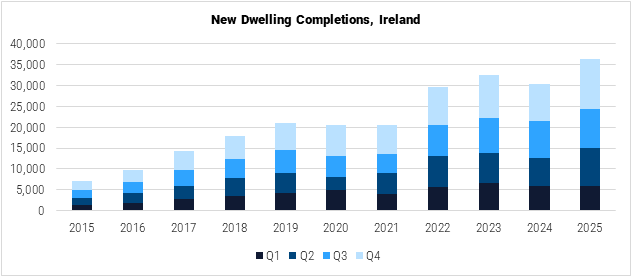
According to the CSO, new dwelling completions rose to 36,284 units in 2025 (+20.4% year-on-year), the highest annual total since the series began in 2011. The rebound was led by apartments, which rose 38.7% year-on-year to 12,047 units, lifting apartments to roughly one-third of total completions, with delivery heavily concentrated in Dublin and the Mid-East.
Political and industry commentary, however, continues to frame 2025’s step-up as meaningful but insufficient versus underlying need: Taoiseach Micheál Martin described the increase as “very significant” but conceded that “it’s not enough,” adding that “we have to get to about 50,000 per annum, some say even more.”
Data Source: CSO.
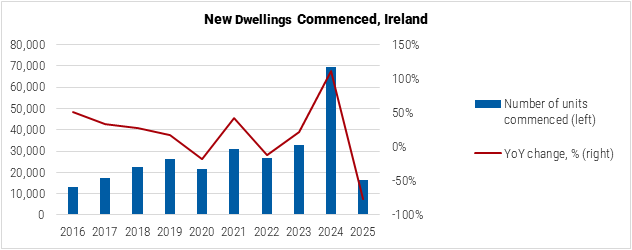
Forward indicators turned sharply weaker on the “starts” side. The Department of Housing, Local Government and Heritage reported 16,412 dwelling commencements in 2025 (-76.3% year-on-year), explicitly linking the reversal to the unwinding of the exceptional 2024 surge, when “government initiatives such as the development levy waiver and the Úisce Éireann rebate had a positive impact, fast tracking projects towards commencement.”
December 2025 delivered a notable late-year spike (3,065 units commenced, versus 1,533 in November), which the Minister for Housing, James Browne, called “very encouraging” and said it “signals the uptick in confidence in the construction sector,” adding: “I would expect to see commencements rise this year [2026] – and year on year.”
Data Source: CSO.
Looking ahead, the outlook remains positive in headline terms but more uncertain at the margin, as the recent commencements cycle has been unusually policy-distorted. The Economic & Social Research Institute (ESRI) revised its forecast for 2026 completions to around 36,000 units, warning that “the outlook beyond the forecast horizon appears to be weakening with falling planning permissions and low commencements.” The Central Bank of Ireland’s Q4 2025 Quarterly Bulletin projects completions rising to 37,000 (2026), 40,500 (2027), and 44,500 (2028), but stresses that delivery is conditional on easing enabling-infrastructure and planning constraints; it also notes that the historical link between commencements and completions has been “disturbed by the policy-induced volatility in commencements,” adding uncertainty to near-term projections. The Department of Finance similarly points to a “considerable slowdown in the time from commencement to completion” after the levy-waiver spikes, implying that traditional “rules-of-thumb” lags may currently overstate the speed at which starts translate into output.
Rental Market: Rents and Rental Yields
Slower Growth Rates and Uncertainty Over New Regulations
According to the CSO reporting, the rate of homeownership in Ireland has decreased over the last decade, from almost 70% in 2011 to 68% in 2016 and about 66% recorded during the most recent Census in 2022. At the same time, the nationwide share of tenants increased to nearly 29% (of which 18% rent from private landlords). In Dublin City, the share of households renting their residence is even higher at over 45%.
Ireland's rent price index:
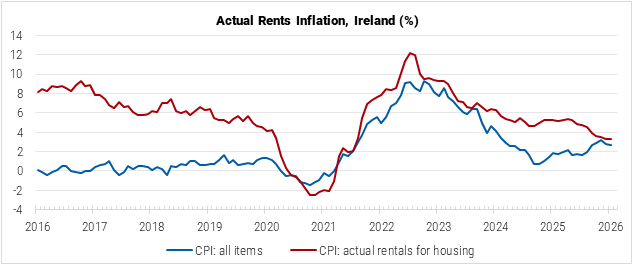
In parallel with the expansion of the tenant pool, Ireland has experienced substantial rental inflation in recent years, which has trended above the overall price growth in the country for the better part of the decade. In the second half of 2025, however, the annual growth rate in the actual rentals for the housing component of the consumer price index (CPI) reported by the CSO continued to moderate, narrowing the gap and reaching 3.3% in January 2026 - the lowest level observed since the pandemic. The all-item CPI registered a 2.7% year-on-year increase during the same period.
The latest reporting from the property website Daft.ie also shows a continued, albeit more moderate, growth in listed rents across Ireland. According to Daft.ie, inflation in open-market rents during 2025 was 4.4%, which was above the 2024 rate of 3.6% but below the rates seen in the previous three years, including a peak of 12.3% in 2023. At the same time, in his introduction to the report, Ronan Lyons, Associate Professor in Economics at Trinity College Dublin, cautioned against excessively optimistic interpretations of the slowing inflation trend, as the availability of rental properties continues to deteriorate and the potential impact of new rent control measures is uncertain.
“Slower growth rates do not signal balance; they reflect the fact that rents have already risen sharply, with market rents nationally 34% above pre-COVID levels,” Lyons said. “Over the past two decades, the number of homes available to rent has proven the best predictor of what happens next for rental prices. With supply still shrinking, and significant uncertainty about the exact nature and impact of new rent control measures due to come into force in a matter of weeks, underlying pressures in the rental market remain firmly upward in 2026.”
Data Source: CSO.
In nominal terms, data from Daft.ie shows that the average listed rent for a 2-bedroom apartment in Ireland reached EUR 2,086 (USD 2,427) in Q4 2025. Among the key regional submarkets, based on 2-bedroom units, the highest rent level outside the capital was registered in Limerick City at EUR 2,127 (USD 2,475), while Waterford City remained relatively more affordable at EUR 1,525 (USD 1,774). Within the capital region, the indicator exceeded EUR 2,500 (USD 2,909) in Dublin City Center, South Dublin City, and South Dublin County.
Good Rental Yields
Reflecting the slower pace of rental inflation, rental yields for apartments in Ireland have moderated somewhat, but remain high compared to many other European markets. Most recently, research conducted by Global Property Guide in December 2025 found gross rental yields at an average level of 7.71%, virtually unchanged from 7.76% previously reported in December 2024. Regionally, Cork (8.20%) continued to demonstrate higher potential performance compared to Dublin (7.22%).
Average listed rent by submarket:
| 2-bedroom apt, EUR/month Q4 2025 |
2-bedroom apt, USD/month Q4 2025 |
YoY, % Q4 2025 vs Q4 2024 |
|
| Dublin City Center | EUR 2,628 | USD 3,057 | 2.1% |
| North Dublin City | EUR 2,376 | USD 2,764 | 2.5% |
| South Dublin City | EUR 2,708 | USD 3,150 | 5.7% |
| North Dublin County | EUR 2,269 | USD 2,640 | 3.2% |
| South Dublin County | EUR 2,552 | USD 2,969 | 3.7% |
| West Dublin | EUR 2,230 | USD 2,594 | 2.2% |
| Cork City | EUR 2,013 | USD 2,342 | 9.1% |
| Galway City | EUR 2,113 | USD 2,458 | 8.4% |
| Limerick City | EUR 2,127 | USD 2,475 | 4.0% |
| Waterford City | EUR 1,525 | USD 1,774 | 12.0% |
| Note: Exchange rate as of Q4 2025, EUR 1 = USD 1.1634. | |||
| Data Source: Daft.ie. | |||
The almost uninterrupted growth in rents across Ireland over the past decade is largely tied to the insufficient supply of rental housing. As of February 2026, Daft.ie reported the number of properties available for rent on the platform at the lowest level recorded for this time of the year in almost twenty years. According to their analysis, the overall supply availability is now just two-fifths of its 2015-2019 average, with particularly severe shortages observed outside Leinster.
Earlier last year, Sherry FitzGerald, the country’s largest estate agency, reported a net loss of approximately 42,300 rental properties owned by private investors between January 2020 and the end of March 2025, which highlights the ongoing trend of small landlords exiting the sector. The agency’s latest market update also highlights the unintended consequences of the upcoming regulatory changes.
“While the reforms provide greater clarity for tenants and larger landlords and may attract investment back to the Private Rented Sector, many smaller landlords are exiting the market at pace, further exacerbating the supply shortage within the rental sector,” said the Sherry FitzGerald report.
Aiming to balance tenant protections with the need to boost housing supply, the Irish government previously unveiled a rental sector reform package, which includes expansion of rent controls as well as measures to encourage investment in the sector, and will come into effect from March 2026.
Under the new regulation, the Rental Pressure Zones (RPZ) were expanded to include all private and student-specific accommodation tenancies across the country. For existing tenancies within RPZs, annual rent increases are capped at the level of inflation to a maximum of 2%. Apartments in new developments (commenced after June 10, 2025), however, will no longer be subject to the 2% cap, with allowed rent increases tied directly to inflation. Landlords will also be able to reset rents to market rates between tenancies.
Mortgage Market and Interest Rates
Interest Rates at Lowest Level in Almost Three Years, Lending Activity Grows
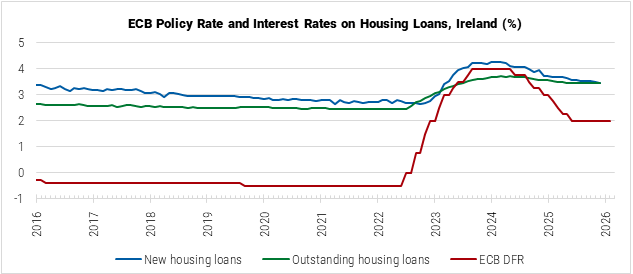
Reflecting the stabilization of the European Central Bank’s (ECB) monetary policy in recent months, with key rates on hold since June 2025 and no further moves announced at the February 2026 meeting of the Governing Council, interest rates on housing loans in the Irish market have been demonstrating a more stable trend as well, edging downwards due to competition among lenders rather than policy shifts.
Ireland's mortgage loan interest rates:
According to the ECB, the average interest rate on loans to households for house purchase in Ireland stood at 3.46% for new loans and 3.47% for outstanding loans in December 2025, having decreased for both new and outstanding credit categories over a twelve-month period and now at levels previously observed in early 2023. As the regulator is likely to keep its rates on hold at least until the end of 2026, local experts don’t anticipate much further movement for mortgage rates in Ireland in the upcoming months either.
“[ECB rates being on hold for the rest of the year] could put the brakes on any further falls in average Irish mortgage costs in the near future,” Fiona McMahon, senior mortgage advisor with NFP Ireland, told The Irish Times in February.
“I don’t think mortgage rates will change much more over the coming months,” agreed Daragh Cassidy of the price comparison website bonkers.ie, adding that competitive offer from a new player expected to enter the market later this year could “push rates down a bit”.
Data Source: ECB.
Average interest rates on loans to households for house purchase:
| Dec 2025 | YoY | Dec 2024 | YoY | Dec 2023 | |
| New housing loans | 3.46% | ↓ | 3.73% | ↓ | 4.19% |
| - Floating rate and IRF up to 1 year | 3.89% | ↓ | 4.08% | ↓ | 4.37% |
| - IRF of over 1 and up to 5 years | 3.40% | ↓ | 3.59% | ↓ | 4.13% |
| - IRF of over 5 and up to 10 years | 3.70% | ↑ | 3.68% | ↓ | 4.35% |
| Outstanding housing loans | 3.47% | ↓ | 3.56% | ↓ | 3.63% |
| - Original maturity up to 1 year | 3.23% | ↓ | 3.58% | ↓ | 4.34% |
| - Original maturity over 1 and up to 5 years | 3.65% | ↓ | 3.69% | ↓ | 3.69% |
| - Original maturity of over 5 years | 3.47% | ↓ | 3.56% | ↓ | 3.63% |
| Data Source: ECB. | |||||
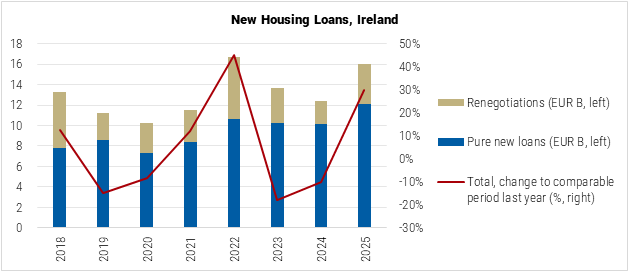
Lower and more predictable borrowing costs supported a rebound in lending activity in Ireland. After two years of declines, the total value of new housing loans (including pure new loans and renegotiations) issued between January and December 2025 reached EUR 16.1 billion (USD 18.1 billion), a 30.1% increase compared to 2024.
The strong positive dynamic in new drawdowns is also confirmed by the Banking & Payments Federation Ireland (BPFI), which reported over 27,000 mortgages amounting to more than EUR 8.8 billion (USD 9.9 billion) were drawn by first-time buyers throughout the year - the highest volume and value recorded for this category of borrowers since 2008 and 2003, respectively.
The upward momentum for lending activity is expected to carry into this year. “Looking ahead at 2026, we expect continued strong demand in the housing and mortgage markets. Potential mortgage output for 2026 looks positive, evident from the solid growth in mortgage approvals activity,” said Brian Hayes, BPFI Chief Executive.
Data Source: ECB.
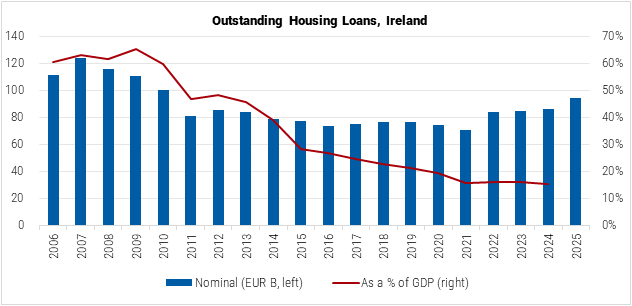
As for the overall size of the mortgage market, the Irish government’s containment measures (including loan-to-income caps and loan-to-value requirements for different categories of buyers), combined with the global economic slowdown and elevated interest rates, resulted in its shrinking in recent years from an estimated 65% of GDP in 2009 to 28% in 2015 and 15% in 2024. In nominal terms, the value of outstanding housing loans to households continued to grow nonetheless and reached EUR 94.1 billion (USD 106.4 billion) at the end of 2025, representing a 9.4% increase from the end of 2024, according to the ECB figures.
Reporting from the Central Bank of Ireland indicates that only 2.7% of the country's mortgage stock is currently comprised of loans on buy-to-let properties (BTL), compared to over 27% in 2009 and over 19% in 2015, illustrating a continued shift of the market towards owner-occupied principal dwellings. Typically structured as interest-only credit and seen by lenders as a riskier category, BTL mortgages in Ireland involve higher downpayment requirements and often higher interest rates than traditional housing loans.
The level of mortgage indebtedness in Ireland remains above the EU average, with 35.5% of households reported as owning their residences with a mortgage or housing loan as of 2024.
Data Source: ECB.
Economic and Social Factors
Economy Shifts to a Slower Path After Exceptional Growth
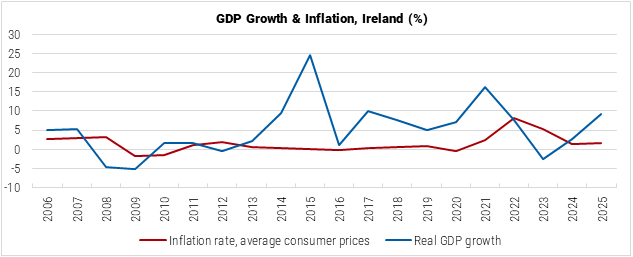
After a solid 2.6% rebound, Ireland’s economy demonstrated exceptionally strong expansion in 2025, with the real GDP growth estimated by the International Monetary Fund (IMF) at 9.1%. According to the European Commission’s assessment, such high growth was largely driven by strong export activity in the first half of the year, specifically pharmaceutical exports to the US, likely reflecting frontloading in anticipation of US tariffs. As this effect unwinds, growth is expected to moderate to 0.2% in 2026, before stabilizing at 2.9% in 2027.
“Ireland’s growth outlook remains vulnerable to risks stemming from further global trade fragmentation and shifting US policies that could impact the activity and profitability of multinationals operating in Ireland,” noted the fall economic forecast from the European Commission.
At the same time, consumer price index (CPI) inflation in the country appears to have largely stabilized, reaching an average annual level of 1.7% in 2025, only a slight uptick from 1.3% previously reported in 2024, and is expected by the IMF to remain low at 1.7% in 2026 and 1.8% in 2027. Similarly, the European Commission forecasts inflation in Ireland below 2% for the next two years.
Data Source: IMF.
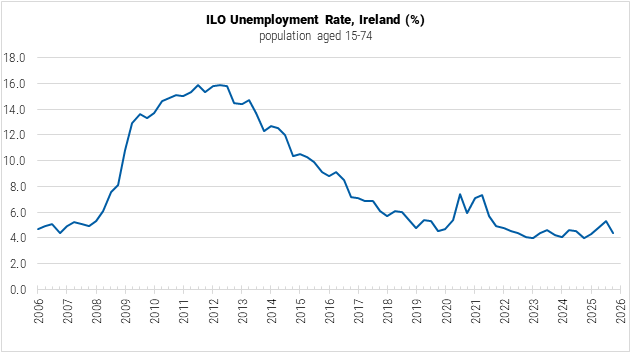
Ireland’s labor market remains robust, but shows signs of moderation, according to the European Commission’s assessment. Employment in the country is set to continue growing, albeit at a more moderate pace, while unemployment edged up slightly in 2025 and is expected to stay at similar levels in 2026 and 2027. The ILO unemployment rate for the population aged 15-74 was most recently reported by the CSO at 4.4% in Q4 2025, compared to 4.1% in Q4 2024.
Data Source: CSO.
Overall, the Irish economy has proven resilience in a weaker global economic environment, but risks to its growth outlook are tilted to the downside.
In November 2025, Fitch Ratings affirmed Ireland’s ‘AA-’ standing with a stable outlook, citing its favorable governance indicators, high GDP per capita, budget surpluses, and steady debt decline. These strengths, however, are balanced by high GDP volatility due to the large impact of multinational enterprises and sizeable exposure to US and global tax and regulatory changes affecting these enterprises.
“As a small open economy with extensive trade and Foreign Direct Investment (FDI) linkages with the US, the Irish economy, public finances, and labor market are exposed to changes in US economic policy and any broader deterioration in the global trading environment,” noted the most recent outlook from the Central Bank of Ireland.
Sources:
- The Government of Ireland
- Delivering Homes, Building Communities 2025-2030: https://www.gov.ie/
- Economic Insights – Volume 3 2025, November 2025: https://assets.gov.ie/
- Government to Introduce Major Reforms to the Rental Sector: https://www.gov.ie/
- Over 40,000 More Tenancies Now Benefit From Rent Controls as Rent Pressure Zones Expanded Nationwide: https://www.gov.ie/
- Central Statistics Office (CSO)
- Residential Property Price Index December 2025: https://www.cso.ie/
- New Dwelling Completions Q4 2025: https://www.cso.ie/
- Labor Force Survey Quarter 4 2025: https://www.cso.ie/
- Press Statement Census 2022 Results Profile 2 — Housing in Ireland: https://www.cso.ie/
- Consumer Price Index January 2026: https://www.cso.ie/
- Central Bank of Ireland
- Quarterly Bulletin No. 4 2025: https://www.centralbank.ie/
- Private Household Credit and Deposits: https://www.centralbank.ie/
- Retail Interest Rates: https://www.centralbank.ie/
- Mortgage Measures: https://www.centralbank.ie/
- New Mortgage Lending Data: https://www.centralbank.ie/
- European Central Bank (ECB)
- ECB Data Portal: https://data.ecb.europa.eu/
- Key ECB Interest Rates: https://www.ecb.europa.eu/
- Monetary Policy Decisions, 5 February 2025: https://www.ecb.europa.eu/
- International Monetary Fund (IMF)
- Country Overview: Ireland: https://www.imf.org/
- 2025 Article IV Staff Report: https://www.imf.org/
- European Commission
- Economic Forecast for Ireland: https://economy-finance.ec.europa.eu/
- Distribution of Population by Tenure Status, Type of Household, and Income group: https://ec.europa.eu/
- Department of Housing, Local Government and Heritage
- December Commencements 2025: https://www.gov.ie/
- Commencements Data for December 2025 Shows Significant Jump in New Home Starts: https://www.gov.ie/
- Society of Chartered Surveyors Ireland (SCSI)
- Annual Residential Market Monitor, Review and Outlook 2026: https://ww1.daft.ie/
- Banking & Payments Federation Ireland (BPFI)
- BPFI Housing Market Monitor Q3/2025: https://bpfi.ie/
- BPFI Mortgage Drawdowns Report Q4 2025: https://bpfi.ie/
- Economic & Social Research Institute (ESRI)
- Economic Policy Decisions Crucial to Preserve Robust Economic Growth: https://www.esri.ie/
- Bank of Ireland
- Housing Update: January 2026: https://personalbanking.bankofireland.com/
- Daft.ie
- 2025 Q4 – Year in Review, Daft.ie Sales Report: https://ww1.daft.ie/
- 2025 Q4 – Year in Review, Daft.ie Rental Report: https://ww1.daft.ie/
- Sherry FitzGerald
- Irish Residential Market Update, Q4 2025: https://www.sherryfitz.ie/
- Press Release Q2 2025: https://www.sherryfitz.ie/
- Morningstar DBRS
- Irish Residential Mortgage Market Update 2025: https://dbrs.morningstar.com/
- Irish Residential Mortgage Market Update 2024: https://dbrs.morningstar.com/
- Fitch Ratings
- Fitch Affirms Ireland at 'AA'; Outlook Stable: https://www.fitchratings.com/
- The Irish Times
- Number of Home Built Rises by 20% in 2025…: https://www.irishtimes.com/
- Irish Mortgage Rates Fall to Lowest Level in Almost Three Years: https://www.irishtimes.com/