The Netherlands’ Residential Property Market Analysis 2026
Structural supply scarcity continues to support price increases in the Dutch housing market, although the pace of growth has been temporarily dampened by the inflow of secondary properties from the sell-offs of former rental inventory amid fiscal and regulatory changes.
This extended overview from Global Property Guide covers key aspects of the Dutch housing market and takes a closer look at its most recent developments and long-term trends.
Table of Contents
- Property Prices and Price Index
- Historic Perspective
- Property Demand Trends
- Property Supply Trends
- Rental Market: Rents and Rental Yields
- Mortgage Market and Interest Rates
- Economic and Social Factors
Property Prices and Price Index
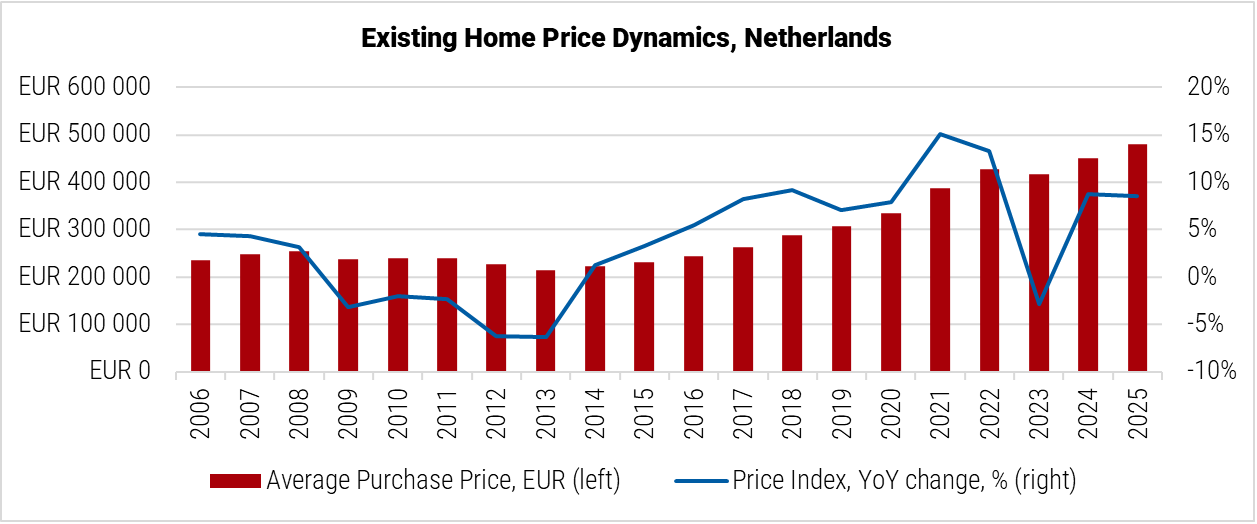
Dutch house prices continue to rise, although the pace of growth has clearly moderated since the peak of the latest upswing. According to Statistics Netherlands (CBS) and the Land Registry, the House Price Index for Existing Owner-Occupied Homes Sold rose by 8.57% year-on-year in 2025, before slowing to 4.98% year-on-year in March 2026. The market has therefore moved away from the double-digit annual growth recorded in late 2024, but prices remain on an upward trajectory.
The slowdown is closely linked to the temporary increase in available supply. Rabobank notes that the moderation in price growth cannot be viewed separately from the sale of former rental homes by investors, which has expanded the pool of homes available to owner-occupiers. According to the bank, this additional supply has helped relieve pressure in the owner-occupied market and explains part of the flattening in house price growth. At the same time, Rabobank stresses that the market remains tight: prices are still rising despite the extra supply, illustrating the underlying strength of structural scarcity.
The Netherlands' house price annual change:
The national average transaction price for existing owner-occupied homes reached EUR 479,527 (USD 561,190) in 2025, up 6.33% year-on-year. In Q1 2026, the average purchase price increased further to EUR 492,199 (USD 576,020), up 4.72% compared with Q1 2025. Among the four largest municipalities, Amsterdam remained the most expensive market, with the average transaction price reaching EUR 619,117 (USD 724,553). However, price growth in and around Amsterdam has lagged the national average, which Rabobank links to affordability limits in the most expensive urban markets and some narrowing of regional price differences.
Average price of owner-occupied dwellings sold in the four largest municipalities:
| Average sales price of owner-occupied dwellings sold, Q1 2025, EUR |
Average sales price of owner-occupied dwellings sold, Q1 2026, USD |
YoY, % Q1 2026 vs Q1 2025 |
|
| Amsterdam | EUR 619,117 | USD 724,553 | -2.15% |
| The Hague | EUR 473,541 | USD 554,185 | 6.71% |
| Rotterdam | EUR 429,773 | USD 502,963 | 5.81% |
| Utrecht | EUR 574,179 | USD 671,962 | 3.09% |
| Nationwide | EUR 492,199 | USD 576,020 | 4.72% |
| Note: Exchange rate as of Q1 2026, EUR 1 = USD 1.1703. | |||
| Data Sources: Land Registry, CBS. | |||
Looking ahead, forecasters expect further price growth, but at a slower pace than in 2024–2025. Rabobank projects existing owner-occupied homes to become 3.1% more expensive in 2026 and 4.1% in 2027, with the temporary supply from former rental homes and higher new-build completions dampening growth in 2026 before pressure strengthens again as this effect fades. ABN AMRO forecasts a similar path, expecting house prices to rise by 3% in 2026 and 4% in 2027.
ING is more cautious, expecting no further price increase during the rest of 2026, with annual growth of around 1.5% due to gains already recorded at the start of the year, followed by around 2% in 2027. The bank attributes the softer outlook to increased supply, particularly from investors selling rental properties into the owner-occupied market, as well as slightly higher mortgage rates and more cautious buyer sentiment. Overall, the outlook points to slower but still positive price growth, supported by persistent housing scarcity and income growth, but constrained by affordability pressures, elevated financing costs, cautious sentiment, and the temporary increase in supply from investor sell-offs.
Historic Perspective:
Core Trends and Economic Drivers Behind the Dutch Housing Market Evolution
Following a prolonged downturn in the aftermath of the global financial crisis, the Dutch housing market entered an extended phase of robust price growth. After reaching a low in mid-2013, house prices began a steady upward trajectory, culminating in a peak annual increase of 20.21% (13.72% in real terms) in the price index for existing homes in December 2021.
This sustained appreciation was underpinned by historically low mortgage interest rates and favorable financing conditions, including high loan-to-value ratios and the widespread availability of interest-only mortgages. The tax framework further bolstered demand by offering strong incentives for homeownership. Demographic dynamics also played a significant role, with consistent growth in net migration and the emergence of smaller, more numerous households contributing to increased housing demand.
By late 2022, however, the pace of growth began to moderate. In 2023, the Price Index for Existing Homes posted a 2.91% annual decline, reflecting the impact of rising mortgage rates, heightened geopolitical uncertainty, and a weakening economic outlook. The downturn proved short-lived. As inflation eased, mortgage rates began to fall, household incomes improved, and demand rebounded. Coupled with ongoing supply constraints, these factors drove a renewed upswing in prices, which rose by 8.77% year-on-year in 2024.
The market strengthened again in 2025, with price growth remaining solid but gradually losing momentum as additional supply from former rental homes entered the owner-occupied segment and affordability constraints became more visible. By early 2026, the cycle had shifted into a more moderate phase: prices were still rising, but at a slower pace, supported by persistent housing shortages while constrained by elevated price levels, cautious buyer sentiment, and financing costs.
20-year annual house price change (based on annual price index for existing homes and consumer price index):
| Year | Nominal house prices (%) |
Inflation-adjusted house prices (%) |
Year | Nominal house prices (%) |
Inflation-adjusted house prices (%) |
|
| 2006 | 4.55% | 3.41% | 2016 | 5.47% | 5.13% | |
| 2007 | 4.35% | 2.69% | 2017 | 8.19% | 6.71% | |
| 2008 | 3.16% | 0.65% | 2018 | 9.21% | 7.38% | |
| 2009 | -3.18% | -4.32% | 2019 | 7.04% | 4.30% | |
| 2010 | -2.02% | -3.26% | 2020 | 7.87% | 6.52% | |
| 2011 | -2.32% | -4.56% | 2021 | 15.10% | 12.10% | |
| 2012 | -6.21% | -8.46% | 2022 | 13.29% | 2.99% | |
| 2013 | -6.34% | -8.63% | 2023 | -2.91% | -6.50% | |
| 2014 | 1.20% | 0.22% | 2024 | 8.77% | 5.24% | |
| 2015 | 3.27% | 2.65% | 2025 | 8.57% | 5.14% | |
| Data Sources: CBC, OECD, Global Property Guide. | ||||||
Data Source: Land Registry, CBS.
Property Demand Trends
Sales Activity Remains Strong, but Growth Is Becoming More Measured
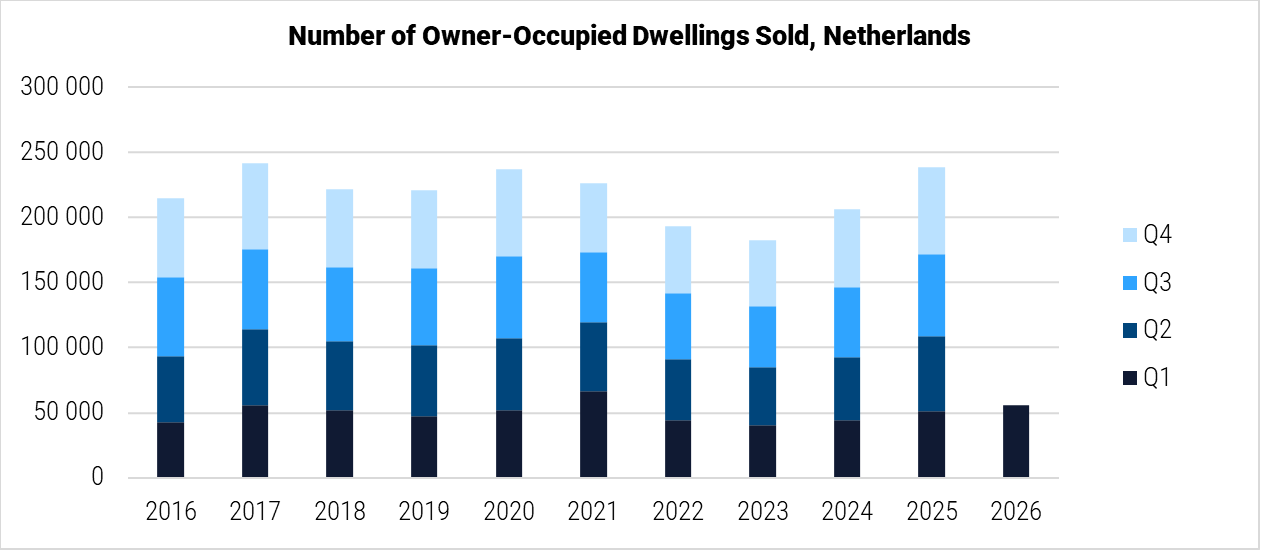
The Dutch owner-occupied housing market recorded a strong increase in transaction activity in 2025, as resilient buyer demand coincided with a temporary improvement in the availability of homes for sale. According to CBS and Land Registry data, 238,695 existing owner-occupied homes were sold in 2025, up by 15.61% year-on-year, bringing sales volumes close to the previous cyclical high.
A key factor behind this increase was the continued sale of former rental homes by residential investors. Recent fiscal and regulatory changes, including tighter rent regulation through the Affordable Rent Act and less favorable tax treatment, have reduced the attractiveness of private rental investment and encouraged some landlords to exit the market. Rabobank estimates that investors sold no fewer than 36,000 homes to owner-occupiers in 2025, equivalent to more than 15% of all owner-occupied home purchases. This helped support transaction volumes by widening the pool of homes available for purchase, particularly in markets where investor ownership has historically been more common.
Activity remained solid in early 2026, but the pace of growth moderated. In Q1 2026, 55,949 existing owner-occupied homes were sold, representing an 8.69% year-on-year increase and suggesting that the strongest phase of the 2025 rebound is beginning to normalize. Leading market indicators point in the same direction. NVM estate agents reported fewer viewing requests, viewings, and bids per home, while Funda data also showed a decline in contact requests per listing and a lower share of respondents planning to buy a home within one year. The sentiment indicates that buyers remain active, but are becoming more cautious and selective.
Data Source: Land Registry, CBS.
Regionally, transaction activity in the four largest cities rebounded particularly strongly in 2025, outpacing the national average. The recovery was partly supported by the release of former rental stock onto the owner-occupied market, a trend especially relevant in larger urban areas where investor ownership has historically been more concentrated. However, momentum eased in Q1 2026, with annual transaction growth slowing across Amsterdam, The Hague, Rotterdam, and Utrecht and falling below the nationwide pace.
Number of owner-occupied dwellings sold in key submarkets:
| Number of dwellings sold, 2025 |
YoY, % 2025 vs 2024 |
Number of dwellings sold, Q1 2026 |
YoY, % Q1 2026 vs Q1 2025 |
|
| Amsterdam | 14,683 | 18.15% | 3,135 | 7.81% |
| The Hague | 8,376 | 18.46% | 1,838 | 4.08% |
| Rotterdam | 8,384 | 18.92% | 1,856 | 0.27% |
| Utrecht | 5,988 | 20.14% | 1,351 | 5.71% |
| Nationwide | 238,695 | 15.61% | 55,949 | 8.69% |
| Data Sources: Land Registry, CBS. | ||||
Looking ahead, transaction volumes are expected to remain high by historical standards, but further acceleration appears unlikely. Rabobank expects the number of existing owner-occupied home transactions to decline from around 229,000 in 2026 to 210,000 in 2027, as the wave of former rental-home sales gradually fades. ABN AMRO is also cautious, forecasting a 3% decline in transactions in 2026 and a further 4% fall in 2027, citing growing uncertainty and a limited number of newly added homes. ING is somewhat more positive, expecting existing-home sales to reach around 240,000 in 2026, broadly comparable to 2025 and still just below the 2017 record level. Overall, the outlook points to a market that remains supported by structural housing shortages and income growth, but where affordability pressures, weaker buyer confidence, still-elevated financing costs, and the fading investor sell-off are likely to limit further growth in transaction activity.
Property Supply Trends
New Delivery Still Lags Behind Need Despite Stronger Permit Activity
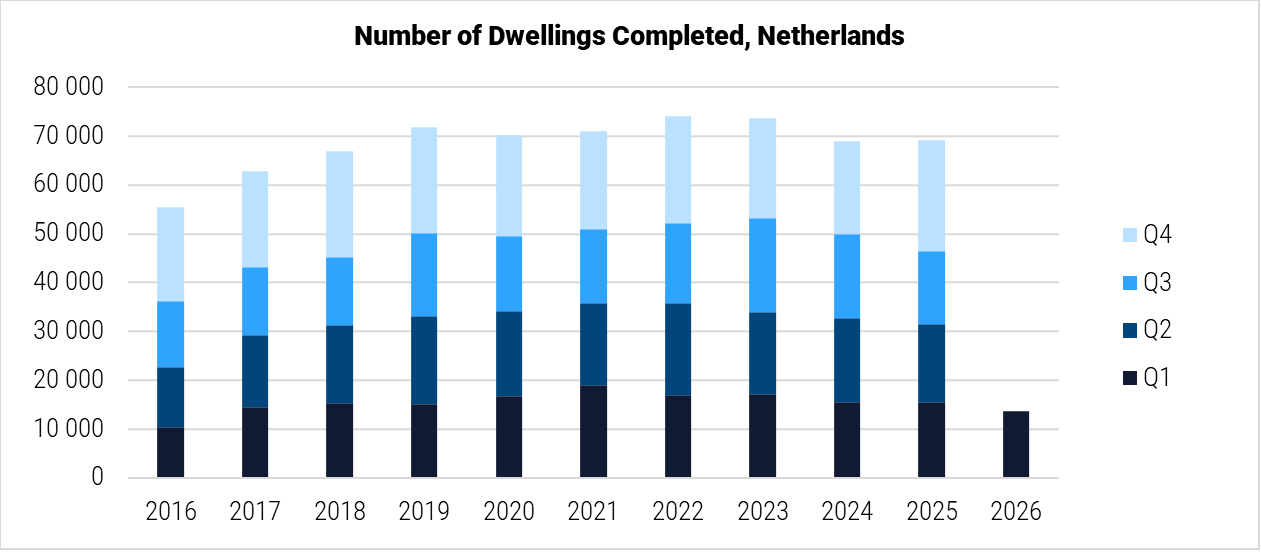
Housing supply in the Netherlands remains structurally constrained, with new delivery still below the level needed to ease market pressure. According to CBS, 69,189 newly built homes were completed in 2025, broadly unchanged from 68,970 in 2024, but still well below the government’s annual target of 100,000 homes. In Q1 2026, completions weakened further, with 13,711 newly built homes delivered, down 11.60% year-on-year.
The housing shortage, therefore, remains significant. The Ministry of Housing and Spatial Planning estimated the statistical shortage at 396,000 homes in 2025, equivalent to 4.8% of the housing stock. Around 226,000 additional homes would be needed to bring the shortage down to the policy target of 2%. The Ministry links the persistent gap to years of insufficient construction relative to demographic demand, including population growth and changing household structures.
Data Source: CBS.
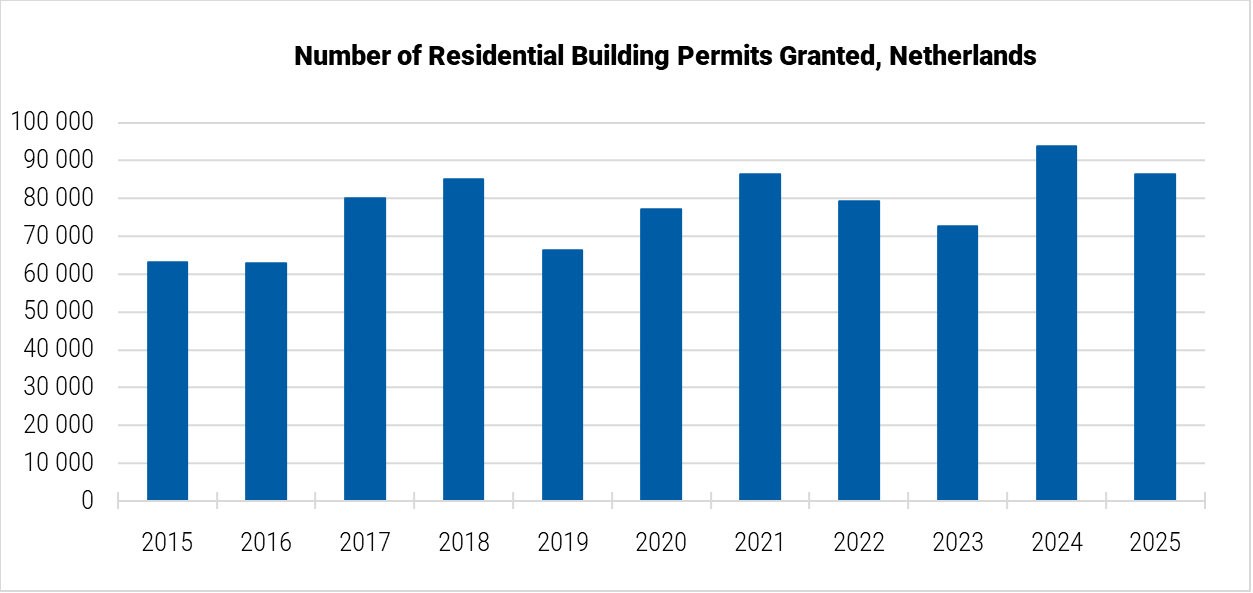
Permit activity provides a more positive signal for future supply, despite some year-on-year volatility. According to CBS, permits were issued for 86,269 new-build homes in 2025, down from 93,915 in 2024, representing an 8.14% year-on-year drop. However, the decline followed a particularly strong permitting year in 2024, while the 2025 level remained elevated compared with most recent years. Early 2026 data also points to renewed momentum: in Q1 2026, permits were issued for 23,474 new-build homes, up 25.30% year-on-year and the highest first-quarter level on record. Capital Value interprets this as a positive signal for future housing production, although the effect on completions will materialize only with a delay.
The conversion of permits into completed homes remains a key constraint. CBS notes that construction timelines have lengthened and that some permits are later withdrawn, while Rabobank estimates that the average period between permit issuance and completion has increased to around 2.4 years, compared with 1.7 years ten years ago. The bank links this partly to the growing share of apartment construction, which generally takes longer to deliver than single-family housing.
Data Source: CBS.
Looking ahead, the official pipeline points to some recovery, but delivery risks remain significant. For 2025–2030, municipalities have around 932,300 housing plans in the pipeline, equivalent to 128% of the agreed construction task, with overprogramming intended to account for delays and non-delivery. However, only around 440,000 homes have already received municipal approval, meaning that much of the pipeline still has to move through approval, permitting, and construction. Overall, supply is expected to recover only gradually, with no near-term material easing of the housing shortage.
Rental Market: Rents and Rental Yields
Continued Landlord Sell-Off Shrinks Supply, Keeps Private Rents Under Pressure
In the highly regulated Dutch rental market, caps on starting rates in new contracts and allowed annual increases are established by a point-based system, which segments rental housing according to factors such as surface area, energy efficiency, and value of each property, determined by local authorities.
The Netherlands' rent price index:
In mid-2024, the system was revised by the Affordable Rent Act, which brought turmoil into the country’s rental market. The controversial legislation introduced a new mid-range tier to the regulated segment of the market, effectively widening the spectrum of properties falling under both base rent and rent increase control and narrowing the so-called liberalized private segment, limited only in terms of maximum annual increases. These changes, in turn, prompted many smaller landlords to sell off their properties due to anticipated loss of profitability, while larger players shifted their focus to higher-end homes not subject to the new rules.
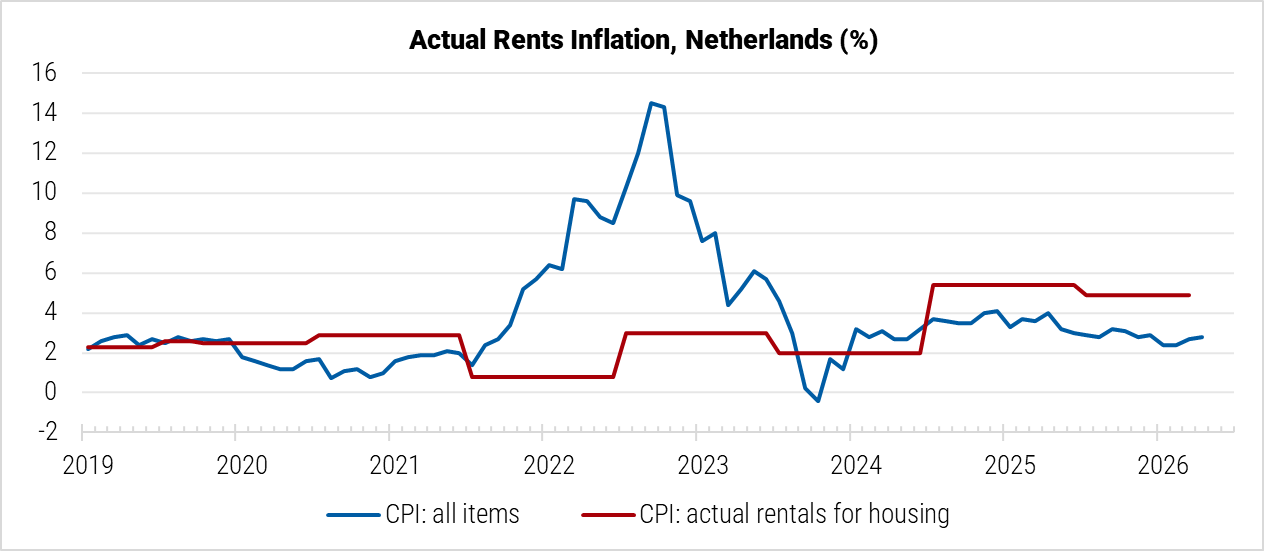
Before the enactment of the Affordable Rent Act, the CBS reported the average annual increase in rents across the country at 5.4% between July 2023 and July 2024 — the steepest increase in over 30 years. In the year ended in July 2025, overall rental inflation slowed to 4.9%, with the liberalized sector demonstrating 4.4% and the regulated sector (including social and other landlords) 5.0% annual growth. In 2026, the maximum allowed rent increases in existing contracts are set at 4.1% for the social sector, 4.4% for the private sector, and 6.1% for the mid-market sector.
In this environment, the overall rental inflation, as measured by the annual change in actual rentals for the housing component of the consumer price index, has been stable at 4.9% in the second half of 2025 and early 2026, consistently trending above the general price growth in the Netherlands since the enactment of the new regulation.
Data Source: CBS.
At the same time, the unregulated sector of the market remains under pressure, as supply continues to shrink due to landlord sell-offs fueled by revised regulations. The latest quarterly report from the popular rental platform Pararius indicates a continued outflow of available rental properties, noting that 5.5% of all properties listed for sale on the platform during Q1 2026 had been previously offered as rental homes in the private sector. In parallel, the average rental price per square meter rose by 7.3% year-on-year.
"The sell-off is slowing, but remains structural, commented Jasper de Groot, CEO of Pararius. “Before 2023, the share of divested rental homes was consistently around 2.5%. The current level is still more than double that."
Average asking rent for private sector housing in key submarkets:
| City | Avg Monthly Rent, EUR/sqm Q1 2026 |
Avg Monthly Rent, USD/sqm Q1 2026 |
YoY, % Q1 2026 vs Q1 2025 |
| Amsterdam | EUR 28.53 | USD 33.39 | 5.1% |
| Rotterdam | EUR 22.78 | USD 26.66 | 10.4% |
| The Hague | EUR 21.92 | USD 25.65 | 6.5% |
| Utrecht | EUR 22.27 | USD 26.06 | 5.9% |
| Eindhoven | EUR 19.55 | USD 22.88 | 10.0% |
| Note: Exchange rate as of Q1 2026, EUR 1 = USD 1.1703. | |||
| Data Source: Pararius. | |||
In nominal terms, according to Pararius, the nationwide average asking rent for private sector housing reached EUR 21.12 (USD 24.72) per sqm in Q1 2026, apartments generally being more expensive with an average rate of EUR 22.40 (USD 26.21) per square meter, while for single-family homes the indicator stood at EUR 16.83 (USD 19.70) per square meter. Among the major cities, Amsterdam remained by far the most expensive city in the Netherlands, with an average rent of EUR 28.53 (USD 33.39) per square meter, while Rotterdam (10.4%) and Eindhoven (10.0%) saw the strongest annual increases in average private rents.
As for gross rental yields for residential units in the country, research conducted by Global Property Guide in January 2026 found them at the average level of 6.28%. Among the monitored submarkets, the highest potential performance was registered in Rotterdam (6.91%), while for Amsterdam, the indicator remained notably lower at 5.35%.
Mortgage Market and Interest Rates
Higher Rates Anticipated Amid Global Uncertainty
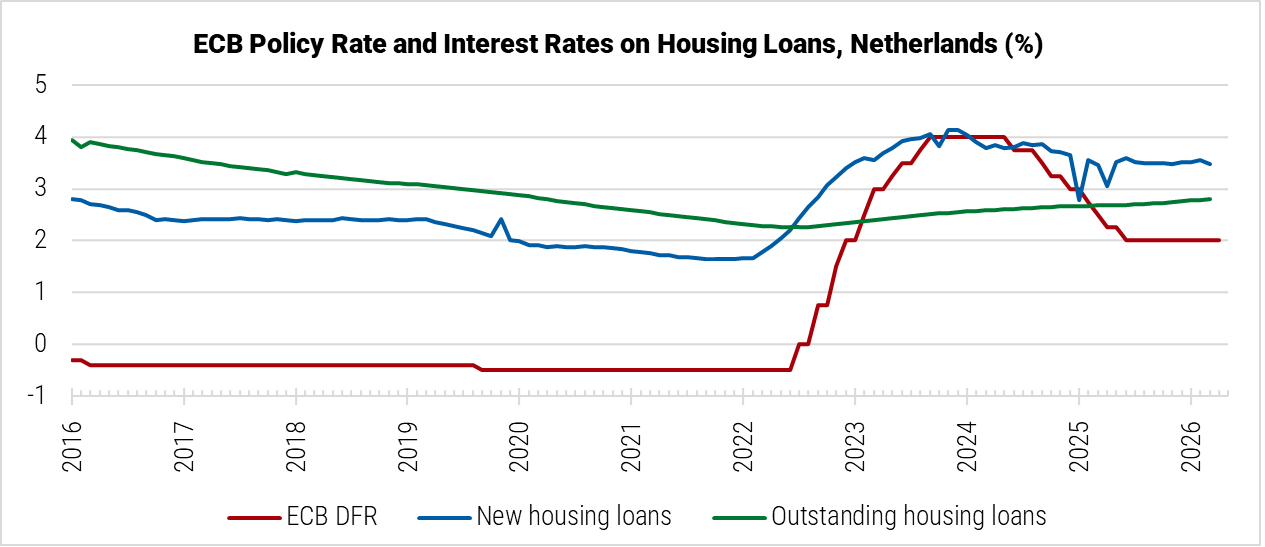
Based on the European Central Bank (ECB) figures, as of March 2026, the average interest rate on loans to households for house purchase in the Netherlands stood at 3.48% for new loans and 2.79% for outstanding loans, both indicators marginally up from the same period a year ago and likely to climb further in coming months, as heightened global uncertainty over the impact of the Middle East conflict and US trade policies is expected to lead to higher mortgage rates in the country in 2026.
The Netherlands' mortgage loan interest rates:
According to ABN AMRO, one of the country’s largest banks, all major lenders have already begun increasing interest rates for loans with long IRF periods towards the end of 2025. With the ECB now expected to raise its policy rates to limit oil-driven inflation, other categories of mortgages are to follow. “We believe the ECB will raise the deposit rate by 25 basis points at least once, but likely twice, in 2026,” said ABN AMRO’s recent housing market monitor. “As a result, mortgage rates will rise, and borrowing will become more expensive, which will dampen housing demand.”
After a series of cuts through 2024 and early 2025, the ECB has kept its key rates unchanged since last June, making no further moves at the latest meeting of the monetary policy committee in April 2026. At the same time, in a post-decision press statement, the regulator noted that upside risks to inflation and downside risks to growth have intensified, as the war in the Middle East has led to a sharp increase in energy prices, pushing up inflation and weighing on economic sentiment. Most economists polled by Reuters in May agreed that the ECB is likely to raise rates in June and possibly once more later in 2026 due to war-driven inflation pressures.
Data Source: ECB.
Average interest rates on loans to households for house purchase:
| Mar 2026 | YoY | Mar 2025 | YoY | Mar 2024 | |
| New housing loans | 3.48% | ↑ | 3.46% | ↓ | 3.79% |
| - Floating rate and IRF up to 1 year | 3.93% | ↓ | 4.57% | ↓ | 5.12% |
| - IRF of over 1 and up to 5 years | 3.79% | ↓ | 3.80% | ↓ | 4.16% |
| - IRF of over 5 and up to 10 years | 3.54% | ↑ | 3.35% | ↓ | 3.60% |
| - IRF of over 10 years | 2.80% | ↓ | 2.86% | ↓ | 2.96% |
| Outstanding housing loans | 2.79% | ↑ | 2.68% | ↑ | 2.58% |
| - Original maturity up to 1 year | 4.26% | ↓ | 4.94% | ↓ | 5.40% |
| - Original maturity over 1 and up to 5 years | 4.06% | ↓ | 4.48% | ↓ | 4.50% |
| - Original maturity of over 5 years | 2.76% | ↑ | 2.65% | ↑ | 2.56% |
| Data Source: ECB. | |||||
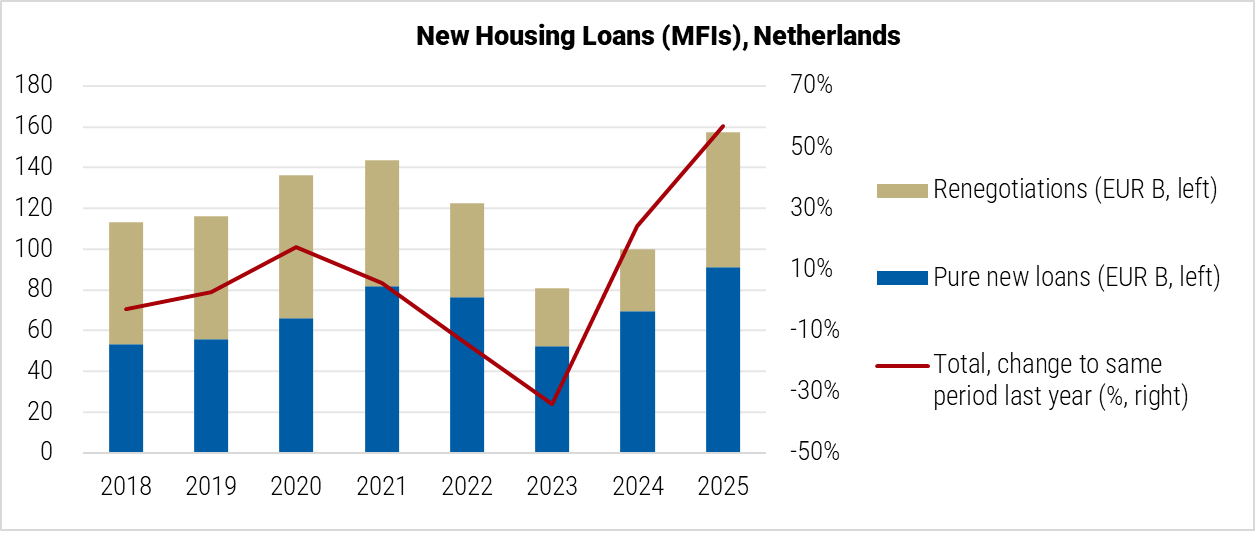
The prior decline in mortgage interest rates from their 2024-2024 peaks, along with rising wages and strong demand for housing, exacerbated by supply shortages, supported a strong rebound in new lending volumes in the Netherlands in 2025. The total amount of new housing loan business reported by monetary financial institutions between January and December of last year reached EUR 157.1 billion (USD 177.5 billion), which was 57.0% above the comparable period in 2024. Pure new loans registered a 31.0% year-on-year increase.
The recovery in demand for residential mortgages has also been registered by the quarterly bank lending survey published by De Nederlandsche Bank (DNB), the country’s central bank, which returned to a neutral and positive assessment of the demand dynamic since Q2 2024 after two years of declines perceived by the majority of lenders.
The reporting from the Hypotheken Data Netwerk (HDN), a digital platform facilitating the submission of approximately 85% of all mortgage requests in the country, shows that the first quarter of 2026 was also busier than the same period a year ago, although growth rates have moderated notably. The platform registered a 3.3% increase in the number of mortgage applications in Q1 2026 compared to Q1 2025, with activity driven by the anticipated interest rate hikes. The average mortgage amount applied for by buyers reached EUR 374,400, which was 1% higher than a year earlier.
Data Source: ECB.
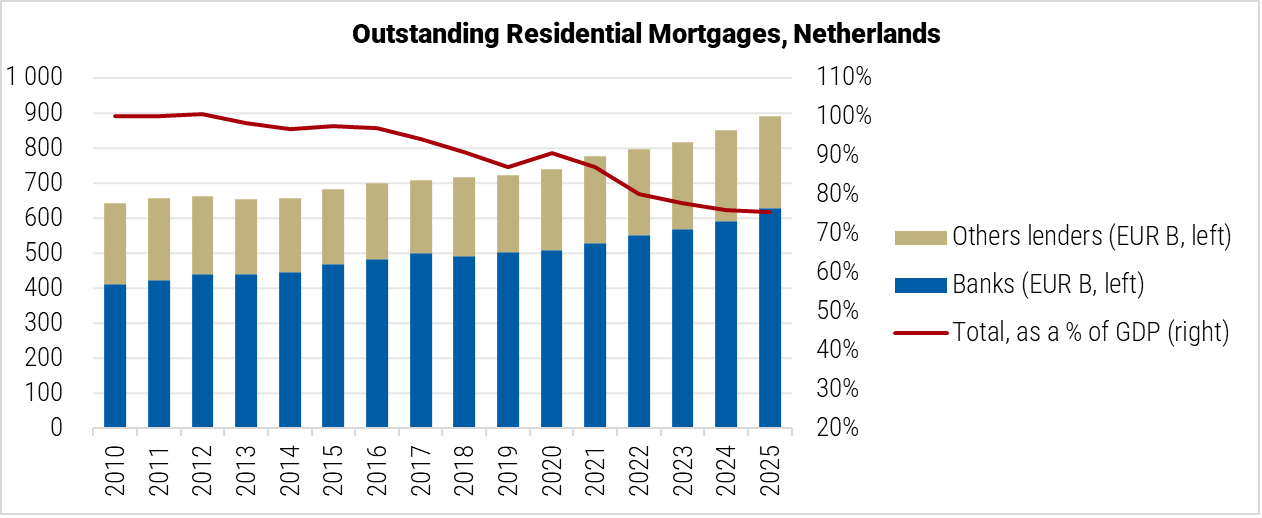
Against this background, after two years of modest growth, the country’s overall housing loan stock registered a more pronounced 4.3% and 4.6% increases in 2024 and 2025, respectively, with the total value of outstanding housing loans reaching EUR 890.2 billion (USD 1.01 trillion) at the end of last year, as reported by DNB. Of that amount, about 71% was credit issued by banks, and about 29% was credit issued by non-banking institutions, such as insurers, pension funds, investment funds, and others.
In relative terms, however, the size of the mortgage market in the Netherlands remained on its long-term downward trajectory, with the ratio of outstanding housing loans to GDP at current prices dropping from an estimated 100.1% in 2010 to 75.5% in 2025. According to the latest Eurostat figures, 57.9% of the country’s population currently lives in owner-occupied residences with an outstanding mortgage or housing loan.
Data Sources: DNB, ECB.
Economic and Social Factors
Slower Growth and Higher Inflation Expected Due to Energy Price Shock
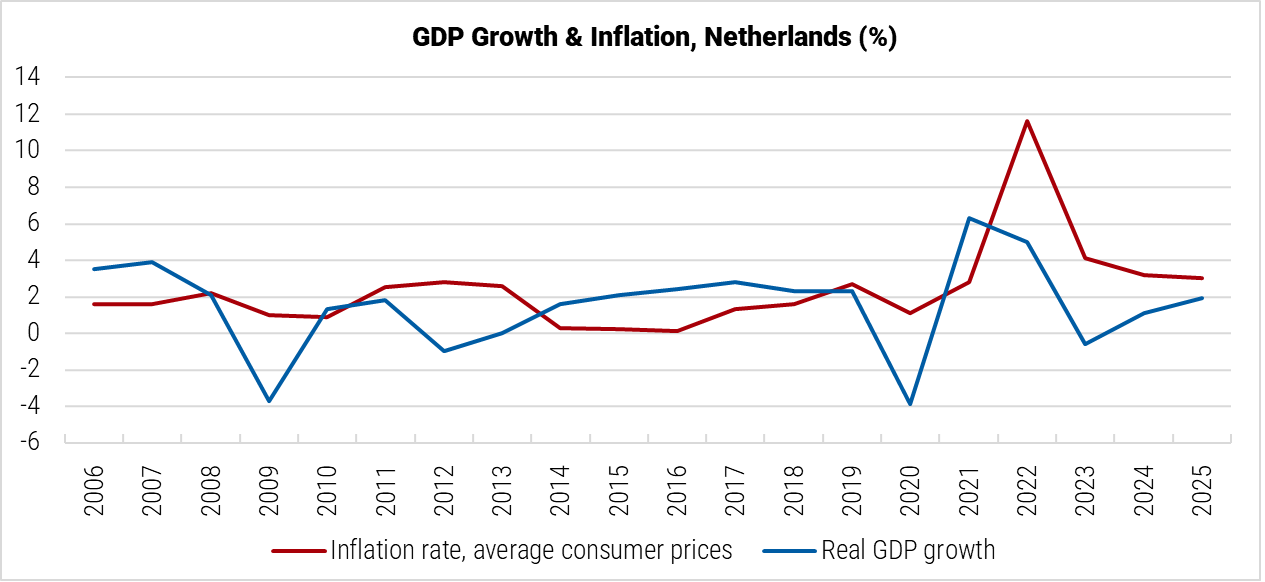
Supported by strong growth momentum and ample macroeconomic buffers, the Dutch economy demonstrated resilience in 2025, with the real GDP growth reaching 1.9%, according to the International Monetary Fund (IMF) figures. However, over the next two years, economic activity growth is projected to slow, as elevated global uncertainty and domestic structural bottlenecks are dampening consumption, investment, and trade. The IMF currently projects growth at 1.2% in 2026 and 1.4% in 2027, while the spring forecast from the European Commission offers an even more conservative outlook of 1.0% and 1.1%, respectively.
Consumer price index (CPI) inflation in the country previously eased gradually from the annual level of 4.1% in 2023 to 3.2% in 2024 and 3.0% in 2025. Most recently, CBS reported the indicator at an estimated 2.8% in April 2026. Considering the impact of the conflict in the Middle East on energy prices, the return of headline inflation to its 2% target is now notably delayed. The IMF expects inflation in the Netherlands to average 2.7% in 2026 and 2.4% in 2027. The European Commission forecasts the indicator at 3.2% this year and 2.5% next year.
Data Source: IMF.
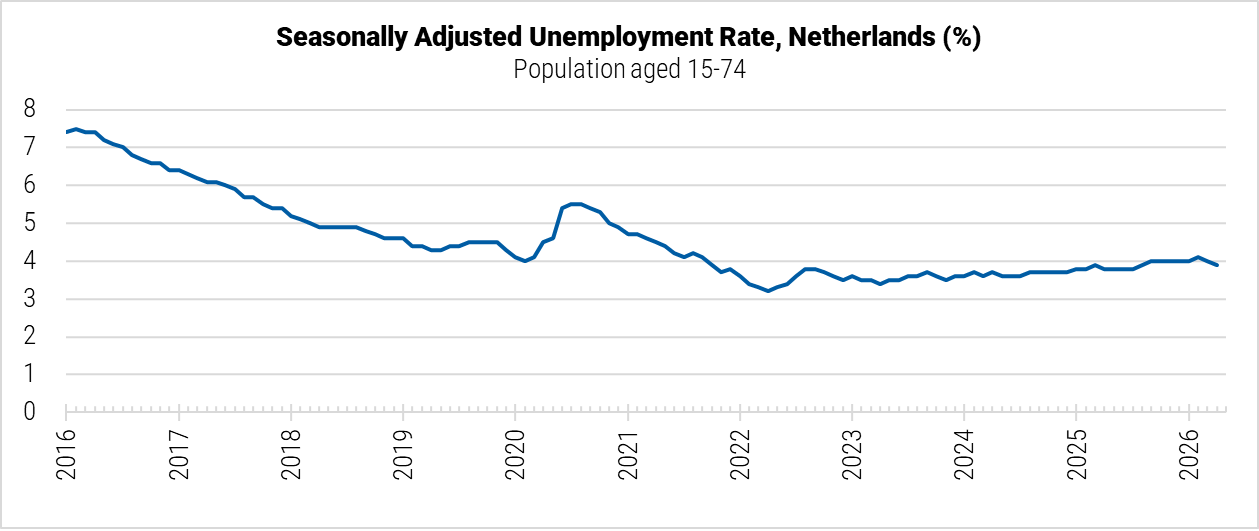
The Dutch labor market remains resilient amid headwinds, according to the European Commission’s assessment. Over the past several years, the unemployment rate edged up from the average level of 3.5% in 2022 to 3.9% most recently reported by CBS in April 2026, although the trend is primarily attributed to rising labor force participation rather than job losses. Looking ahead, slower employment growth and mild job losses are expected to push the unemployment rate up to 4.4% in 2027, though it will remain relatively low. Following strong increases in recent years, nominal wage growth is projected to moderate to 3.8% in 2026 and 3.6% in 2027.
Data Source: CBS.
Overall, the Dutch economy is seen as a wealthy and competitive one. At the beginning of 2026, Fitch Ratings affirmed the Netherlands’ ‘AAA’ standing with a stable outlook, pointing out that its strong institutional set-up, reinforced by eurozone membership, supports consensus-based policy-making and fiscal responsibility.
At the same time, the economy’s openness and relatively small size make it highly sensitive to global developments, with risks to the outlook currently tilted to the downside amid elevated uncertainty tied to the duration and impact of the Middle East conflict.
After prolonged political instability, the pro-EU centrist party D66 won the general election in the Netherlands in the fall of 2025. Among the key development vectors it plans to focus on, a new government, which took office in February 2026, outlined housing construction and delivery of affordable rental units across the country.
Sources:
- Statistics Netherlands (CBS)
- House Prices up by 5 Percent in March, Year on Year: https://www.cbs.nl/
- Growth of Housing Stock Slows for Third Year in a Row: https://www.cbs.nl/
- Inflation at 2.8 Percent in April According to Flash Estimate: https://www.cbs.nl/
- Housing Rents up by 4.9 Percent: https://www.cbs.nl/
- Rent Increases the Highest in Over 30 years: https://www.cbs.nl/
- Unemployment Down in April: https://www.cbs.nl/
- De Nederlandsche Bank (DNB)
- Size and Breakdown of the Mortgage Market: https://www.dnb.nl/
- Bank Mortgage Lending Rates: https://www.dnb.nl/
- Mortgage Supply and Demand (Bank Lending Survey): https://www.dnb.nl/
- Government of the Netherlands
- Sufficient New Construction Plans for 100,000 New Homes per Year (NL): https://www.rijksoverheid.nl/
- Rented Housing: https://www.government.nl/
- What is the Maximum Rent I Pay for My Home? (NL) https://www.rijksoverheid.nl/
- What is the Maximum Rent Increase for a Social Housing Unit in 2026 (NL): https://www.rijksoverheid.nl/
- What is the Maximum Rent Increase for a Mid-Market Rental Home in 2026 (NL): https://www.rijksoverheid.nl/
- What is the Maximum Rent Increase for a Private Sector Home in 2026 (NL): https://www.rijksoverheid.nl/
- The Government’s Plans in Plain Language: https://www.government.nl/
- Land Registry (Kadaster)
- Housing Market in Q4 2025 (NL): https://www.kadaster.nl/
- Ministry of Housing and Spatial Planning
- The Statistical Housing Shortage Explained (NL): https://www.volkshuisvestingnederland.nl/
- State of Public Housing 2025 (NL): https://www.volkshuisvestingnederland.nl/
- European Central Bank (ECB)
- ECB Data Portal: https://data.ecb.europa.eu/
- Key ECB Interest Rates: https://www.ecb.europa.eu/
- Monetary Policy Decisions, 30 April 2026: https://www.ecb.europa.eu/
- European Commission
- Project: Centralized Planning to Increase Housing Supply: https://commission.europa.eu/
- Economic Forecast for the Netherlands: https://economy-finance.ec.europa.eu/
- Distribution of Population by Tenure Status, Type of Household, and Income group: https://ec.europa.eu/
- International Monetary Fund (IMF)
- Country Overview: The Netherlands: https://www.imf.org/
- Staff Concluding Statement for the 2026 Article IV Consultation Mission: https://www.imf.org/
- 2025 Article IV Staff Report: https://www.imf.org/
- The Organisation for Economic Co-operation and Development (OECD)
- OECD Economic Surveys: Netherlands 2025: https://www.oecd.org/
- ABN AMRO
- Housing Market Cools: House Prices Set to Rise by 3 Percent in 2026: https://www.abnamro.com/
- Housing Market Monitor – Uncertainty is Slowing the Housing Market: https://assets.ctfassets.net/
- Housing Market Monitor – Lower Housing Costs for Those Who Can Afford It: https://assets.ctfassets.net/
- Hypotheken Data Netwerk (HDN)
- Q1 2026 Review (NL): https://hdn.nl/
- Pararius
- Rental Report Q1 2026: https://www.pararius.com/
- ING
- House Prices Expected to Stay Stable Until the End of the Year… (NL): https://www.ing.nl/
- Rabobank
- Housing Market Quarterly: House Prices Will Rise Slightly This Year: https://www.rabobank.com/
- NVM
- NVM: Housing Market is More Balanced Due to Increased Supply and Flattening Prices (NL): https://www.nvm.nl/
- Funda
- Funda Index, Q4 2025 (NL): https://pers.funda.nl/
- Capital Value
- New Built Residential Market Overview: https://research.capitalvalue.nl/
- Dutch Senate Approves Affordable Rent Act: https://www.capitalvalue.nl/
- Fitch Ratings
- Fitch Affirms the Netherlands at 'AAA'; Outlook Stable: https://www.fitchratings.com/
- Reuters
- ECB to Hike Rates in June and at Least Once More on War-Led Inflation Spike: Reuters Poll: https://www.reuters.com/
- Dutch Centrist D66 Party Confirmed as Election Winner: https://www.reuters.com/