Turkey Residential Real Estate Market Analysis 2026
Deferred demand, high rents, and somewhat eased borrowing costs underpin domestic buyer activity in the Turkish housing market, while strong nominal price growth is offset by still-high inflation, resulting in real-term price declines nationwide and in the largest urban submarkets.
This extended overview from Global Property Guide covers key aspects of the Turkish housing market and takes a closer look at its most recent developments and long-term trends.
Table of Contents
- Property Prices and Price Index
- Historic Perspective
- Property Demand Trends
- Property Supply Trends
- Rental Market: Rents and Rental Yields
- Mortgage Market and Interest Rates
- Economic and Social Factors
Property Prices and Price Index
Despite continued nominal sale-price growth and still-positive market sentiment, Turkey’s housing market in early 2026 remained characterized by real price declines, as inflation continued to outpace house-price increases nationally and in the largest urban markets. According to the Central Bank of the Republic of Turkey (CBRT), the Residential Property Price Index (RPPI) rose by 26.36% year-on-year in February 2026, corresponding to a 3.93% decline after adjusting for inflation.
Among the three largest cities, Ankara posted the strongest year-on-year growth at 29.69%, marking an inflation-adjusted decline of 1.40%. In Istanbul, the index increased by 27.99%, down 2.69% in real terms, while Izmir registered a 25.82% rise, equivalent to a 4.34% real-term drop.
Turkey's house price annual change:
Nationwide, the average housing unit price stood at TRY 45,447 (USD 1,076) per square meter in Q4 2025, up by 26.03% year-on-year. Istanbul remained the country’s most expensive major market at TRY 74,101 (USD 1,755) per square meter, while Ankara recorded the fastest annual increase among the largest cities, with prices rising by 38.69% year-on-year. Muğla also stood out with an average of TRY 76,619 (USD 1,815) per square meter, remaining well above the national average and underlining the premium still commanded by Turkey’s high-value coastal markets.
Average housing unit price, selected submarkets:
| Average Housing Unit Price, Q4 2025, TRY/sqm |
Average Housing Unit Price, Q4 2025, USD/sqm |
YoY | |
| İstanbul | TRY 74,101 | USD 1,755 | 33.51% |
| Ankara | TRY 41,281 | USD 978 | 38.69% |
| İzmir | TRY 49,544 | USD 1,173 | 22.04% |
| Antalya | TRY 50,363 | USD 1,193 | 26.20% |
| Bursa | TRY 36,404 | USD 862 | 29.05% |
| Mersin | TRY 35,476 | USD 840 | 26.74% |
| Muğla | TRY 76,619 | USD 1,815 | 17.01% |
| Nationwide | TRY 45,447 | USD 1,076 | 26.03% |
| Note: Exchange rate as of Q4 2025, USD 1 = TRY 42.2256. | |||
| Data Source: CBRT. | |||
Forward-looking indicators continued to point to further nominal house-price increases, although expectations for real price growth remained more cautious. On the industry side, the KONUTDER/NielsenIQ Housing Sector Expectations Survey for H2 2025, based on the views of 25 housing developers and investors, showed that 72.0% expected housing prices to rise over the following six months, while the remaining 28.0% anticipated broadly stable prices and none expected a decline. On the household side, the CBRT’s February 2026 Household Expectations Survey showed that households still expected housing prices to increase by 35.4% over the next 12 months, although this was down from 39.2% in January. Taken together, these findings suggest that both professional market participants and households continued to expect further sale-price growth, even if expectations had become somewhat more measured by early 2026.
Recent professional commentary also supports a view of continued nominal price increases, but with a more moderate profile. Prof. Dr. Ali Hepşen said that gradual easing on the interest-rate side would not create “a sharp price jump at once,” but could create conditions in which “the real decline stops” and a recovery begins in some areas. Similarly, housing economist Ahmet Büyükduman argued there was an expectation that prices could move “somewhat above inflation” as demand indicators strengthen.
Historic Perspective:
Rapid Urbanization, Lira Depreciation, and Inflation Hedge Role of Housing
From the mid-2000s through 2017, Turkey’s housing market underwent a prolonged expansion driven by rapid urbanization, large-scale construction activity, and strong domestic demand. During this period, nominal prices rose across most major cities, new supply increased sharply as developers responded to growing demand for apartment living, and transaction volumes expanded as credit conditions and household income supported home purchases.
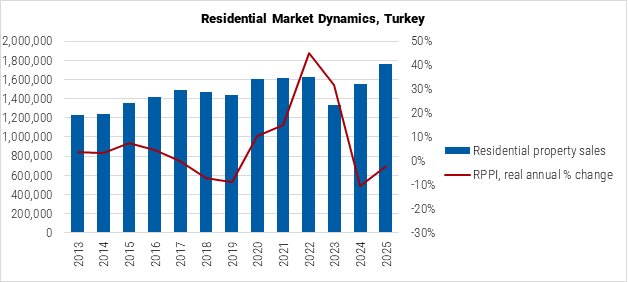
Beginning in 2018, the housing market was reshaped by macroeconomic volatility: a sharp depreciation of the lira and an associated economic slowdown in 2018, followed by subsequent large exchange-rate moves and a period of very high consumer inflation, produced wide nominal house-price swings; at the same time, inflation-adjusted (real) house-price gains were actually recorded as negative.
From 2020 to 2022, property increasingly functioned as an inflation hedge for many investors, supporting robust demand for housing. Coupled with supply-side cost pressures, this led to particularly large nominal gains in property prices that were, however, uneven across regions and materially reduced once adjusted for inflation.
The February 2023 earthquakes introduced a major market shock. Emergency reconstruction programs, large public housing initiatives, and rebuilding activity accelerated construction in affected provinces and reshaped local demand and pricing dynamics. These developments amplified regional divergence: affected provinces saw intense rebuilding-related demand while other urban centers experienced differing post-shock trajectories.
Transaction volumes were volatile through 2023-24: overall annual house sales fell in 2023 relative to 2022, mortgage-financed sales contracted during episodes of tight credit and high rates, and pockets of recovery emerged in 2024 when windows of cheaper mortgage finance and episodic policy easing temporarily encouraged buyers. Foreign purchases were important for particular segments (coastal and large-city markets), peaking in 2022 and then declining sharply in 2023-24 as higher and more complex thresholds for investment-linked residency/citizenship dampened demand.
By 2025, Turkey’s housing market was showing a clearer recovery in activity than in real pricing. Residential sales rose strongly to a new multi-year high, but real house prices still declined slightly, indicating that demand had strengthened even though the market had not yet returned to broad-based real appreciation.
Data Sources: CBRT, TURKSTAT, Global Property Guide.
Property Demand Trends
Housing Demand Remains Resilient, Led by Domestic Purchasers and Deferred Demand
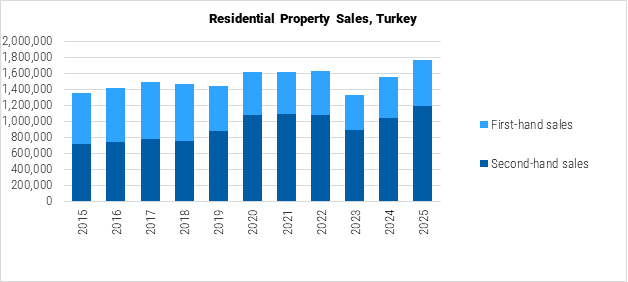
Residential property sales in Turkey remained robust in 2025, with the recovery driven primarily by domestic demand rather than foreign capital. According to the Turkish Statistical Institute (TURKSTAT), a total of 1,760,292 homes were sold nationwide in 2025, up 13.58% year on year. Resale properties represented 68% of all transactions and rose by 15.24% year on year, while first-hand sales accounted for the remaining 32%, increasing by a more moderate 10.28%. The rebound was therefore broad-based, but remained tilted toward existing inventory, where supply is immediately available, and pricing is generally more flexible.
Data Source: TURKSTAT.
The Turkish Real Estate Investors Association (GYODER) notes that market activity was supported by expectations of lower interest rates, housing’s continued role as a store of value, some improvement in access to finance, and internal migration following the February 2023 earthquakes. At the same time, the association stresses that homeownership remains difficult for middle-income households, meaning that stronger transaction volumes should not be interpreted as a full restoration of affordability.
A similar view has been expressed by market participants in the media. Mustafa Kemal Şahin of the Real Estate Marketing and Sales Professionals Association (GAPAS) noted that it was “not possible to explain the record with a single factor,” citing deferred demand, post-earthquake mobility, and high rental costs as key influences on buyer behavior. The Construction Contractors Association (AYİDER) Chairman Hakan Şişik likewise argued that high rents and expectations of renewed price increases encouraged households to bring purchases forward.
Going into 2026, demand appears to have shifted from a sharp rebound to a more stable phase. Total sales reached 236,029 units in January-February, up by just 0.60% year on year. That near-flat reading is better interpreted as normalization after a very strong 2025 rather than as a meaningful deterioration in market conditions. February sales still rose by 5.9% year on year to 124,549 units, suggesting that buyer interest remained present, but that the market was no longer accelerating at the pace seen during the catch-up phase of the previous year.
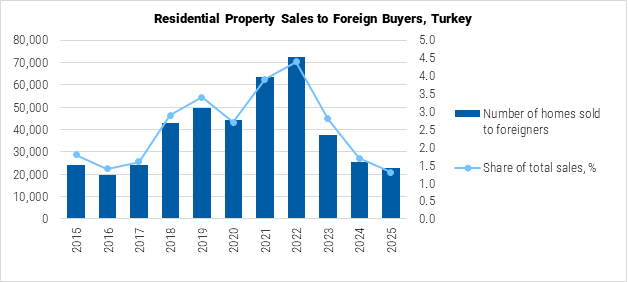
At the same time, the rebound in market activity remained overwhelmingly domestic. Foreign purchases continued to decline in 2025, falling to 22,980 units, down 10.50% from the previous year, while their share of total transactions dropped to just 1.3%, compared with 1.7% in 2024 and 4.4% at the market peak in 2022. Russian buyers remained the largest group, followed by Iranians, Ukrainians, and buyers from Germany and Iraq.
Industry professionals argue that this prolonged decline reflects both weaker relative affordability and a less supportive administrative environment. Bayram Tekçe, chairman of the Real Estate Service Exporters Association (GİGDER), said that the “rapid rise in property prices” and the slowing of residence-permit procedures were among the main reasons behind the decline, helping explain why foreign demand has become narrower, more selective, and far less important to national market momentum than it was at its peak.
Data Source: TURKSTAT.
Regionally, Istanbul accounted for the largest share of transactions, representing 18% of national sales and recording year-on-year growth of 16.51%. Collectively, the four main markets of Istanbul, Ankara, Izmir, and Antalya accounted for 37% of total transactions and recorded year-on-year growth of 15.47%. Among international buyers, Istanbul, Antalya, and Mersin remained the most sought-after destinations.
Residential sales, selected regions:
| Region | Total Residential Property Sales, 2025 |
YoY, % | Residential Property Sales to Foreigners, 2025 |
YoY, % | Share of Sales to Foreigners in Total Sales, % |
| Istanbul | 310,453 | 16.51% | 9,101 | -5.25% | 2.9% |
| Ankara | 153,470 | 13.35% | 772 | 19.50% | 0.5% |
| Izmir | 100,084 | 19.47% | 416 | 0.00% | 0.4% |
| Antalya | 87,639 | 11.37% | 7,237 | -14.39% | 8.3% |
| Bursa | 60,707 | 9.82% | 438 | -22.06% | 0.7% |
| Mersin | 59,919 | 20.73% | 1,929 | -13.77% | 3.2% |
| Muğla | 24,247 | 5.54% | 388 | 4.30% | 1.6% |
| Nationwide | 1,760,292 | 13.58% | 22,980 | -10.50% | 1.31% |
| Data Source: TURKSTAT. | |||||
Looking ahead, housing demand in Turkey is expected to remain resilient, although the next phase is likely to be steadier and more selective than the rebound recorded in 2025. Mustafa Ekiz, President of the Real Estate and Construction Platform, noted that 2025 was “not an endpoint, but a transition point,” and that in 2026 the sector would become “more selective but lively.” Hakan Bucak, Chairman of the Board of Hakan Bucak Real Estate, similarly argued that a more selective market should be viewed as “maturing, not weakening.” In this context, high rents, deferred demand, replacement demand, and households’ continued preference for housing as a value-preservation asset should continue to underpin activity, while affordability pressures are likely to keep the recovery uneven across segments.
Property Supply Trends
Residential Construction Rebounds, But Completed Delivery Remains Gradual
Residential construction in Turkey strengthened markedly in 2025, with permit issuance rebounding sharply and pointing to a significantly fuller future supply pipeline. According to the latest TURKSTAT data, 1,109,424 residential units received construction permits in 2025, representing a 30.25% year-on-year increase and marking the highest total since 2017. The majority of permitted units (95%) were part of multi-dwelling developments, which recorded an annual growth rate of 31.67%. By contrast, single-unit homes accounted for just 5% of permits, with more modest growth of 9.40% year-on-year.
GYODER attributes the rebound in permit activity to expectations of stronger demand after several weak years, limited supply in previous periods, faster earthquake housing construction, and the ongoing urban transformation process. The earthquake-reconstruction cycle appears especially important: in the 11 provinces affected by the February 2023 earthquakes, 308,628 dwellings received permits in 2025, accounting for almost 28% of the national total. Against this backdrop, stronger permit issuance is only beginning to translate into higher completed supply. Occupancy approvals are therefore likely to continue increasing with a lag.
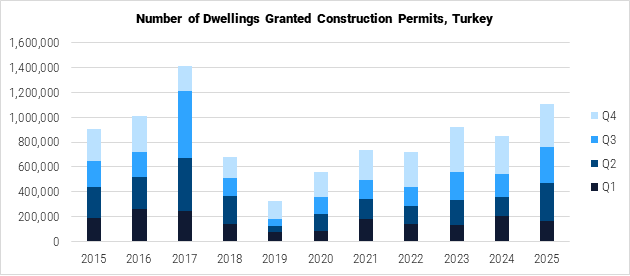
Note: Data covers only one-dwelling and multi-dwelling residential buildings.
Data Source: TURKSTAT.
The TURKSTAT reported 671,553 dwellings receiving occupancy permits in 2025, representing a more modest 5.89% year-on-year increase. Within this total, multi-dwelling developments registered a 6.92% year-on-year increase, while single-unit homes declined, falling 10.72% year-on-year. In other words, the pipeline is rebuilding, but the pass-through into finished stock remains gradual.
Despite these advances, affordability remains one of the sector’s main challenges. Elevated construction costs, with the construction cost index still up 24.5% year-on-year in December 2025, continue to weigh on project economics, while still-restrictive financing conditions limit access to homeownership for many households. Industry bodies argue that stronger growth in supply alone will not be sufficient unless accompanied by measures that improve affordability, expand access to finance, and lower land costs. This has increased attention on delivery models that combine publicly produced land with private-sector development capacity to accelerate the supply of lower-cost housing.
In response, policymakers are preparing a landmark social housing initiative. The government plans to launch the largest program of its kind in the Republic’s history, targeting 500,000 units across all 81 provinces. In addition, a rental social housing program will be implemented for the first time in order to offset high rent increases in Istanbul. Together, these initiatives are expected to expand access, ease affordability pressures, and reinforce the ongoing recovery in residential supply, even though first deliveries are only planned from March 2027, so they will not fully ease near-term tightness.
Rental Market: Rents and Rental Yields
Rental Inflation High But Consistently Moderating
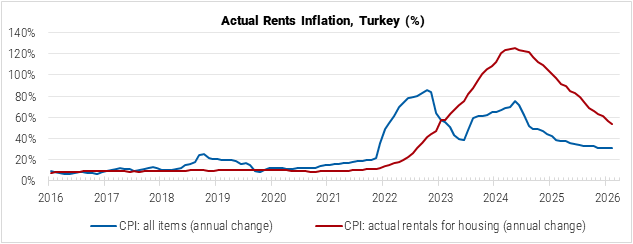
Previously pushed to record highs by macroeconomic imbalances, increased foreign demand, and the impact of the 2023 earthquake, rental inflation in Turkey continues to decelerate, although it still outpaces both the overall growth of consumer prices and growth in sales prices for residential properties, incentivizing many tenants to seek homeownership options.
Turkey's rent price index:
In February 2026, the TURKSTAT reported a 53.9% year-on-year increase in the actual rentals for the housing component of the consumer price index (CPI), a notable decline from 78.9% inflation rate registered in July and 97.2% observed a year earlier in February 2025. The all-item CPI during the same period recorded an annual increase of 31.5%, down from 33.5% in July and 39.1% in February 2025.
Data Source: TURKSTAT.
A decelerating trajectory is also demonstrated by the New Tenant Rent Index (NTRI), recently developed by the CBRT based on rental valuations obtained from banks for the calculation of the Housing Price Index (HPI). Over twelve months to February 2026, the nationwide index increased by 34.2%, compared to 49.1% over twelve months to July 2025 and 53.9% over the twelve months to February 2025. Regionally, the most pronounced annual growth in new tenant rents was reported in Istanbul (41.0%), while the slowest annual growth was observed in the region of Hatay, Kahramanmaraş, and Osmaniye (20.0%).
“With the tightening of monetary policy, annual growth rates [for the NTRI] followed a downtrend starting in the final quarter of 2023,” the central bank commented in a recent blog post. “As of January 2026, annual NTRI increases fell below 40% both nationwide and across the three major provinces.”
Assessing this trend amid heightened macroeconomic uncertainty, which is expected to persist until the end of the year, some local analysts now describe Turkey’s rental market as cooling. “Landlords, fearful of losing reliable tenants or facing long vacancies, are opting for minimal increases or keeping rents steady,” the news platform PA Turkey wrote in February. “In many cases, effective rental rates have fallen below levels seen two years ago.”
Average rent of appraised residential properties in selected submarkets:
| Average Unit Rent, TRY/sqm Q4 2025 |
Average Unit Rent, USD/sqm Q4 2025 |
YoY, % Q4 2025 vs Q4 2024 |
|||
| İstanbul | TRY 367.9 | USD 8.7 | 41.2% | ||
| Ankara | TRY 210.1 | USD 5.0 | 42.8% | ||
| İzmir | TRY 252.2 | USD 6.0 | 32.3% | ||
| Antalya | TRY 230.9 | USD 5.5 | 34.6% | ||
| Bursa | TRY 185.4 | USD 4.4 | 34.8% | ||
| Mersin | TRY 174.9 | USD 4.1 | 35.6% | ||
| Muğla | TRY 325.8 | USD 7.7 | 34.7% | ||
| Turkey | TRY 224.8 | USD 5.3 | 33.2% | ||
| Note: Exchange rate as of Q4 2025, USD 1 = TRY 42.22561. | |||||
| Data Source: CBRT. | |||||
In nominal terms, the CBRT reported the average rent of appraised residential properties at TRY 224.8 (USD 5.3) per sqm in Q4 2025. Istanbul remained the most expensive rental submarket, followed by Muğla, Izmir, Çanakkale, and Antalya, in all of which the indicator exceeded the national average.
As for gross rental yields for residential units in Turkey, research conducted by Global Property Guide in February 2026 found them at an average level of 7.32%, down from 7.76% previously reported in August 2025. The highest potential performance among the surveyed submarkets was estimated for rental properties in Istanbul (8.17%) and Ankara (8.10%), while the lowest yields were recorded in Antalya (6.14%).
Mortgage Market and Interest Rates
Interest Rates Ease Somewhat, Lending Activity Picks Up
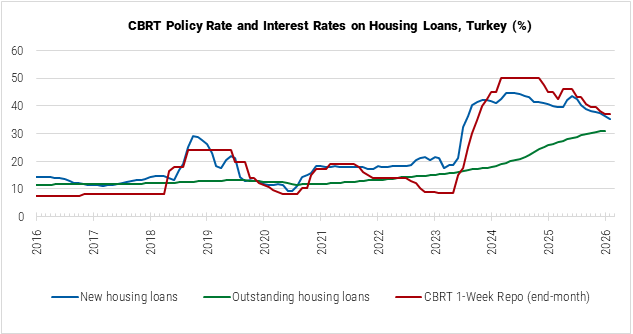
Following a temporary re-tightening in Q2 2025, the CBRT continued to cautiously relax its monetary policy in the second half of the year, eventually bringing down the 1-Week Repo Rate to its current level of 37%. Despite earlier projections, at the most recent policy meeting in March 2026, the regulator made no additional cuts, opting to maintain the benchmark rate amid heightened uncertainty related to regional geopolitical developments and energy prices.
Turkey's mortgage loan interest rates:
While further trims later this year are still anticipated by industry experts as of the time of this research, based on elevated uncertainty and revised inflation forecasts for Turkey, CBRT’s rate-cutting cycle is likely to slow in 2026, reflecting, in turn, a slower moderation of mortgage rates offered by the country’s lenders.
Data Source: CBRT.
Previously, mirroring the policy rate trajectory, the average interest rate on new housing loans in Turkey eased somewhat over the second half of the year, dropping from 42.6% in July 2025 to 36.2% in January 2026. Nonetheless, the indicator remains substantially elevated compared to pre-2023 levels, consistently pushing up the average interest rate on outstanding housing loans, which reached 31.0% in January 2026.
A similar trend was observed for loan profit rates reported by the country’s participation banks (Islamic banking), the indicator reaching 37.1% (-5.8 points since July) for new loans and 31.9% (+1.6 points since July) for outstanding loans in January 2026.
Weighted average interest rates on housing loans:
| Jan 2026 | YoY | Jan 2025 | YoY | Jan 2024 | |
| New housing loans | 36.2% | ↓ | 40.5% | ↓ | 41.6% |
| Outstanding housing loans | 31.0% | ↑ | 25.7% | ↑ | 18.0% |
| Data Source: CBRT. | |||||
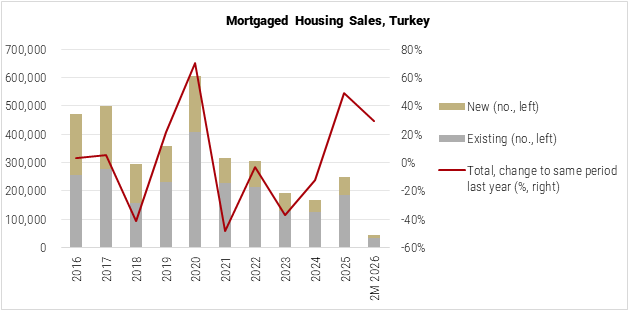
Reflecting a certain easing of interest rates, the annual volume of mortgaged housing sales (a general indicator of lending activity) returned to growth in 2025 after several years of declines. Between January and December 2025, a little over 248 thousand mortgaged sales were reported by the TURKSTAT, representing a 48.8% gain against the previous year. The trend has continued into early 2026, with the number of mortgage transactions registered in the first two months of the year reaching 45.3 thousand, a 29.0% increase compared to the same period in 2025.
Despite this apparent rebound, overall lending activity levels in Turkey are still subdued. The share of mortgaged sales in total housing transactions in 2025 reached just 14.1%, which was above the 10.8% ratio reported in 2024, but substantially below the 30.5% annual average observed between 2015 and 2020.
Data Sources: CBRT, TURKSTAT.
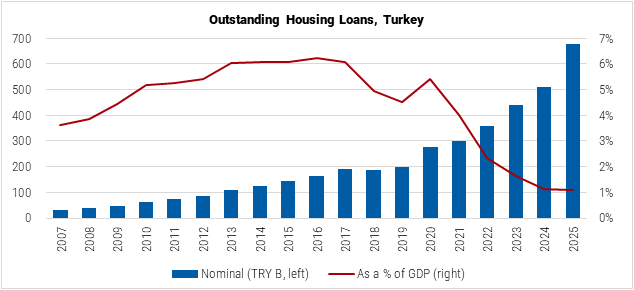
At the same time, the nominal size of the housing credit market in Turkey continues to expand rapidly, with the total value of outstanding housing loans demonstrating an average annual growth rate of 19.8% in the last five years. At the end of 2025, the combined loan stock of the country’s banking sector stood at TRY 678.3 billion (USD 17.2 billion), of which 90.3% was maintained by deposit money banks, and the remaining 10.3% split between participation banks and investment and development banks.
In relative terms, however, it is still significantly smaller than in other countries with well-developed mortgage systems. Moreover, Turkey’s loan-to-GDP ratio has been on a downward trajectory in recent years, dropping from an estimated 6.2% in 2016 to 5.5% in 2020 and just 1.1% of GDP at current prices in 2025.
Data Sources: CBRT, OECD.
Economic and Social Factors
Geopolitical Shock Increases Risks to Macroeconomic Stabilization
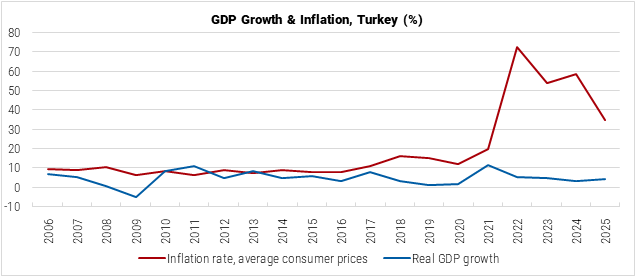
Following periods of strong growth driven by expansionary fiscal and monetary policies, which stimulated domestic demand but created large imbalances, including surging inflation, a widening current account deficit, and a large depreciation of the national currency, Turkey is now in the midst of macroeconomic stabilization aimed at taming inflation and creating the conditions for sustainable growth. Based on the latest figures from the TURKSTAT, the country’s real GDP growth re-accelerated from 3.3% in 2024 to 3.6% in 2025 and is expected to remain solid in the upcoming periods by early 2026 forecasts, with the International Monetary Fund (IMF) projecting growth to reach 4.2% in 2026 and 4.1% in 2027.
While gradually falling from the extraordinary peak of 72.3% in 2022 to 34.9% in 2025 and most recently reported by the TURKSTAT at 31.5% in February 2026, consumer price index (CPI) inflation in Turkey remains high, particularly for services, and especially rents. The trend is projected to continue over the forecast period, with the average annual inflation falling to 24.7% in 2026 and 19.5% in 2027. “Tight monetary policy, moderate wage growth, and broadly neutral fiscal policy are expected to support gradual disinflation,” said the 2025 Article IV staff report from the IMF.
It should be noted, however, that these earlier projections do not account for the latest shock from the Middle East conflict, which has increased near-term risks to the macroeconomic outlook, according to expert commentary. The full impact of recent geopolitical developments on Turkey’s economy will depend on both the scale and duration of the disruption in the region.
“A prolonged conflict risks triggering higher inflation, widening the current account deficit, and slowing economic growth due to rising energy prices and regional instability,” PA Turkey wrote in early March 2026.
Data Source: IMF.
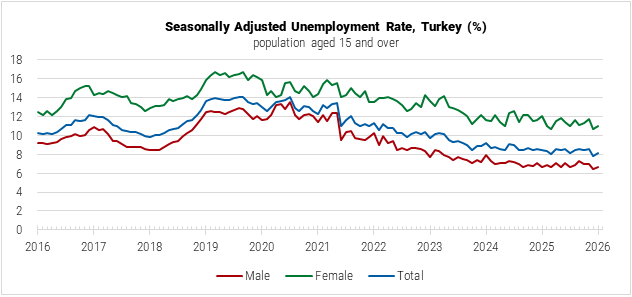
In a challenging macroeconomic landscape, the Turkish labor market is showing resilience, with formal sector employment at historical highs and unemployment and unregistered employment relatively low. As of January 2026, the seasonally adjusted unemployment rate was reported by the TURKSTAT at 8.1%. At the same time, the broader measure of labor underutilization (consisting of time-related underemployment, potential labor force, and unemployment) remained high at 29.9% during the same period.
Earlier in 2025, an economic survey from the Organization for Economic Co-operation and Development (OECD) noted that lifting labor force participation will be essential for Turkey’s future development. While the country’s economy has benefited from a young and dynamic population over the past decades, this “demographic dividend” is set to gradually decline, slowing future potential growth.
Data Source: TURKSTAT.
Overall, the still-high inflation environment means the Turkish economy remains highly exposed to risks, as outlined in the IMF staff report, which points out that “a soft landing might be difficult to achieve”.
The fall 2025 analysis from the World Bank also viewed risks to Turkey’s outlook as skewed to the downside, noting that any premature easing of monetary policy could prompt domestic investors to seek foreign exchange, potentially putting pressure on the exchange rate, inflation, and reserves, while delays in substantial fiscal consolidation and slow progress on structural reforms could further impede disinflation. Externally, additional downside risks are tied to increased global economic uncertainty and higher-than-expected oil prices.
In January 2026, Fitch Ratings affirmed the country’s ‘BB-’ standing, citing a combination of fundamental strengths and weaknesses that define the economy. The outlook for Turkey’s sovereign rating was revised from stable to positive on account of a faster-than-expected rise in foreign-exchange reserves.
Sources:
- Turkish Statistical Institute (TURKSTAT)
- House and Commercial Property Sales Statistics, February 2026: https://veriportali.tuik.gov.tr/
- Building Permits, Quarter IV: October-December 2025: https://veriportali.tuik.gov.tr/
- Construction Cost Index, December 2025: https://veriportali.tuik.gov.tr/
- Consumer Price Index, February 2026: https://veriportali.tuik.gov.tr/
- Labor Force Statistics, January 2026: https://veriportali.tuik.gov.tr/
- Quarterly Gross Domestic Product, Quarter IV: October-December, 2025: https://veriportali.tuik.gov.tr/
- Central Bank of the Republic of Turkey (CBRT)
- Residential Property Price Index and New Tenant Rent Index, February 2026: https://www.tcmb.gov.tr/
- A New Indicator for Rents: The New Tenant Rent Index: https://tcmbblog.org/
- Household Expectations Survey, February 2026 (TR): https://tcmb.gov.tr/
- Monthly Money and Banking Statistics: https://www.tcmb.gov.tr/
- Interest Rate and Profit Rate Statistics: https://www.tcmb.gov.tr/
- Press Release on Interest Rates, March 12, 2026: https://www.tcmb.gov.tr/
- Republic of Türkiye Ministry of Trade
- Economic Outlook, February 2026: https://www.trade.gov.tr/
- International Monetary Fund (IMF)
- Country Overview: Turkey: https://www.imf.org/
- 2025 Article IV Staff Report: https://www.imf.org/
- World Economic Outlook Update, January 2026: https://www.imf.org/
- World Bank
- Turkey MPO, October 2025: https://thedocs.worldbank.org/
- Organization for Economic Co-operation and Development (OECD)
- OECD Data Explorer: https://data.oecd.org/
- OECD Economic Surveys: Türkiye 2025: https://www.oecd.org/
- European Central Bank (ECB)
- Turkish lira/Euro, Monthly: https://data.ecb.europa.eu/
- Federal Reserve Economic Data (FRED)
- US Dollar Exchange Rate: Average of Daily Rates: National Currency: USD for Turkey: https://fred.stlouisfed.org/
- Housing Developers and Investors Association (KONUTDER)
- 6-Month Outlook Indicators: KONUTDER Members’ Housing Sector Expectations H2 2025 Report (TR): https://konutder.org.tr/
- KONUTDER's Two Strategic Priorities for the New Era: Affordable Land and Accessible Financing (TR): https://konutder.org.tr/
- Real Estate Investors Association (GYODER)
- GYODER Indicator: Turkish Real Estate Sector Report, Issue 41, 2025/3 (TR): https://portal.gyoder.org.tr/
- Republic of Türkiye, Ministry of Environment, Urbanization, and Climate Change
- Century’s Housing Project (TR): https://evsahibiturkiye.gov.tr/
- Bahcesehir University Center for Economic and Social Research (BETAM)
- Sahibindex Rental Housing Market Outlook, February 2026 (TR): https://betam.bahcesehir.edu.tr/
- ING Think
- Monitoring Turkey: Geopolitical Shock Increases Risks: https://think.ing.com/
- Fitch Ratings
- Fitch Revises Turkiye's Outlook to Positive; Affirms at 'BB-': https://www.fitchratings.com/
- Reuters
- Turkey Cenbank Sells $8 bln in FX; Rate Cuts Seen in Question: https://www.reuters.com/
- Anadolu Agency
- Housing Prices Resumed Their Real Decline in December… (TR): https://www.aa.com.tr/
- Housing Sales Ended the Year With a Double Record (TR): https://www.aa.com.tr/
- Forbes Turkey
- Sharp Decline in Home Sales to Foreigners (TR): https://www.forbes.com.tr/
- ORSİAD
- Will the 2025 Momentum in the Real Estate Market Continue in 2026?: https://orsiad.com.tr/
- PA Turkey
- Why Turkish Investors Are Abandoning Housing for Gold: https://www.paturkey.com/
- What the Iran War Means for Türkiye: Inflation, Energy Risks and Geopolitics: https://www.paturkey.com/