Property Investment in Turkey: Foreigner’s Guide (2026)
Turkey appeals to tourists, digital nomads, expatriates, and foreign residents thanks to its beautiful coastline, rich cultural history, affordable housing, and popular citizenship program that grants citizenship to property owners investing at least $400,000. Although there are some national restrictions, they are few and generally limited in scope, including caps on the amount of land a non-citizen can own. Property prices in Turkey are among the lowest in the region, and rental yields are considered strong.
This recently updated 2025 edition guide will walk you through the basic steps and important considerations for first-time buyers looking to invest in Turkey.
12 Things to Know Before Buying a Property in Turkey
- Can Foreigners Buy Property in Turkey
- Best Cities and Regions to Invest
- Square Meter / Square Foot Prices
- Median Asking Prices
- Rental Yields and Rents
- Market Performance (Past and Present)
- Landlord and Tenant Laws
- Property Related Taxes
- Buying (and Selling) Costs
- Short-Term Rental Regulations
- Mortgage and Financing Options
- How to buy property in Turkey: step-by-step
1) Can Foreigners Buy Property in Turkey?
Yes, with a few exceptions. Foreign investors can own up to a total of 30 hectares across the country, but foreign ownership cannot exceed more than 10% of private land in any district. Some areas require approval by the governor, and military zones are off limits.
2) Best Regions and Cities to Invest
Turkey offers a diverse and dynamic real estate landscape, combining global metropolitan centers, fast-growing business hubs, lifestyle-driven coastal markets, and historically significant cities.
Istanbul
As Turkey’s financial, cultural, and commercial heart, Istanbul stands out as the country’s most important real estate market. The city’s sheer scale, international connectivity, and economic diversity support continuous demand across both residential and commercial segments. Central and well-connected districts such as Beşiktaş, Şişli, Kadıköy, and parts of Başakşehir and Maslak attract professionals, families, and international buyers alike. Strong domestic demand, ongoing infrastructure projects, and limited land availability in prime areas contribute to long-term value growth and resilient rental performance.
Ankara
Turkey’s capital city offers a more stable and institution-driven property market, supported by government offices, universities, and a large professional population. Neighborhoods such as Çankaya, Yenimahalle, and Gölbaşı are particularly attractive for residential investment due to consistent demand from civil servants, academics, and long-term tenants. While price growth tends to be more moderate than in Istanbul, Ankara appeals to investors seeking predictability, lower volatility, and steady rental income.
Izmir
Located on the Aegean coast, Izmir combines a relaxed lifestyle with a growing economy and strong demographic fundamentals. The city has gained popularity among young professionals, families, and returnee expatriates looking for a balance between urban living and coastal quality of life. Areas such as Alsancak, Karşıyaka, and Bornova offer attractive investment opportunities, supported by universities, commercial activity, and improving infrastructure. Izmir’s rising profile continues to drive long-term appreciation and healthy rental demand.
Antalya
Antalya is one of Turkey’s most prominent tourism and lifestyle-driven real estate markets. With its Mediterranean climate, modern infrastructure, and international appeal, the city attracts both short-term visitors and long-term foreign residents. Districts such as Lara, Konyaaltı, and parts of Alanya are especially popular for holiday homes and rental properties. Year-round tourism, combined with strong demand from international buyers, makes Antalya particularly appealing for investors focused on rental yields and foreign-currency exposure.
Bodrum
Known for its luxury marina lifestyle, upscale resorts, and scenic coastline, Bodrum represents the premium end of Turkey’s real estate market. The area attracts high-net-worth individuals, second-home buyers, and seasonal residents seeking exclusivity and lifestyle value. Neighborhoods such as Yalıkavak, Türkbükü, and Gümüşlük are especially prized for high-end villas and boutique developments. While entry prices are higher, Bodrum offers strong long-term value retention and appeal within the luxury segment.
Bursa
As an important industrial and cultural city near Istanbul, Bursa offers a compelling mix of affordability, economic strength, and historical character. Its manufacturing base, growing population, and proximity to major transport routes support steady housing demand. Districts such as Nilüfer are particularly attractive due to modern urban planning and family-oriented developments. Bursa appeals to investors looking for emerging-market potential with solid fundamentals and room for future growth.
3) Square Meter / Square Foot Prices
Square meter prices in Turkey are moderate compared to other Middle Eastern countries. Average rates are three times as much in Istanbul compared to Kayseri, where prices are lowest.
- Istanbul – $1,518
- Antalya – $1,102
- Izmir – $1,062
- Ankara – $846
- Bursa – $759
- Adana – $747
- Konya – $690
- Kayseri – $522
4) Median Asking Prices
The median asking prices in Turkey are almost the lowest in the Middle East. As of January 2026, one-bedroom apartments ranged from $35,000 to $82,000, making them an affordable option for investors.
- Istanbul – $79,000
- Ankara – $82,000
- Antalya – $79,000
- Izmir – $73,000
- Bursa – $48,000
- Konya – $44,000
- Adana – $35,000
5) Rental Yields and Rents
Turkey’s rental yields are considered very good, averaging 7.76% overall
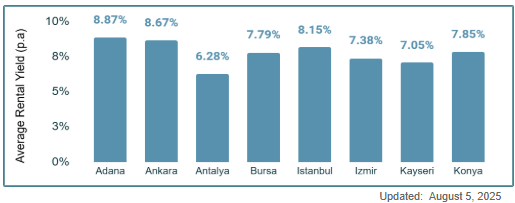
As of August 2025, the average yield for one-bedroom apartments across Turkey was as follows:
- Istanbul – 8.84%
- Ankara – 8.17%
- Antalya – 6.68%
- Iszmir – 8.11%
- Adana – 11.31%
- Konya – 10.58%
- Bursa – 8.52%
Turkey's rent price index:
Data Source: OECD.
6) Market Performance (Past and Present)
From the mid-2000s through 2017, Turkey’s housing market expanded rapidly, supported by urbanization, strong domestic demand, and large-scale apartment construction in major cities. Prices generally rose alongside economic growth, and transaction activity remained healthy. This cycle shifted in 2018, when sharp lira depreciation and rising inflation slowed the economy. Although nominal house prices increased, inflation-adjusted values declined, eroding real returns.
Between 2020 and 2022, persistently high inflation led many investors to view residential property as an inflation hedge, sustaining demand despite rising construction costs. Price gains were substantial in nominal terms but varied widely by region and were significantly reduced after adjusting for inflation. The February 2023 earthquakes introduced a major market shock, sharply increasing demand and construction activity in affected provinces and prompting large government-led rebuilding and public housing programs. By 2023, national transaction volumes declined as reconstruction demand moderated, interest rates rose, and credit conditions tightened. Since then, the market has experienced intermittent rebounds driven by short-term policy easing, though activity and price momentum remain below post-earthquake peaks.
Turkey's house price annual change:
Data Source: Central Bank of the Republic of Türkiye.
7) Landlord and Tenant Laws
Turkish laws are deemed to be Pro-Tenant by the Global Property Guide and require a notarized rental contract. Rent increases are legally capped, which can make it difficult for landlords to raise rent to match the market. Additionally, the eviction process is long and can only be done for certain reasons, not including wanting to sell the property. Even evicting tenants for non-payment typically takes several months.
8) Property Related Taxes
Turkey’s tax authorities reassess the official taxable values of all properties every four years, with new rates starting in 2026. Although the tax percentage will remain at 0.1%-0.2% for residential properties, property tax amounts will be going up based on the new valuations, which may increase some properties by 500% or more compared to 2025, especially in major cities.
Income taxes from rental property are based on a sliding scale, which ranges from 15% to 40%.
9) Buying (and Selling) Costs
Foreign investors have an advantage when it comes to value-added taxes (VAT), as VATs on new property purchases may be exempt, saving foreign buyers as much as 10% up front. To qualify, foreigners must not be Turkish residents, funds must be transferred in foreign currency through proper channels, and the new property cannot be resold for a specified amount of time.
Sellers must pay a capital gains tax if the property is being resold within 5 years of buying it. Properties that have been owned for at least five years or that are sold at a loss are exempt. Otherwise, any income from the sale is taxed on the progressive income tax scale.
A title transfer fee is also due at closing, equating to 4% of the purchase price. This is often divided by the buyer and seller, or sometimes the seller will pay the entire fee to help make the property more attractive to buyers.
Here's a full breakdown:
| Tax Type | Rate |
| Property Transfer Tax | 4.00% |
| Agent Fee (Buyer) | 2.00% |
| Agent Fee (Seller) | 2.00% |
| Legal Fees | 0.50% |
| Notary Fee | 0.10% - 0.20% |
| Costs Paid By Buyer | 6.60% - 6.70% |
| Costs Paid By Seller | 2.00% |
| Roundtrip Cost | 8.60% - 8.70% |
| Source: Global Property Guide, PWC, Deloitte | |
10) Short-Term Rental Regulations
In Turkey, any property that is rented out for less than 100 days is considered a short-term rental and requires a special tourist accommodation license from the Ministry of Culture and Tourism. Only the property owner can apply, and the application must be made through the e-Government portal. Someone from the tourism ministry must also physically inspect the property, making the approval process take around three months to complete. Once approved, an official plaque from the Ministry must be displayed at the entrance.
All short-term rentals must have at least one bed, a living area, a kitchen, and access to a bathroom. The property must also meet safety requirements, including smoke alarms and a fire extinguisher. All property in Turkey is required to carry earthquake insurance.
To get a short-term rental license in an apartment complex, all unit owners must unanimously consent. Properties in villas do not require building consent.
Property owners must keep records of all rental contracts and guest registrations. Additionally, all rental payments must be made through a bank transfer. Cash rentals are prohibited.
Short-term rentals require collecting a 2% accommodation tax for any tourism-related stay. This money is collected from the guests and paid on a monthly basis. Short-term furnished apartments must also pay a 20% value added tax on any rental income.
11) Mortgage and Financing Options
Turkish banks will sometimes provide mortgage loans to foreign buyers, but interest rates are usually higher, and loan lengths are shorter than for citizens. Additionally, down payments are usually high, and usually require as much as 30%-50% down.
In Turkey, buyers generally apply for a mortgage after a property is found rather than prequalifying for a loan. The approval process can take up to six weeks.
It is often possible for buyers to get a Turkish mortgage through an international bank in their home country. This can often speed up the purchasing process.
Turkey's mortgage loan interest rates:
Data Source: Central Bank of the Republic of Turkey.
12) How to Buy Property in Turkey: Step-by-Step
- Research and Find Property: Turkey’s diverse regions provide different experiences and investment opportunities. While it is best to work with a licensed bilingual real estate professional to find the best property for your specific investment goals, online searches can help buyers get started by providing insights on available properties in various regions. Popular websites to begin with include turkeyhomes.com, propertyturkey.com, and Hepsiemlak.com.
- Research Pricing, Rental Yields, and Legal Restrictions: Property prices in Turkey are some of the lowest in the Middle East, and rental yields are considered very good.
Foreign investors face few legal hurdles, but there are limits on how much land can be owned. Additionally, short-term rentals, which are considered any rental of less than 100 days, have more stringent regulations, including requiring unanimous approval by all apartment complex residents before they can be let short-term.
All Turkish properties must carry earthquake insurance. - Research Long-Term Market Trends: Turkey is an increasingly popular destination for tourists, expats, and retirees. Turkey offers a real-estate program that grants citizenship to foreigners who spend at least $400,000 on Turkish property, which can be divided among multiple properties and used as long-term rentals.
Following the February 2023 earthquake, the market skyrocketed due to the need to replace damaged properties, but has since leveled out. Turkey’s entry prices are low while yields remain very good, reaching more than 11% in some communities. - Research Local Taxation and Landlord Laws: Foreign investors generally pay the same taxes that Turkish residents do on property and in-country income. However, some foreign investors pay less up front than citizens through a special VAT exemption on new construction properties.
Turkish landlord laws tend to be pro-tenant, with legal caps on rent increases and difficult eviction processes. - Hire a Bilingual Real Estate Attorney: Although an attorney is not a legal requirement, it is strongly recommended. An attorney works to keep buyers’ interests up front by ensuring the property qualifies as an investment property, the asking price is reasonable, and the title is clear. An attorney can also serve as the buyer’s representative for signing documents and applying for a Tax ID.
- Obtain a TaxID Number (VKN): A Turkish tax ID number (Vergi Kimlik Numarası) can be obtained at any point, and will be required for opening a Turkish bank account, applying for a mortgage, and making any required payments when purchasing property. To apply, buyers will need to use a Turkish address, which can be a hotel or an attorney’s address. An attorney can complete the application. The ID is usually issued within 2 business days.
- Make an Offer: Once the right property is found, the buyer makes an offer. Prices are often negotiated, and the buyer’s real estate agent or attorney can help determine a fair asking price. After the offer is accepted, buyers put down a reservation deposit – which is usually 1%-5% of the purchase price – taking the property off the market.
Because reservation agreements in Turkey favor the seller, it is important that an attorney review the agreement before paying the deposit. Unless the contract distinctly says differently, the buyer will lose the deposit for backing out of the deal for anything other than legal reasons, including failure to qualify for a mortgage loan. - Conduct Due Diligence: The buyer’s attorney will double check there are no title or other legal hindrances to the purchase, as well as zoning laws, short-term rental approval (if applicable), and the 10% foreign-owned land cap per district.
- Conduct Due Diligence: Your attorney is responsible for checking registries to ensure there are no hidden liens or other ownership issues.
- Complete the Title Deed Transfer (TAPU): All foreign investors are required to have the property independently appraised to determine its valuation, which will be used for calculating property taxes and other purposes. Afterwards, an application is filed with the TAPU office, and an official transfer appointment is scheduled. All taxes and fees must be paid before the final signing.
- Sign Final Paperwork and Transfer Ownership: The final paperwork is signed by both the buyer and seller (or their legal representatives) at the TAPU office. The TAPU officer reads the official transcript. A sworn interpreter can also read it out loud in another language if needed. The buyer and seller (or representatives) then sign the paperwork in front of the TAPU officer. Once all paperwork is signed, read, and all payments are confirmed, the property is officially transferred.
Timeline: 1-3 Months from Offer to Closing
Need Help?
Buying property in a foreign country can feel overwhelming, but we're here to help.
At Global Property Guide, we offer:
- Data-backed insights on property prices, rental yields, and taxes
- Country-specific legal and tax guidance through our partner network
- Pre-screened investment properties, including income-generating Airbnb units
- 1-on-1 consultations with real estate experts focused on international buyers
- Step-by-step buyer support, from due diligence to closing
Whether you're looking for your first investment in Turkey or expanding your international portfolio, we can help you make smart, secure decisions.
Contact our team or book a free consultation to get started.