Is Chile a Good Country to Buy Property?
Chile offers one of the most accessible real estate markets in Latin America for foreign investors, granting the same rights and legal protections as those available to Chilean citizens. The market features high property prices per square meter compared to other countries in the region, but lower median apartment prices, moderate rental yields, and a robust mortgage sector. Key investment areas include Santiago’s affluent districts, such as Las Condes, Providencia, and Vitacura, as well as coastal cities like Viña del Mar and Valparaíso. The housing market has demonstrated steady long-term growth, supported by declining mortgage rates, stable inflation, clear landlord-tenant regulations, and transparent property taxes and transaction costs. These factors contribute to a stable environment for residential real estate investment.
11 Things to Know Before Buying a Property in Chile
- Can Foreigners Buy Property in Chile
- Best Cities and Regions to Invest
- Square Meter / Square Foot Prices
- Median Asking Prices
- Rental Yields and Rents
- Market Performance (Past and Present)
- Landlord and Tenant Laws
- Property Related Taxes
- Buying (and Selling) Costs
- Mortgage and Financing Options
- How to buy property in Chile: step-by-step
1. Can Foreigners Buy Property in Chile?
Yes, Chile makes no distinction between locals and foreign buyers regarding property ownership. Foreigners have the same rights as Chilean citizens, with equal legal protections. Any real estate investment is secured under the same laws that apply to domestic owners.
2. Best Regions and Cities to Invest
Santiago
This is one of the wealthiest and most modern districts in Santiago, known for its high-end residential properties, shopping centers, and business districts.
Las Condes, Santiago
This is one of the wealthiest and most modern districts in Santiago, known for its high-end residential properties, shopping centers, and business districts.
Providencia, Santiago
Another desirable district in Santiago, Providencia, is known for its parks, cultural attractions, and a mix of residential and commercial spaces.
Vitacura, Santiago
Similar to Las Condes, Vitacura is an affluent district with upscale residential areas, shopping, and dining options. It's a popular choice among those seeking a high-end lifestyle.
Ñuñoa, Santiago
Ñuñoa is a diverse district with a mix of residential and commercial areas. It's known for its cultural events, parks, and accessibility to different parts of the city.
Viña del Mar
Located on the Pacific coast, Viña del Mar is a resort city known for its beaches, gardens, and cultural events. It's a popular destination for both tourists and those seeking a more relaxed lifestyle.
3. Square Meter / Square Foot Prices
Square-meter prices in Chile are the highest in Latin America.
- Santiago - $3,350
- Valparaiso - $2,903
- Viña del Mar - $2,708
- Anfogasta - $2,470
4. Median Asking Prices
Chile has the lowest median asking prices in Latin America. As of January 2026, one-bedroom apartments ranged from $83,000 to $160,000.
- Santiago - $83,000
- Concon - $160,000
- Valparaiso - $147,000
- Vina Del Mar - $146,000
- Anfogasta - $138,000
- Concepcion - $106,000
- Temuco - $102,000
5. Rental Yields and Rents
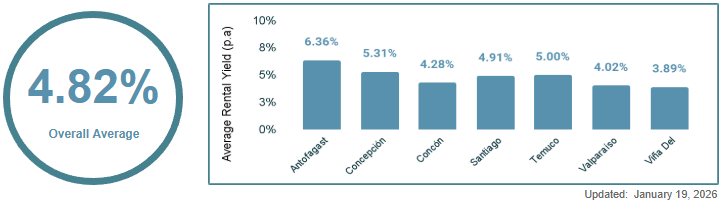
Chile’s rental yields are just below average, with an overall rating of 4.82%.
Chile's rent price index:
Data Source: OECD.
As of January 2026, average yields for one-bedroom apartments across Chile are as follows:
- Anfogasta - 6.36%
- Concepcion - 5.31%
- Temuco - 5.00%
- Santiago - 4.91%
- Concon - 4.28%
- Valparaiso - 4.02%
- Vina Del Mar - 3.89%
6. Market Performance (Past and Present)
Chile’s residential property market has experienced sustained long-term price growth, though recent momentum has been moderate. National house price indices indicate continued increases into 2025, with the index reaching approximately 376.7 points in the second quarter, up from 2024 and 2023. Real (inflation-adjusted) price changes have been modest in recent years, with multi-year data showing only slight positive gains. This suggests that nominal price increases are largely driven by inflation and broader economic trends, rather than rapid market expansion.
Recent annual growth trends in Chile’s housing market show moderate, ongoing increases tempered by economic conditions. Quarterly and yearly comparisons reveal property price growth of about 2–3 percent in real terms as of mid-2025, showing resilience but slower expansion than earlier periods. Over the longer term, Chilean house prices have risen significantly, roughly 40 percent over the past decade, nominally. However, annual gains in recent years have been more restrained, reflecting a market that continues to appreciate at a steadier, moderate pace.
Chile's house price annual change:
Data Source: Chilean Chamber of Construction.
7. Landlord and Tenant Laws
Chile’s rental framework is generally pro-tenant, providing strong protections against arbitrary eviction and prioritizing tenant rights. Recent legal updates have also strengthened landlords’ enforcement mechanisms, resulting in a more balanced system. Rent levels are freely negotiated and governed by the Civil Code and Urban Lease Law. Written contracts must specify key terms, including duration, rent, and maintenance obligations. Security deposits, usually equal to one or two months’ rent, must comply with legal standards. Tenants benefit from notice requirements and eviction safeguards, while landlords are responsible for property maintenance and necessary repairs. While court proceedings can be lengthy, some evictions for indefinite or monthly leases may proceed through a notary without full judicial intervention. However, many disputes still require formal legal action.
8. Property Related Taxes
Real estate tax is levied on Chilean property annually, payable by the property owners. The tax base is the cadastral value of the property, and an exemption is granted for properties whose cadastral value does not exceed a certain limit. The tax rate is 1.4% for urban properties. For residential properties, the tax rate is 0.98% on part of the cadastral value not exceeding a certain limit and 1.143% on the remaining value. Surcharges may apply.
9. Buying (and Selling) Costs
In Chile, property transactions involve standard costs for both buyers and sellers. Buyers typically pay notary fees of from 0.30% to 0.40% of the property value, legal fees of around 1%, and real estate agent commissions of 1% to 2%, totaling approximately 2.30% to 3.40% of the purchase price. Sellers usually pay agent fees of 1% to 2%, resulting in combined transaction costs of 3.30% to 5.40% of the property value.
Here's a full breakdown:
| Transaction Costs | ||
| Who Pays? | ||
| Property Transfer Tax | 0.00% | buyer |
| Legal Fees | 1.00% | buyer |
| Notary Fees | 0.30% - 0.40% | buyer |
| Real Estate Agent Fee | 1.00% - 2.00% 1.00% - 2.00% |
buyer seller |
| Costs Paid by Buyer | 2.30% - 3.40% | |
| Costs Paid by Seller | 1.00% - 2.00% | |
| ROUNDTRIP TRANSACTION COSTS | 3.30% - 5.40% | |
| Source: Global Property Guide, PWC | ||
10. Mortgage and Financing Options
Chile’s mortgage market is among the most developed in Latin America, growing from 11.2% of GDP in 2000 to 27.2% by 2025. Outstanding housing loans totaled CLP 89.75 trillion (US$104.05 billion) in January 2026, up 5% year over year. This is a clear slowdown from the double-digit increases in 2021 and 2022. Growth has moderated since the post-pandemic peak and is expected to continue at a slower pace due to softer property demand. Most mortgages are fixed-rate, with loan-to-value ratios of 75% to 80%, which helps limit banking-sector risk. However, strict lending standards and limited credit access for foreigners have constrained broader market growth, despite supporting financial stability.
Housing interest rates have declined following a prolonged period of monetary easing. The Central Bank of Chile maintained its benchmark rate at 4.50% in January 2026, after 13 consecutive rate cuts from a peak of 11.25% in 2023. Average mortgage rates fell to 4.12% in January 2026, down from 5.00% two years earlier, reflecting lower inflation. Nationwide inflation decreased to 2.8%, within the central bank’s 3% target range, after a sharp rise in 2022 and gradual moderation through 2024 and 2025. Inflation is expected to remain near the target through 2026, supporting a favorable lending environment and macroeconomic stability.
Chile's mortgage loan interest rates:
Data Source: Banco Central de Chile.
11. How to Buy Property in Chile: Step-by-Step
- Determine Your Eligibility and Intent: Before buying property in Chile, clarify your residency status and purpose. Chile has no formal restrictions on foreigners owning property, but banks usually do not lend to non-residents, so cash purchases are common. Assess whether your purchase is for personal use, investment, or development, as this may affect your financing strategy and timeline.
- Engage Professional Advisors: Engaging local experts early is crucial. Consult a Chilean attorney and a notary public familiar with real estate transactions to navigate legal requirements and conduct title and due diligence searches. These professionals interpret contract language, verify property status, and ensure all legal obligations are met.
- Conduct Due Diligence on the Property: Once you identify a property of interest, conduct comprehensive due diligence to confirm a clear title, absence of liens or encumbrances, and compliance with zoning and land use regulations. Your legal advisor will review the property’s title records and related documentation, helping you understand any potential risks or obligations attached to the property before you commit financially.
- Negotiate the Purchase Terms: After completing due diligence and deciding to proceed, negotiate with the seller to agree on the price and terms of sale. This includes settlement timelines, responsibilities for closing costs, fixtures or inclusions, and provisions for contingencies. Your attorney can advise and negotiate on your behalf to ensure the terms are fair and enforceable.
- Arrange Funding or Confirm Cash Purchase: Because local banks rarely extend mortgage credit to foreign buyers, plan how you will fund the purchase, whether through personal funds, offshore financing, or structuring the acquisition through a local company if appropriate. Confirm that funds are in place and compliant with Chilean financial regulations before the closing date.
- Budget for Transaction Costs and Taxes: Throughout the process, ensure you have accounted for all related costs, including notary fees (usually around 0.30%-0.40% of the property value), legal fees (about 1%), and real estate agent commissions (typically 1% to 2%). Buyer and seller fees affect your total outlay, so confirm these figures early with your advisors to avoid surprises.
- Sign the Contract of Sale: After successful negotiation, you will sign the Contrato de Promesa de Venta with the seller. This legally binding agreement outlines the agreed price, payment schedule, conditions for transfer, and other material terms. At this stage, a deposit is typically paid according to the contract’s terms to secure the transaction.
- Finalize Registration and Take Possession: Once all payments are made, taxes are settled, and the deed is registered, you will receive formal documentation of ownership. Your advisor will ensure the title is registered in your name with the appropriate Chilean authorities, allowing you to take possession and fully exercise your rights as the property owner.
Need Help?
Buying property in a foreign country can feel overwhelming, but we're here to help.
At Global Property Guide, we offer:
- Data-backed insights on property prices, rental yields, and taxes
- Country-specific legal and tax guidance through our partner network
- Pre-screened investment properties, including income-generating Airbnb units
- 1-on-1 consultations with real estate experts focused on international buyers
- Step-by-step buyer support, from due diligence to closing
Whether you're looking for your first investment in Chile or expanding your international portfolio, we can help you make smart, secure decisions.
Contact our team or book a free consultation to get started.