United Arab Emirates' Residential Property Market Analysis 2026
The UAE’s housing market upswing continues across both sales and rental segments, with Dubai entering a more balanced phase, while Abu Dhabi maintains stronger momentum supported by population growth, infrastructure development, and tighter supply.
This extended overview from Global Property Guide covers key aspects of the housing market in the United Arab Emirates and takes a closer look at its most recent developments and long-term trends.
Table of Contents
- Housing Market Snapshot
- Demand Highlights
- Supply Highlights
- Rental Market
- Mortgage Market
- Socio-Economic Context
Housing Market Snapshot
Dubai’s residential market remained firmly expansionary through year-end 2025, although leading indicators increasingly point to a more measured phase after several years of exceptional growth. As of December 2025, the Residential Market Sales Price Index reported by REIDIN rose by 12.88% year-on-year, with villas (+15.16%) continuing to outperform apartments (+12.52%), consistent with ongoing preference for larger-format homes and more quality-led segmentation.
Commenting on the trend, Prathyusha Gurrapu, Head of Research at Cushman & Wakefield Core, notes that the Dubai residential market is transitioning into a more balanced phase, while Knight Frank similarly observes that following a multi-year upswing, a gradual easing in the pace of price growth is a natural characteristic of a maturing cycle.
Dubai's house price annual change:
The UAE’s second-largest residential market, Abu Dhabi, closed 2025 with a tighter demand–supply balance and stronger momentum, supported by population growth, rising transaction activity, and constrained ready stock. By December 2025, its Residential Market Sales Price Index rose by 31.59% year-on-year. Apartment prices increased by 34.77% annually, while villa prices rose by 13.60%, underpinned by robust socio-economic fundamentals and Abu Dhabi’s perceived relative value versus global peers.
In nominal terms, ValuStrat’s December 2025 benchmarks place Dubai’s citywide weighted-average residential values at AED 1,689 per sq ft (USD 460), up 19.8% year-on-year. For Abu Dhabi, ValuStrat’s latest published citywide benchmarks (Q3 2025) indicate that the weighted-average home value stood at AED 1,005 per sq ft (USD 274), up 9.0% year-on-year compared to Q3 2024. These nominal benchmarks complement the index-based performance metrics by anchoring market growth in absolute AED-per-square-foot price levels.
Weighted-average residential values:
| Dubai Apartments, Dec 2025 |
Dubai Villas, Dec 2025 |
Abu Dhabi, Apartments, Q3 2025 |
Abu Dhabi Villas, Q3 2025 |
|
| AED/ sq ft | AED 1,477 | AED 3,048 | AED 1,082 | AED 823 |
| USD/ sq ft | USD 402 | USD 830 | USD 295 | USD 224 |
| YoY change, % | 14.2% | 25.1% | 9.18% | 9.01% |
| Note: Exchange rate USD 1 = AED 3.6725. | ||||
| Data Source: ValuStrat. | ||||
Looking ahead to 2026, professional forecasters broadly expect the UAE’s residential upswing to continue, albeit at a more sustainable pace. For Dubai, Knight Frank anticipates ongoing but modest appreciation, with Faisal Durrani, Partner and Head of Research (MENA), stating: “Our expectation for 2026 is for price rises of around 3 per cent in the prime segment, while the growth in the mainstream market is likely to average around 1 per cent by the time we get to the end of December 2026.” This outlook is consistent with a market that remains supported by underlying demand, while transitioning into a more balanced stage of the cycle.
Cushman & Wakefield Core also expects growth to moderate, with Prathyusha Gurrapu noting that “price appreciation is forecast to moderate to mid-single-digit levels of around 5 to 8 per cent in 2026,” indicating a deceleration from the stronger annual gains recorded over 2024–2025.
For Abu Dhabi, forward-looking commentary remains comparatively constructive, reflecting a tighter supply backdrop and steadier fundamentals. In The National’s year-end outlook, Cavendish Maxwell’s Ronan Arthur said the market has shown “steadier fundamentals,” pointing to continued moderate price increases through mid-2026, supported by sustained demand and a more conservative supply pipeline. Cushman & Wakefield similarly expects market conditions to remain tight, “supporting additional price and rental growth of 8-12% in 2026.”
Demand Highlights:
Strong Fundamentals Persist; Policy Support Encourages Locally Anchored Participation
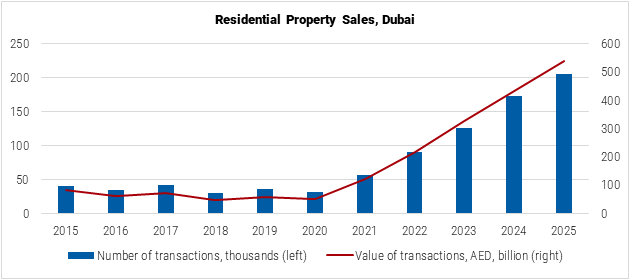
Residential sales activity in Dubai remained robust in 2025. According to the latest figures from the Dubai Land Department (DLD), compiled by DXB Interact, 205.1 thousand residential sales transactions were registered during the year, representing an 18.33% year-on-year increase in transaction volume. Transaction value rose in parallel, reaching AED 539.9 billion (USD 147.0 billion), up 24.67% compared to 2024.
Commenting on the market’s underlying dynamics, Will McKintosh, Partner – Head of Residential, MENA at Knight Frank, noted that “the sustained momentum in market activity <…> reflects the city’s evolution from a speculative real estate market to one characterized by genuine end-user demand, structural depth and long-term investor confidence.”
Data Sources: Dubai Land Department, DXB Interact.
Apartments accounted for the majority of activity, representing 83% of total transaction volume and 62% of value. Off-plan apartment sales continued to outpace transactions for ready properties, reinforcing the market’s increasing orientation toward future deliveries, supported by payment flexibility and developer incentives. Cavendish Maxwell cautions, however, that if resale activity continues to slow, it could “affect demand from speculative investors who typically buy to flip properties before completion, as limited resale opportunities may reduce their willingness to purchase at launch.”
In the villas and townhouses segment, off-plan transaction volumes eased, reflecting a slower pace of new launches. By contrast, activity in ready villas and townhouses was supported by high-net-worth individuals and families seeking larger formats: more spacious layouts, dedicated outdoor areas, and greater privacy.
Geographically, transaction volumes were concentrated in established, high-liquidity submarkets. The top-performing areas by number of residential sales transactions included Jumeirah Village Circle (JVC), Business Bay, Wadi Al Safa 5, Dubai South, Jebel Ali First, Dubai Marina, and Dubai Investment Park Second.
Residential sales by type, Dubai:
| Residential Sales Volume (no. of transactions), 2025 |
YoY, % | |
| Apartments | 170,390 | 19.93% |
| - Off-plan | 122,904 | 27.17% |
| - Ready | 47,486 | 4.54% |
| Villas | 34,671 | 11.03% |
| - Off-plan | 11,276 | -41.65% |
| - Ready | 23,395 | 96.56% |
| Data Sources: Dubai Land Department, DXB Interact. | ||
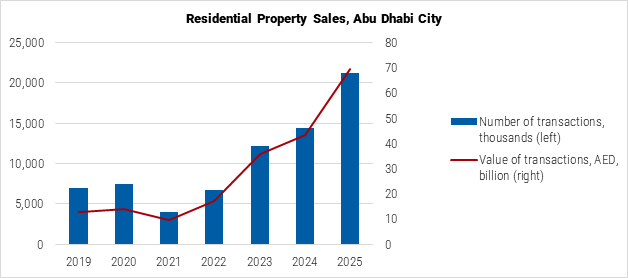
In Abu Dhabi, despite a slower start to the year, sales momentum strengthened materially. According to the Abu Dhabi Real Estate Centre (ADREC), the annual number of residential sales transactions recorded in 2025 increased by 47.43% year-on-year to 21,279. Sales were primarily concentrated in Al Reem Island, Yas Island, Fahid Island, and Al Saadiyat Island. “This rebound was supported by favorable economic conditions and rising demand from both investors and end users”, noted Cavendish Maxwell.
Note: Residential sales include apartment, duplex, townhouse, and villa property types.
Data Source: ADREC.
Looking ahead, fundamentals across both cities are expected to remain supportive in the short to medium term, underpinned by sustained investor interest and a growing base of owner-occupier demand. JLL links this outlook to the UAE’s broader macro and labor-market drivers, stating that “this market strength stems largely from the UAE’s comprehensive economic diversification initiatives,” which “have proven effective in attracting a steady influx of international professionals and expatriate families,” while “the expanding job market across various sectors, including technology, finance, tourism, and renewable energy, has accelerated the need for quality housing options.”
At the same time, the demand outlook, particularly in Dubai, needs to be considered against rising cost pressures. CBRE notes that “as prices rise, so too do living costs, impacting the city’s competitiveness for middle-income residents.” In response, Dubai has introduced initiatives such as the First-Time Home Buyer Program, designed to broaden access for resident demand through improved entry terms for eligible buyers (including access to off-plan projects and preferential pricing mechanisms). Over time, such measures are intended to deepen domestic participation and support a more stable, locally anchored demand base, reducing reliance on purely internationally driven inflows while improving affordability pathways for middle-income households.
Supply Highlights:
Pipeline Remains Substantial, Supply Growth Expected to Smooth Market Dynamics
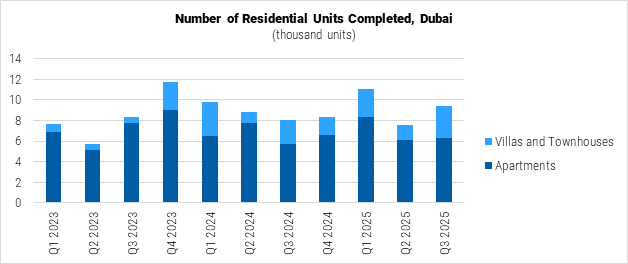
According to Property Monitor data compiled by Cavendish Maxwell, approximately 28,100 residential units were completed in Dubai in the first three quarters of 2025, representing a 6.04% year-on-year increase. Apartments accounted for 74% of total deliveries, with the balance comprising villas and townhouses. Supply additions were concentrated in a handful of growth submarkets: Jumeirah Village Circle, Mohammed Bin Rashid City, Business Bay, Dubai Hills Estate, and Tilal Al Ghaf, which together accounted for 41.5% of units delivered over the period.
Data Sources: Property Monitor, Cavendish Maxwell.
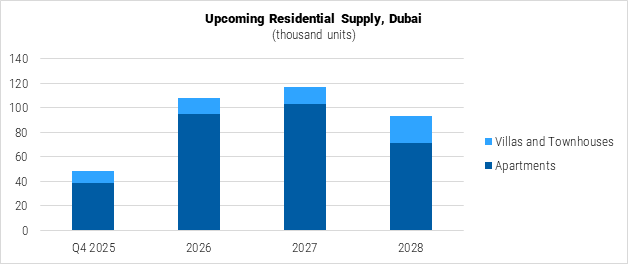
Looking ahead, Dubai’s development pipeline indicates a significant supply expansion. Nearly 366,000 residential units are projected to enter the market by 2028, with a substantial portion scheduled for 2026–2027, implying a potential acceleration in completions during those years. The largest contributions are expected from Jumeirah Village Circle, Dubai South, Business Bay, Dubai Residence Complex, and Dubai Islands, which collectively represent 31.2% of projected deliveries through 2028.
Commenting on the implications of the pipeline, Ronan Arthur, Director, Head of Residential Valuation at Cavendish Maxwell, argues that “rather than signaling imbalance, this pipeline points to a period of healthy normalization in Dubai’s housing market.” He adds that while the upcoming supply wave “may temper the recent pace of price growth,” it also “reflects a maturing market, characterized by steadier expansion, longer cycles and a growing emphasis on sustainable delivery rather than short-term spikes.”
Data Sources: Property Monitor, Cavendish Maxwell.
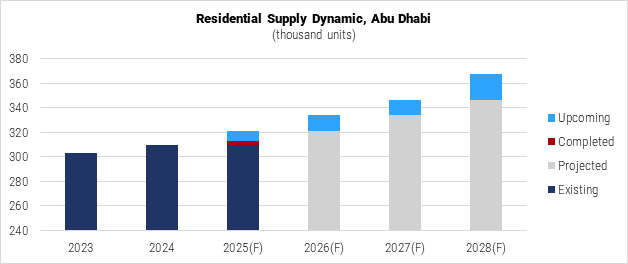
In Abu Dhabi, Cavendish Maxwell estimates approximately 2,700 residential unit deliveries in the first nine months of 2025, with around 8,400 more scheduled for completion in Q4 2025. Based on recent handover trends, however, actual deliveries are expected to come in below initial projections.
Over 2026–2028, an additional 46.6 thousand residential units are projected to be delivered, with completions expected to peak in 2028 at approximately 21.4 thousand units. Cavendish Maxwell does not anticipate a market-wide oversupply scenario; however, it notes that the concentration of handovers could create temporary absorption pressure in specific locations. As the latest report cautions, “while the broader market is unlikely to face widespread oversupply, this clustering could create pockets of absorption pressure, particularly in districts where several phases are delivered simultaneously.”
Note: Years market (F) include the forecast period. The project supply is based on the information available at the time of the research.
Data Sources: Cavendish Maxwell, MEED Projects.
Rental Market:
Rents Continue to Grow, Dynamics Vary in Key Submarkets
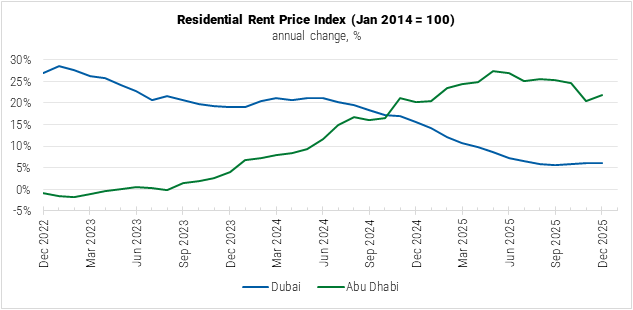
The REIDIN Residential Market Rent Price Index continues to demonstrate diverging trajectories for rental inflation in Dubai and Abu Dhabi; however, in both submarkets, the dynamic appears to be more stable compared to previous periods.
United Arab Emirates' rent price index:
After a period of rapid deceleration from 20%+ levels, the annual rental growth for all residential properties in Dubai has been more stable in the second half of 2025, fluctuating slightly from 6.4% in July to 5.7% in September and 6.2% most recently recorded in December. “ Recent months saw growth ease <…>, driven by the Smart Rental Index's regulatory influence and increasing supply deliveries,” real estate advisory firm Cavendish Maxwell commented on the shift in their Q3 2025 report. “Overall, Dubai's residential market is entering a more mature phase. Off-plan sales are expected to remain strong in the near term if new launches continue, while the ready segment and rental market may show more measured activity.”
According to the latest assessment from the real estate agency Betterhomes, “robust tenant activity and rising leads signal continued confidence in Dubai’s rental sector, underscoring its appeal to both new residents and long-term occupiers”. Looking forward, however, the combination of higher delivery volumes and faster construction timelines is expected to increase the supply of residential units in the submarket, helping to stabilize rental rates and ease pressure on tenants, Cavendish Maxwell experts believe.
Data Source: REIDIN.
Previously moving in the opposite direction, annual rental growth in Abu Dhabi has also moderated somewhat in 2025, slowing from the peak level of 27.3% in May to 21.8% in December, based on REIDIN figures. At the same time, growth in Abu Dhabi’s rental segment is likely to remain strong, as demand (supported by a growing population due to consistent inflow of skilled professionals drawn to the emirate by employment opportunities and business creation) is expected to continue outpacing supply in the near term.
Despite the submarket’s overall strong performance, the analysis from Cavendish Maxwell notes diverse dynamics across local communities, some recording single-digit increases while others experienced double-digit annual growth in rents. In Q3 2025, apartments demonstrated the strongest year-on-year growth in Yas Island and Al Reem Island, while villa rents increased the most in Al Reef. “With supply expected to remain constrained in the near term, rental rates are likely to increase further; however, the pace of growth may vary depending on new supply delivery and evolving tenant preferences,” the latest quarterly report from the firm summarized.
Average annual rents by unit type and submarket:
| Unit type | Dubai | Abu Dhabi City | ||
| Q3 2025 (AED) | Q3 2025 (USD) | Q3 2025 (AED) | Q3 2025 (USD) | |
| Studio | AED 42,396 | USD 11,544 | AED 42,159 | USD 11,480 |
| 1-bedroom | AED 64,119 | USD 17,459 | AED 58,955 | USD 16,053 |
| 2-bedroom | AED 91,052 | USD 24,793 | AED 83,027 | USD 22,608 |
| 3-bedroom | AED 155,733 | USD 42,405 | AED 121,539 | USD 33,094 |
| 4-bedroom | AED 283,565 | USD 77,213 | AED 161,458 | USD 43,964 |
| 5-bedroom | AED 467,877 | USD 127,400 | AED 199,401 | USD 54,296 |
| Note: Exchange rate USD 1 = AED 3.6725. | ||||
| Data Sources: Engel & Völkers, ADREC. | ||||
In nominal terms, the real estate brokerage firm Engel & Völkers, based on Property Monitor data, reported average annual rent in Dubai at AED 91,052 (USD 24,793) for a 2-bedroom unit in Q3 2025. According to the report, for apartment leases, tenants preferred communities such as Jumeirah Village Circle, Business Bay, and Silicon Oasis, offering a mix of affordability and lifestyle appeal. In the villa and townhouse segment, Damac Hills 2, Mirdif, and Emirates Living saw the highest activity, reflecting continued demand for family-friendly homes in suburban locations.
During the same period, in Abu Dhabi City, the average annual rent reached AED 83,027 (USD 22,608) for a 2-bedroom unit, according to figures published by the Abu Dhabi Real Estate Centre (ADREC).
The research conducted by Global Property Guide in November 2025 showed gross rental yields for residential properties in the UAE at the average level of 5.45%, up from 4.94% previously reported in November 2024. The highest potential performance among the surveyed submarkets was estimated for rental properties in Dubai (6.66%), while the lowest yields were observed in Ras al Khaimah (3.29%).
The REIDIN December 2025 reporting also offered a positive assessment of potential investment performance, estimating the residential market rental yields at 6.55% in Dubai and 6.32% in Abu Dhabi, with apartment yields reaching as high as 7.03% in Dubai and 6.78% in Abu Dhabi, while villas averaged at 4.63% in Dubai and 4.83% in Abu Dhabi.
Mortgage Market:
Benchmark Interest Rates Down, Mortgage Activity Growing
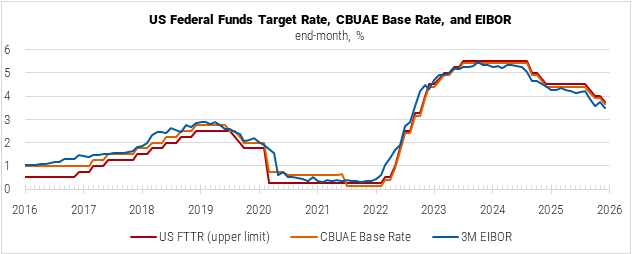
With the Dirham pegged to the US dollar, benchmark rates published by the Central Bank of the United Arab Emirates (CBUAE) closely follow the trajectory set by the US Federal Reserve. In line with the American regulator’s decisions, the CBUAE reduced its base rate applicable to the overnight deposit facility by 75 bps in the second half of 2025, bringing it to 3.65% by the end of the year. In parallel, the 3-month Emirates Interbank Offered Rate (EIBOR), often used as a reference in individual variable and hybrid mortgage products, also decreased and stood at 3.47% at the end of December 2025.
While no consolidated figures on mortgage interest rates across the UAE are publicly available, as the latest base rate cut from the central bank flows through the financial system, individual lenders are likely to adjust their pricing accordingly. Domestic and international banks in the country have a variety of home loan programs for citizens and foreign residents, typically based on a floating rate set as a combination of EIBOR and a fixed margin or a fixed rate during an introductory period of 1 to 5 years, after which the rate reverts to EIBOR plus the bank’s margin.
At the time of research in January 2026, First Abu Dhabi Bank, one of the country’s largest lenders, offered home loans for residences and investments at fixed rates between 3.99% and 4.44% during the introductory period. Another prominent lender, Emirates NBD, posted indicative home loan rates ranging from 2.14% to 6.00%.
Data Sources: FRED, CBUAE.
According to the Q3 2025 Credit Sentiment Survey from the CBUAE, stronger household incomes and favorable economic conditions, as well as lower interest rates and seasonal influences, continue to underpin demand for personal credit, and home credit in particular, across the Emirates. “Credit demand is expected to continue growing across all loan categories, particularly in credit cards, personal (other) loans, and housing loans (owner-occupier and investment),” said the central bank’s report.
Illustrating this trend, Dubai continues to show year-on-year growth in residential mortgage transactions, based on data published by the UAE-based real estate advisory firm Cavendish Maxwell. About 11,500 such transactions were registered in Q3 2025, a 12.7% increase compared to the same period in 2024. In monetary terms, the value of these transactions reached AED 22.5 billion (USD 6.1 billion), also demonstrating a solid 19.0% year-on-year growth. The most pronounced year-on-year increase in transaction volume (20.0%) was registered in the townhouse segment, while villas posted the strongest increase in the total value of transactions (23.1%).
This positive dynamic for the Dubai market is likely to continue, considering the expected improvement in lending conditions as monetary policy eases further. “Following the first interest rate cut of the year in September, mortgage activity is expected to strengthen, particularly as additional rate cuts are anticipated,” said Cavendish Maxwell in their Q3 2025 report.
In Abu Dhabi City, Cavendish Maxwell reporting showed about 1,700 residential mortgage transactions in H1 2025, amounting to AED 3.5 billion (USD 1.0 billion). The total value of transactions increased by 11.8% compared to the same period in 2024, mainly due to a stronger performance of the villa and townhouse segment, which helped offset declines in apartment transactions.
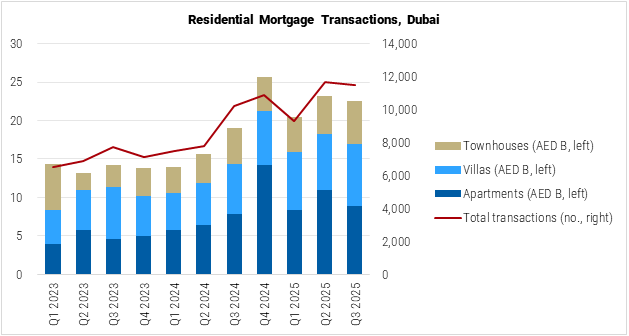
Data Sources: Property Monitor, Cavendish Maxwell.
Observations from local experts consistently highlight the rising mortgage activity in the UAE over time, which, in part, has been supported by long-time tenants shifting to homeownership as the gap between renting and borrowing costs narrowed.
Knight Frank’s Q3 2025 residential market review notes that financing activity has steadily risen in Dubai, particularly for completed units in the secondary market, with the total number of homes purchased with mortgages in the nine months of the year being more than double the number seen four years ago. According to the report, areas like Jumeirah Village Circle, Dubai Marina, and Villanova remain hotspots for mortgage sales, while cash sales are typical in ultra-luxury zones such as Emirates Hills and Palm Jumeirah.
The most recent report from the real estate agency Betterhomes also reflects a rise in financing activity in Dubai and broader participation from end-users and first-time buyers, which is expected to only keep growing in the lower interest rates environment: “While the recent US Federal Reserve rate cut in September came too late to significantly influence Q3 figures, lower borrowing costs are expected to support mortgage uptake in the coming quarters, potentially shifting the balance further towards financed purchases.”
Overall, however, despite the increased mortgage activity, cash buyers continue to dominate in the UAE’s real estate market. For Dubai, Knight Frank estimated the proportion of cash sales at 86% of total transaction volume in the first three quarters of 2025. In Abu Dhabi, ADREC reporting indicates that about 80% of transactions are conducted in cash.
Socio-Economic Context:
Robust Growth and Ongoing Economic Diversification
Backed by ambitious efforts to diversify and modernize its economy and supported by a growing hydrocarbon sector, the UAE continues to demonstrate resilience in the face of global uncertainty, regional conflicts, and more volatile oil prices. The economy’s real GDP growth is estimated by the International Monetary Fund (IMF) to have accelerated from 4.0% in 2024 to 4.8% in 2025, with an even stronger 5.0% expansion projected for 2026 - the fastest rate among the GCC countries and well above the global average.
At the same time, driven by lower food prices and reduced transportation costs, which offset increases in housing-related costs, consumer price index (CPI) inflation in the country has been contained at the average level of 1.6%-1.7% in the last three years, most recently reported by the Federal Competitiveness and Statistics Center (FCSC) at 2.17% in October 2025. The IMF forecast expects inflation to remain low, around 2% over the medium term, with housing-related costs being the main source of price pressures.
While hydrocarbons remain the main source of revenue for the nation, the UAE continues to pursue economic diversification to mitigate fiscal vulnerabilities. Targeted public investments in AI and digital infrastructure are accelerating innovation-driven growth and expanding the knowledge economy in the country. “[UAE’s] non-oil growth is underpinned by strategic investments in infrastructure, technology, and human capital. Reforms in governance, trade, and energy are reinforcing sustainability and facilitating the shift toward a more diversified growth model,” noted the fall 2025 macroeconomic outlook from the World Bank.
Contributing to the country’s diversification efforts, Dubai’s tourism sector maintained its momentum in 2025, according to the latest economic review from the CBUAE. The city attracted 13.95 million international overnight visitors in the first nine months of the year (5% increase compared to the same period in 2024) and posted a hotel occupancy rate of 79%, up from 76% a year earlier. “These developments reinforce tourism’s vital role in supporting non-oil economic growth,” the central bank commented.
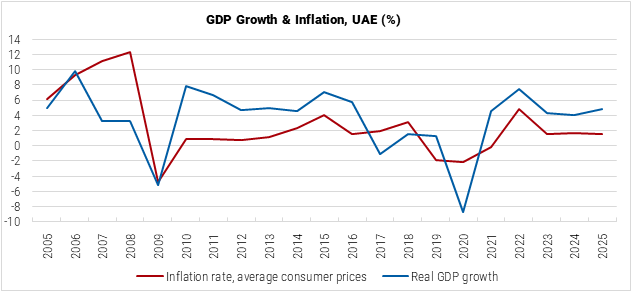
Data Source: IMF.
Amid this pivot from oil dependency to non-oil sectors like tech, renewable energy, healthcare, tourism, and finance, overall unemployment rate in the UAE’s labor market remains relatively low, having decreased from 4.3% in 2020 to 2.1% in 2024, according to the ILO estimates published by the World Bank ( projected to stay at the same level in 2025). Unemployment levels, however, are twice as high (4.4% in 2024) for women and three times as high (6.4% in 2024) for the young population aged 15 to 24, highlighting that further efforts are required to close gender gaps and support modernization, alongside the ongoing initiatives to up-skill and re-skill the population to create an AI-ready labor force.
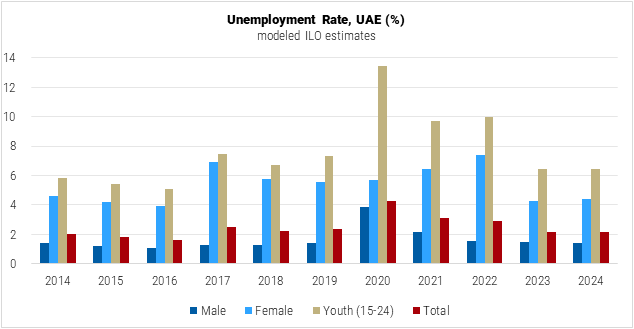
Data Source: World Bank.
Overall, although regional and global uncertainty remains elevated, the UAE is well placed to navigate the ongoing global policy changes with broadly balanced risks to the outlook, the 2025 Article IV staff report from the IMF concludes.
The latest economic review from the CBUAE also sees the medium-term outlook for the economy as broadly balanced, with growth prospects supported by stronger-than-expected non-hydrocarbon activity, continued adoption of AI that could boost productivity, and more favorable global conditions. “A mild softening in external demand or shifts in global financial or energy market conditions could weigh on economic activity, although strong domestic fundamentals should help mitigate these risks,” said the central bank.
Sources:
- Federal Competitiveness and Statistics Center (FCSC)
- Prices - CPI: https://fcsc.gov.ae/
- Central Bank of the United Arab Emirates (CBUAE)
- Quarterly Economic Review, December 2025: https://www.centralbank.ae/
- Credit Sentiment Survey Q3 2025: https://www.centralbank.ae/
- CBUAE Lowers the Base Rate by 25 Basis Points: https://www.centralbank.ae/
- EIBOR Rates: https://www.centralbank.ae/
- Dubai Department of Land (DLD)
- Real Estate Data: https://dubailand.gov.ae/
- First Time Home Buyer Overview: https://dubailand.gov.ae/
- Abu Dhabi Real Estate Centre (ADREC)
- Abu Dhabi’s Real Estate Market Data: https://adrec.gov.ae/
- International Monetary Fund (IMF)
- Country Overview: United Arab Emirates: https://www.imf.org/
- 2025 Article IV Staff Report: https://www.imf.org/
- United Arab Emirates: Selected Issues: https://www.imf.org/
- World Bank
- United Arab Emirates MPO, October 2025: https://thedocs.worldbank.org/
- World Development Indicators: https://datacatalog.worldbank.org/
- DXB Interact
- Dubai Real Estate Market Overview, 2025: https://dxbinteract.com/
- REIDIN
- United Arab Emirates Residential Property Price Report: December 2025: https://reidin.com/
- ValuStrat
- Dubai – VPI Residential Values – December 2025: https://valustrat.com/
- Abu Dhabi – Real Estate Review Q3 2025: https://valustrat.com/
- Cavendish Maxwell
- Dubai Residential Market Performance Q3 2025: https://cavendishmaxwell.com/
- Abu Dhabi Residential Market Performance Q3 2025: https://cavendishmaxwell.com/
- Abu Dhabi Residential Market Performance H1 2025: https://cavendishmaxwell.com/
- Engel & Völkers
- Dubai Residential Real Estate Report (Q3 2025): https://www.engelvoelkers.com/
- Smart Rental Index by DLD: Understanding its Impact on Tenants & Landlords: https://www.engelvoelkers.com/
- Betterhomes
- Q3 2025 Dubai Residential Real Estate Market Report: https://www.bhomes.com/
- Knight Frank
- Dubai Residential Market Review – Q3 2025: https://www.knightfrank.ae/
- Prime House Prices in Dubai to Rise 3% in 2026…: https://www.knightfrank.ae/
- JLL
- UAE Living Market Dynamics, Q3 2025: https://www.jll.com/
- CBRE
- UAE Real Estate Market Review Q3 2025: https://www.cbre.ae/
- Emirates NBD
- Home Loans: https://www.emiratesnbd.com/
- First Abu Dhabi Bank (FAB)
- Home Loan for Residences and Investments in the UAE: https://www.bankfab.com/
- Fitch Ratings
- Fitch Affirms the United Arab Emirates at 'AA-'; Outlook Stable: https://www.fitchratings.com/
- Khaleej Times
- Dubai’s Prime Property Market to Grow 3% in 2026; 331,000 New Homes in 5 Years: https://www.khaleejtimes.com/
- The National
- Where Are UAE Residential and Rent Prices Heading in 2026?: https://www.thenationalnews.com/
- Homeland
- Where Are UAE Residential and Rent Prices Heading in 2026?: https://www.homeland.ae/