Thailand's Residential Property Market Analysis 2026
Thailand's housing market has picked up speed since the spring. Home sales jumped in the second quarter, condominium sales rose by more than a third, and house price growth almost tripled between March and September. Lower fees, looser loan rules, and cheaper mortgages are doing much of the work. But inflation has risen to 3.9%, the economy is growing slowly, and the number of unsold homes in Bangkok is still very large.
This extended overview from Global Property Guide covers key aspects of the Thai housing market and takes a closer look at its most recent developments and long-term trends.
Table of Contents
- Property Prices and Price Index
- Property Demand Trends
- Property Supply Trends
- Rental Market: Rents and Rental Yields
- Mortgage Market and Interest Rates
- Economic and Social Factors
Property Prices and Price Index
In our July 2026 edition, house prices were rising by just 1.3% a year, prices in Bangkok were falling, sales had only just started to recover, and the property market's own research center expected sales to fall in 2026. Four months later, that picture has changed. Prices are rising almost three times as fast, Bangkok has returned to growth, sales are up by almost a fifth in the first half of the year, and the forecast has been raised.
Thailand's house price annual change:
House prices rose by 3.63% in the year to Q3 2026, the Bank of Thailand's (BOT) Residential Property Price Index shows. That was up from 2.35% in Q2 and 1.26% in Q1. With consumer prices up 2.82% in September, house prices rose by about 0.8% in real terms.
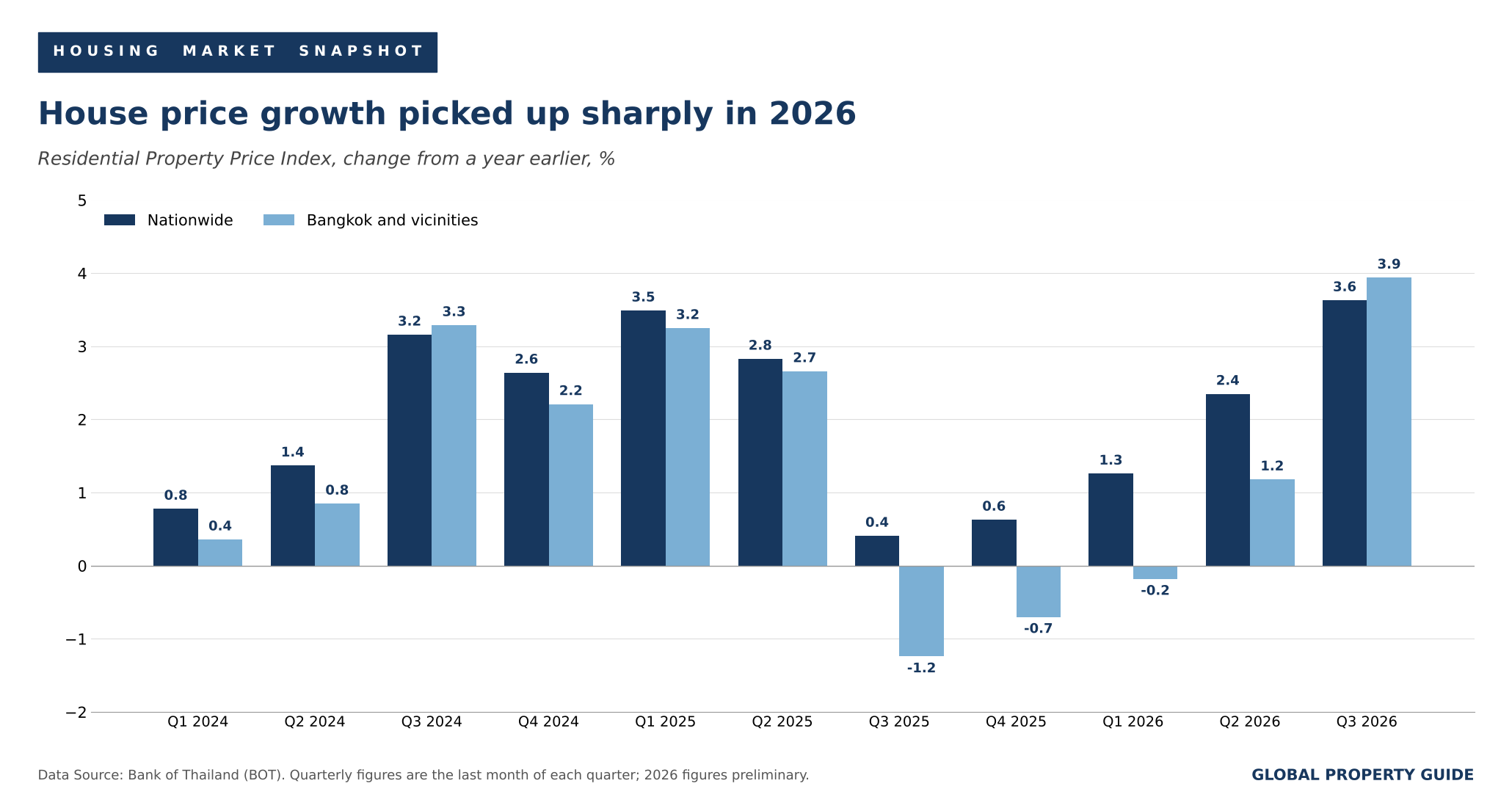
The turnaround is clearest in Bangkok. Prices in Bangkok and its vicinities rose by 3.94% in the year to Q3, after falling for three quarters in a row, down to -0.18% in Q1. Condominium prices in the capital region rose by 4.72%, the fastest of any housing type. Prices of single-detached houses in Bangkok rose by 2.06%, after falling by 1.59% in Q1. Nationwide, townhouse prices rose by 3.50% and single-detached house prices by 2.70%.
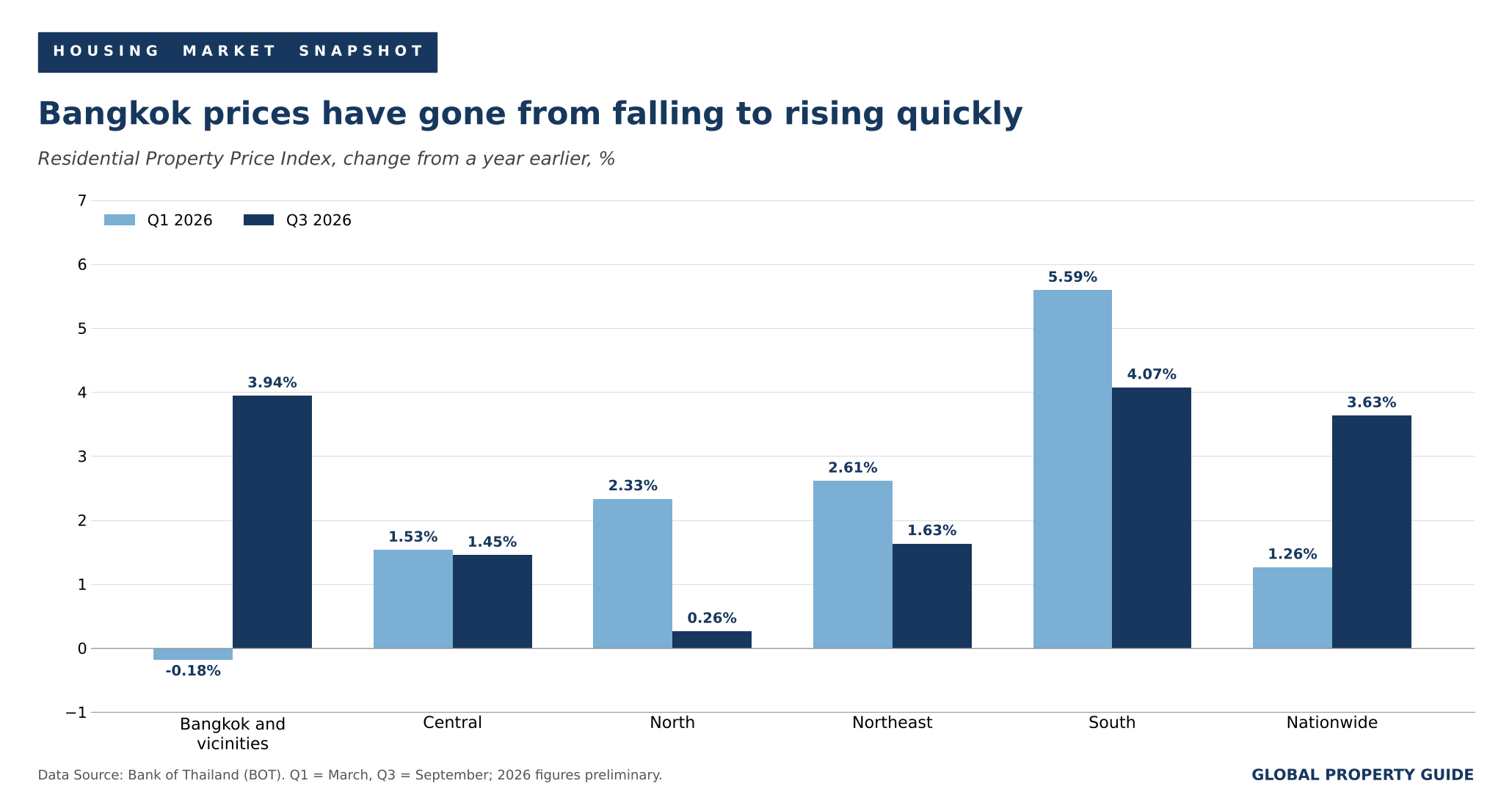
The South still had the strongest growth, at 4.07%, although it slowed from 5.59% in Q1. Growth slowed in the other regions: to 1.45% in the Central region, 1.63% in the Northeast, and just 0.26% in the North.
Residential Property Price Index, by region:
| Region | Q3 2026, change from a year earlier |
2-year change | 5-year change |
| Bangkok and vicinities | 3.94% | 2.65% | 9.84% |
| Central | 1.45% | 3.17% | 13.67% |
| North | 0.26% | 2.46% | 12.10% |
| Northeast | 1.63% | 4.28% | 15.53% |
| South | 4.07% | 10.51% | 18.46% |
| Nationwide | 3.63% | 4.05% | 12.30% |
| Note: Q3 2026 is the index for September 2026; changes are against September 2025, 2024, and 2021. 2026 figures are preliminary. | |||
| Data Source: Bank of Thailand (BOT). | |||
The index is based on mortgage loan data from banks, so it reflects homes bought with a loan. Recent figures are preliminary and can be revised.
All dollar conversions in this article use USD 1 = THB 33.22, the BOT's average exchange rate for September 2026.
Property Demand Trends
Sales are rising fast, led by cheaper homes
Home sales have recovered strongly. In Q2 2026, 95,082 homes changed hands nationwide, 22.9% more than a year earlier, and their value rose by 15.5% to THB 242,657 million (USD 7,305 million), the Real Estate Information Center (REIC) of the Government Housing Bank reports. In Q1, sales had risen by 11.2%, so the recovery gathered pace in the spring.
Condominiums led the rise. Condo sales rose by 37.9% to 32,204 units in Q2, and their value rose by 38.6% to THB 73,986 million (USD 2,227 million). Sales of low-rise homes, such as detached houses and townhouses, rose by 16.5% to 62,878 units, while their value rose by a more modest 7.6%. The average low-rise home sold cost about THB 2.7 million, down from THB 2.9 million a year earlier.
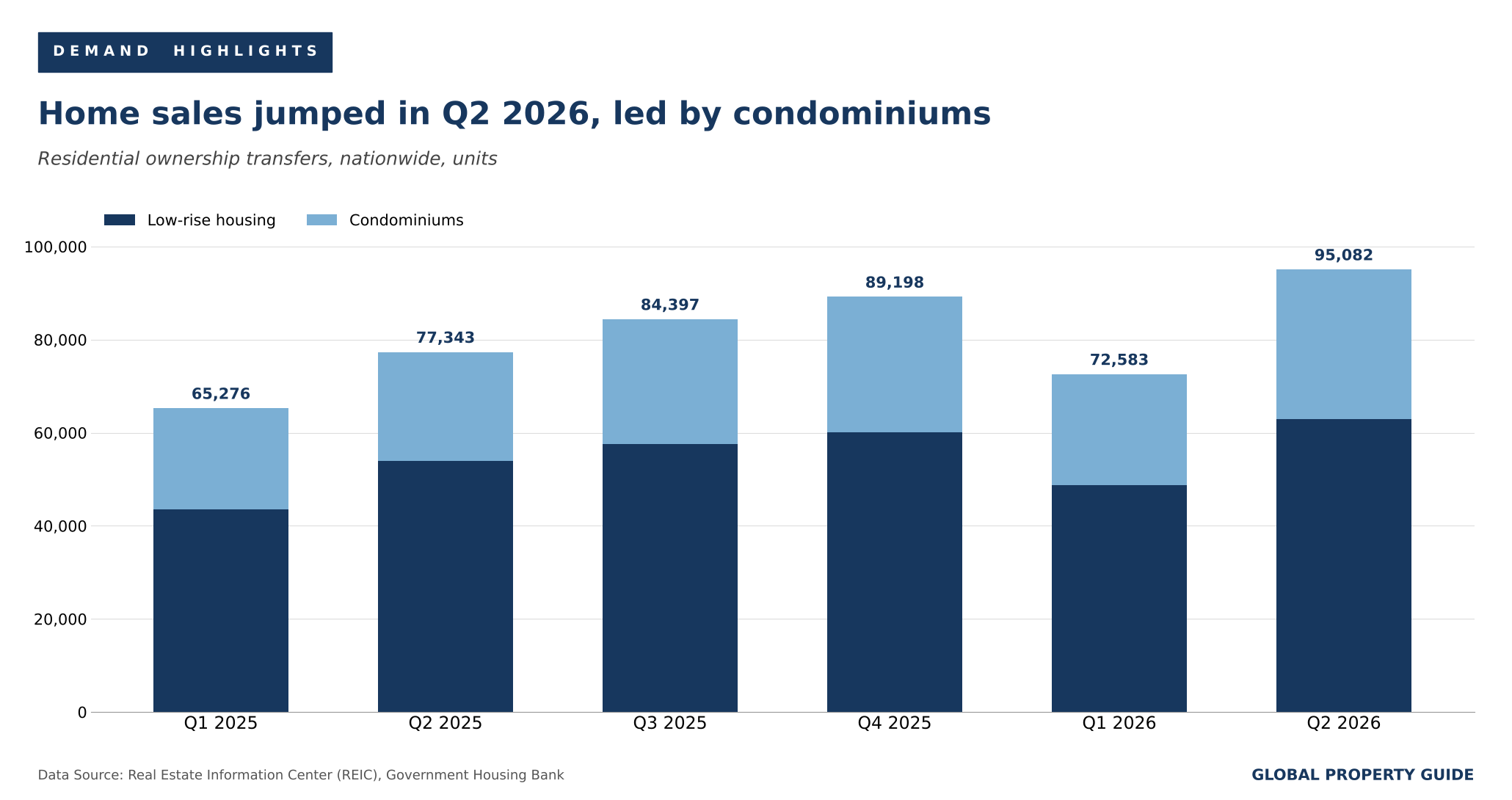
In the first half of 2026, sales rose by 17.6% to 167,665 units, worth THB 429,839 million (USD 12,939 million), up 9.8%. Low-rise homes still make up about 70% of the market by value. Two government measures explain much of the rise, REIC says: lower transfer and mortgage registration fees, and looser loan-to-value rules for housing loans. Both started in Q2 2025, so the comparison with last year will become harder from now on.
Most of the growth is in cheaper homes. Homes priced at THB 3 million (USD 90,307) or less made up 76.9% of all sales in the first half of 2026, and their number rose by 19.9%. Sales of homes priced at THB 1 million or less rose by 21.4%, and of those between THB 2 million and THB 3 million by 21.1%. At the top of the market, sales fell. Sales of homes priced above THB 7.5 million (USD 225,768) fell by 10.1%, and those above THB 10 million by 8.6%. Second-hand homes made up 63% of sales, REIC's full half-year report shows.
REIC now expects sales to grow this year. In May, it forecast a 1.1% fall in the number of homes sold in 2026. In August, it raised its forecast to growth of 2.3%, to 323,479 units, with the value of sales up 1.8% to THB 880,760 million (USD 26,513 million). The government has extended the fee cuts by one year, to 30 June 2027, which should support sales in the second half of 2026 and into 2027. REIC expects the value of sales to reach about THB 900 billion in 2027. It still sees risks from high household debt, strict bank lending, higher building and transport costs, and uncertainty in the world economy.
Foreign buyers are back
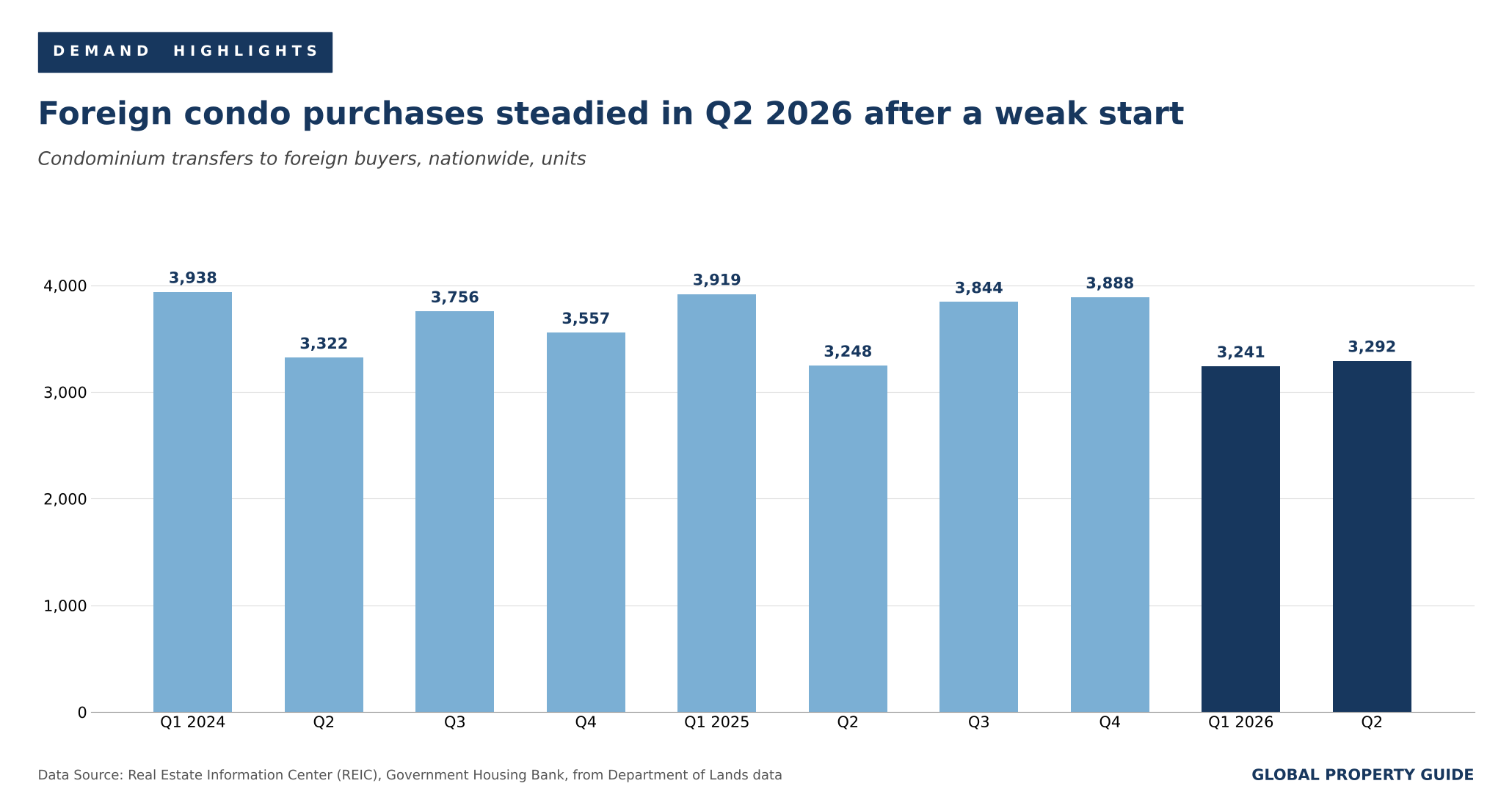
Foreign demand for condos steadied in Q2 2026. Foreign buyers bought 3,292 condos, 1.4% more than a year earlier, and their value rose by 20.2% to THB 14,803 million (USD 446 million), REIC data show. In Q1, purchases had fallen by 17.3%. Foreigners are also buying larger units: the floor area they bought rose by 8.1%.
Foreigners still bought fewer condos over the first half as a whole: 6,533 units, down 8.8%, worth THB 28,267 million (USD 851 million), down 1.5%. Thai buyers drove the market, so the foreign share of condo sales fell to 11.7% of units and 21.7% of value in the first half. The average unit bought by a foreigner cost THB 4.3 million (USD 129,440) and measured 43.9 square meters, or about THB 98,566 (USD 2,967) per square meter.
Chinese buyers remain the largest group, but their purchases fell by 23.8% in the first half. They tend to buy small units, averaging 38.2 square meters and THB 3.8 million (USD 114,389). Russian buyers increased their purchases by 50.4%, and Australian buyers by 63.7%. Buyers from the United States paid the most per unit, an average of THB 6.6 million (USD 198,675), while Indian buyers bought the largest units, averaging 72.1 square meters.
Condominium transfers to foreign buyers, by nationality, H1 2026:
| Nationality | Units | Change from H1 2025 | Value, THB million |
Value, USD million |
Change in value |
| China | 1,813 | -23.8% | THB 6,874 | USD 206.9 | -27.7% |
| Russia | 842 | 50.4% | THB 3,603 | USD 108.5 | 75.9% |
| Myanmar | 641 | -34.1% | THB 2,457 | USD 74.0 | -16.2% |
| United States | 254 | -6.3% | THB 1,668 | USD 50.2 | 22.2% |
| Taiwan | 334 | -11.6% | THB 1,465 | USD 44.1 | -10.1% |
| France | 291 | -11.3% | THB 1,211 | USD 36.5 | -5.0% |
| United Kingdom | 255 | 6.7% | THB 1,116 | USD 33.6 | -9.3% |
| Germany | 241 | 8.1% | THB 954 | USD 28.7 | 15.5% |
| Australia | 185 | 63.7% | THB 814 | USD 24.5 | 61.0% |
| India | 128 | 15.3% | THB 810 | USD 24.4 | 9.3% |
| Others | 1,549 | -2.7% | THB 7,295 | USD 219.6 | 9.7% |
| Total | 6,533 | -8.8% | THB 28,267 | USD 850.9 | -1.5% |
| Data Source: Real Estate Information Center (REIC). | |||||
Foreigners can own condo units in their own name, as long as foreign ownership in a building stays below 49% of the floor area. They cannot normally own land, so houses are mostly out of reach.
Property Supply Trends
Developers are building fewer condos
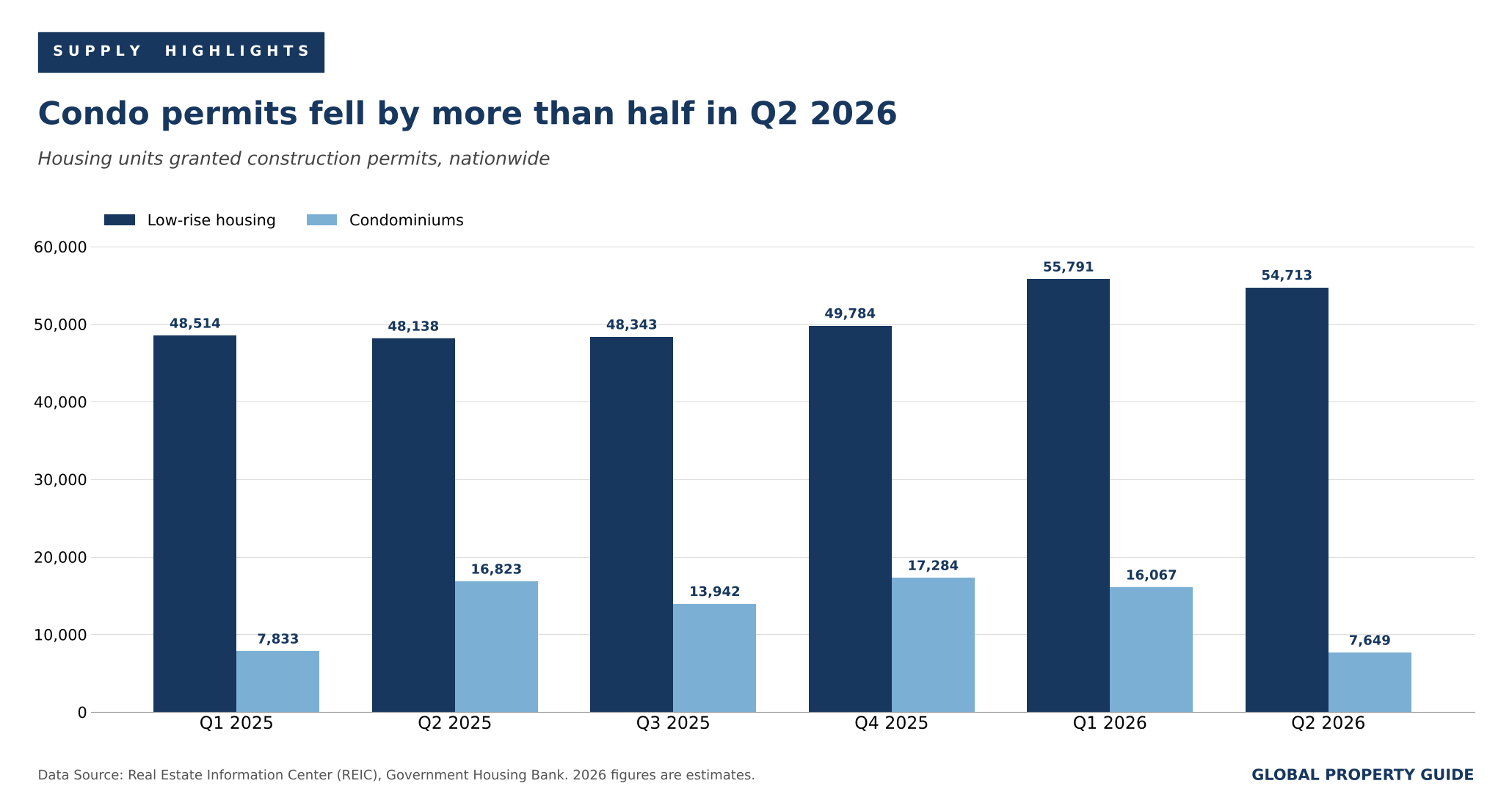
Developers are building fewer condos. In Q2 2026, construction permits were issued for about 7,649 condo units, 54.5% fewer than a year earlier, REIC estimates. Permits for low-rise homes rose by 13.7% to 54,713 units, so the total fell by 4.0% to 62,362 units.
This is a sharp change from Q1, when condo permits had doubled to 16,067 units. Over the first half as a whole, permits rose by 10.6% to 134,220 units. They rose in every region except Bangkok and its vicinities, most of all in the Northeast (+24.8%), the East (+21.3%) and the Central region (+21.1%).
Fewer new housing estates are being planned. Land allocation permits for new housing projects fell by 34.6% to 6,196 units in Q2 2026, and by 39.7% to 12,141 units in the first half. In Bangkok and its vicinities, they fell by 32.2% in Q2. Single-detached houses made up 45.5% of the units approved in the first half, and townhouses 33.3%.
Developers in Bangkok are also launching fewer projects and selling down their stock. In REIC's survey of Bangkok and its five neighboring provinces, new launches fell by 15.6% in Q2 2026 from a year earlier, and the value of new launches fell by 51.9%, as developers focused on cheaper projects. Sales of new units rose by 2.6%, and their value rose by 8.6%. Condo sales rose by 19.5%, but sales of houses in housing estates fell by 11.4%.
The number of unsold homes in the capital region fell by 10.2% to 202,414 units, worth THB 1,283,972 million (USD 38,651 million). That stock is still very large. Developers are selling about 1.8% of it each month, 2.4% for condos and 1.4% for houses. At that pace, it would take about 52 months to sell: 39 months for condos and 67 months for houses. Across the 27 provinces REIC surveys, 359,433 homes were on sale in Q2, and Bangkok and its vicinities accounted for 59.6% of them.
REIC sees the city spreading outward along new rail lines. It names the Rama 9 and Ratchada area as a new business district for premium condos and offices, and the Bang Na and Suvarnabhumi area, toward the Eastern Economic Corridor, for luxury detached houses.
Rental Market: Rents and Rental Yields
Rental yields have edged up
Gross rental yields on apartments in Thailand averaged 6.54% in Q3 2026, up from 6.49% in Q1 2026, Global Property Guide research shows. Yields are lower in central Bangkok, and they fall as apartments get bigger. In Watthana, a central Bangkok district, a studio yields 5.68% and a one-bedroom apartment 5.57%, while apartments with four or more bedrooms yield just 3.87%.
Thailand's rent price index:
Housing costs have not followed overall inflation. In October 2026, prices in the housing and furnishing group of the consumer price index were 0.94% lower than a year earlier, while overall prices rose by 3.90%, the Trade Policy and Strategy Office data show. The group also includes items such as household energy and furniture, so it is a broad measure.
Mortgage Market and Interest Rates
Interest rates are on hold
The Bank of Thailand has kept its policy rate at 1.00% since its last cut in February 2026. On 28 October, the Monetary Policy Committee voted unanimously to keep the rate unchanged, for the fourth meeting in a row. It said the current rate "is appropriate to support economic recovery" and that it would watch the inflation outlook closely, its statement shows. It made the same decision in August, when it noted that lending had picked up, mostly to large companies, while loans to small businesses were still shrinking.
Thailand's mortgage loan interest rates:
With inflation at 3.9% in October, the policy rate is now well below inflation. A rate cut looks unlikely while prices are rising this fast.
Banks' lending rates have not moved since our previous edition. The minimum retail rate (MRR), the base rate for most floating-rate mortgages, averaged 7.43% at the 14 largest banks in every month from April to September 2026, and the minimum lending rate averaged 7.07%, the BOT's monthly indicators show. Banks usually offer a discounted fixed rate for the first three years of a mortgage and then switch to a floating rate linked to the MRR.
MRR of selected banks:
| Bank | November 2026 | November 2025 | November 2024 |
| Bangkok Bank | 6.500% | 6.650% | 7.000% |
| Krung Thai Bank | 6.845% | 7.045% | 7.445% |
| Kasikornbank | 6.580% | 6.780% | 7.180% |
| Siam Commercial Bank | 6.575% | 6.775% | 7.175% |
| Bank of Ayudhya | 6.670% | 6.870% | 7.275% |
| TMBThanachart Bank | 7.105% | 7.305% | 7.705% |
| Note: Rates on 10 November 2026, 10 November 2025 and 11 November 2024. | |||
| Data Source: Bank of Thailand (BOT). | |||
At the largest banks, the MRR is 15 to 20 basis points lower than a year ago and 50 to 61 basis points lower than two years ago, the BOT's daily interest rate data show.
Mortgage lending has picked up
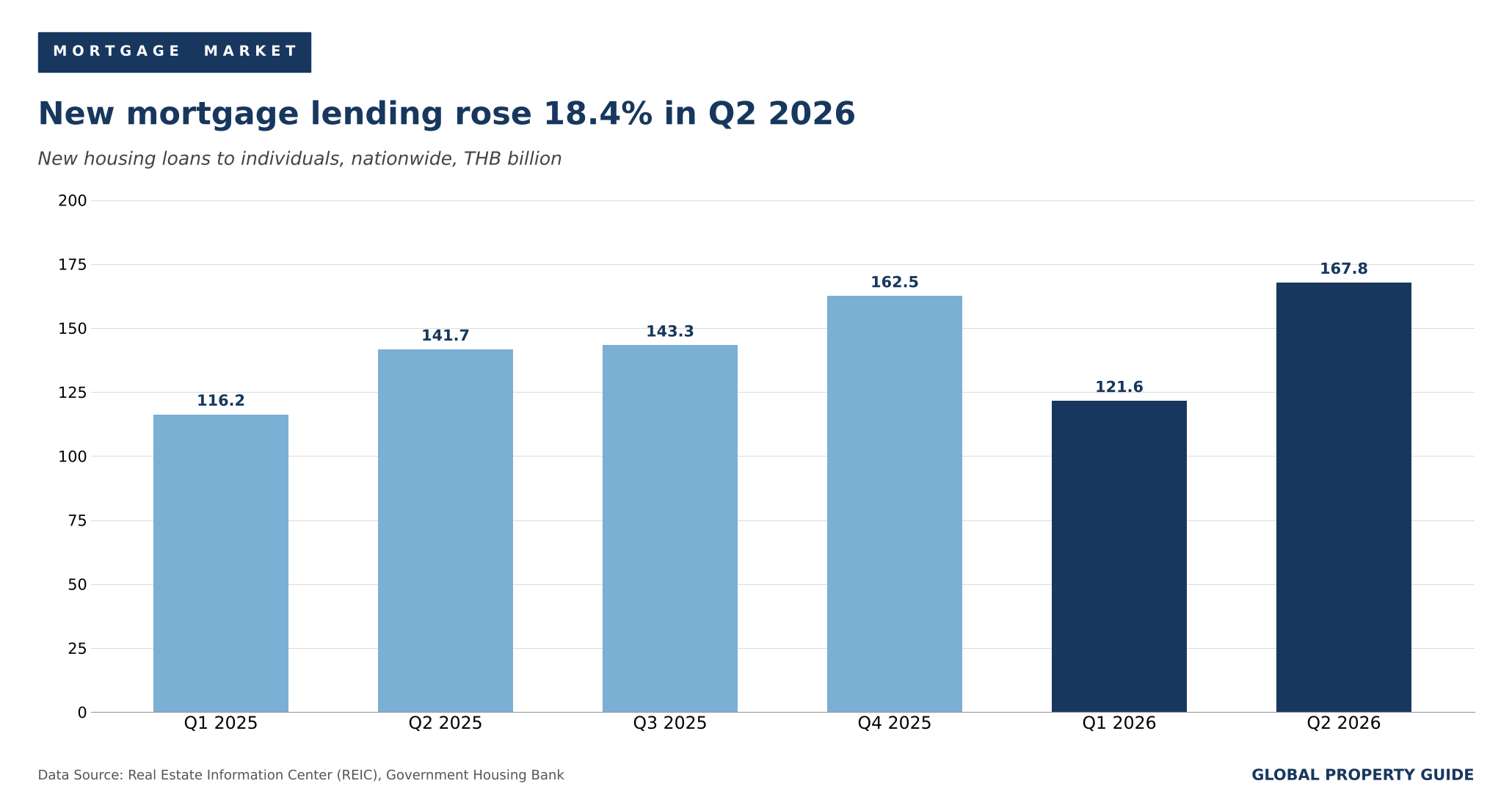
Banks lent more for house purchases in Q2 2026. New housing loans to individuals rose by 18.4% to THB 167,758 million (USD 5,050 million), and by 12.2% to THB 289,315 million (USD 8,709 million) in the first half of the year, REIC's half-year report shows. Growth in Q1 is now put at 4.6%, after a revision to last year's figures; REIC had earlier reported 11.1%.
The stock of mortgage debt is growing much more slowly. Banks' outstanding housing loans to individuals were THB 2,839,591 million (USD 85,478 million) at the end of 2025, just 1.1% more than a year earlier, the BOT's property indicators show. Loans to property developers rose faster, by 4.6%.
Lending is still constrained. REIC expects new housing loans to grow by just 1.4% in 2026 as a whole, to THB 571,066 million (USD 17,190 million). It points to high household debt and banks' strict lending standards. In its Bangkok market review, REIC's director, Mana Nimitvanich, said that buyers in the mid and lower market face pressure from high loan rejection rates.
Economic and Social Factors
Growth is slow, and inflation is rising
Thailand's economy is still growing slowly. The International Monetary Fund (IMF) expects growth of 2.1% in 2026, down from 2.4% in 2025, and 2.1% in 2027. The BOT is a little more optimistic: in October, it forecast growth of 2.4% in 2026 and 2.1% in 2027.
Exports are doing most of the work. In Q3 2026, the economy improved from the previous quarter, driven by exports of electronics and by investment in data centers, the BOT's latest economic report says. Exports rose by 23.6% in Q3 from a year earlier, and private investment by 27.5%, while private consumption grew by just 2.2%. Spending on services slowed as the high cost of living weighed on consumers, and consumer confidence fell in September amid floods at the end of the month. Construction investment also fell in September, reflecting lower building of single-detached houses and townhouses.
Inflation has jumped since our previous edition. Consumer prices rose by 3.90% in the year to October 2026, up from 2.82% in September and 2.42% in June, the Trade Policy and Strategy Office (TPSO) reports. That is above the BOT's target range of 1% to 3%. Energy is the main reason: in September, the BOT linked higher inflation to rising oil prices after renewed tension in the Middle East. Core inflation, which excludes energy and fresh food, was 1.50% in September. Over the first ten months of 2026, inflation averaged 1.77%.
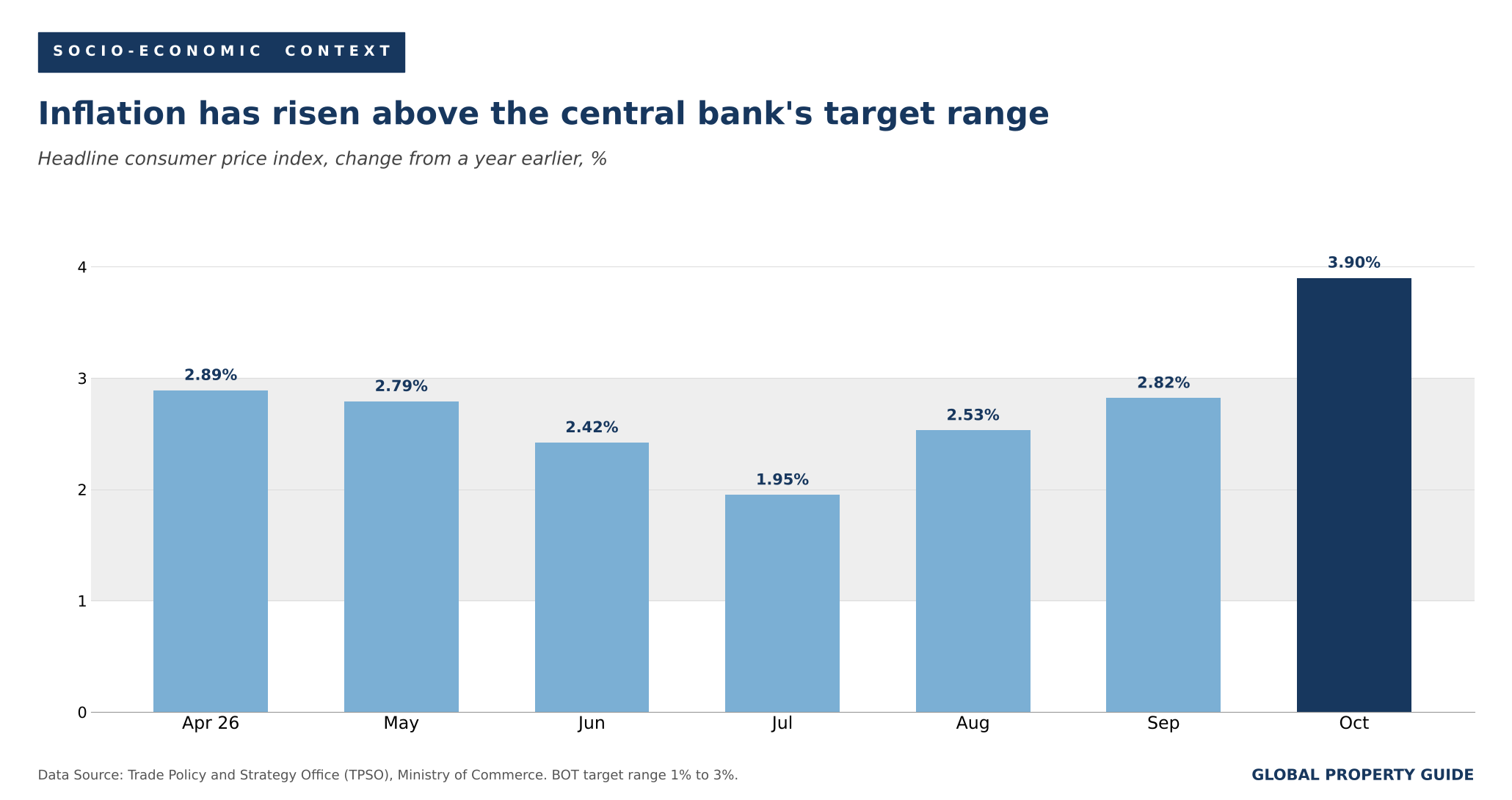
Inflation was negative in 2025, at -0.1%. The IMF expects it to average 2.1% in 2026 and to end the year at 4.0%. The BOT's October forecast is also 2.1% for 2026, falling to 1.3% in 2027. The baht has weakened, from an average of THB 32.34 per dollar in April to THB 33.22 in September, which makes Thai property a little cheaper for buyers paying in dollars.
Fewer tourists, but jobs are holding up
Fewer foreign tourists are coming. Foreign arrivals fell by 7.2% in 2025, to 33.0 million. In the first nine months of 2026, 23.2 million foreign tourists arrived, 3.8% fewer than a year earlier, the BOT's quarterly indicators show. Arrivals from short-haul markets fell most, as flights were limited and travel costs rose. Tourists are staying longer and spending more, however: tourism receipts rose by 10.3% in the first nine months.
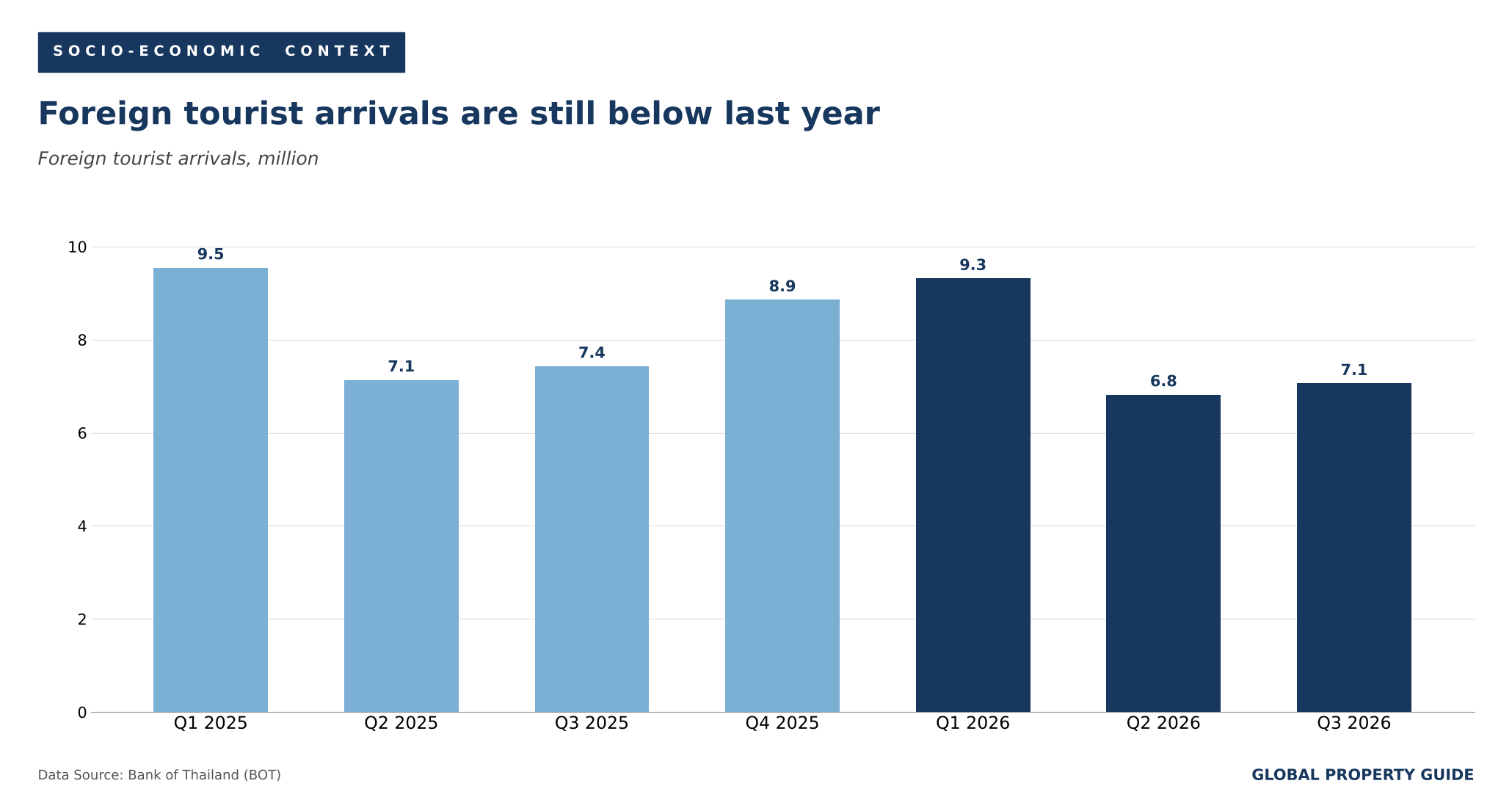
This matters for the property market in resort areas such as Phuket and Pattaya, where foreign buyers and short-term rentals are important.
The labor market remains stable. The unemployment rate was 0.86% in September 2026, and it has stayed close to 1% all year, the BOT's labor force data show. The BOT has noted a rise in claims for unemployment benefits, which it is watching closely.
Sources:
- Bank of Thailand (BOT)
- Residential Property Price Index: app.bot.or.th
- Monetary Policy Committee's Decision 5/2026, 28 October 2026: bot.or.th
- Monetary Policy Committee's Decision 4/2026, 26 August 2026: bot.or.th
- Daily Interest Rates of Commercial Banks: bot.or.th
- Economic and Monetary Conditions, September 2026, Monthly Indicators: bot.or.th
- Economic and Monetary Conditions, Q3 2026, Quarterly Indicators: bot.or.th
- Press Release on the Economic and Monetary Conditions for September and Q3 2026: bot.or.th
- Labour Force Survey: app.bot.or.th
- Property Indicators: app.bot.or.th
- Real Estate Information Center (REIC)
- Nationwide Housing Market, Q2 and H1 2026 (TH): reic.or.th
- Nationwide Housing Market, Q2 and H1 2026, Full Report (TH): reic.or.th
- Housing Market in H1 2026 and Outlook for 2026 and 2027 (TH): reic.or.th
- Condominium Transfers to Foreigners, Q2 and H1 2026 (TH): reic.or.th
- Bangkok and Vicinities Housing Market, Q2 2026 (TH): reic.or.th
- Trade Policy and Strategy Office (TPSO)
- Consumer Price Index and Rate of Change, Thailand (TH): index.tpso.go.th
- International Monetary Fund (IMF)
- World Economic Outlook, October 2026, Online Statistical Appendix Tables A: imf.org
- Global Property Guide
- Gross Rental Yields in Thailand: globalpropertyguide.com