Mexico's Residential Property Market Analysis 2026
With the economy on a slow track amid trade uncertainty and the supply outlook gradually improving, sales prices in the Mexican housing market exhibit a resilient but moderating growth trend, while still-tight affordability supports expansion of the rental sector.
This extended overview from Global Property Guide covers key aspects of Mexico’s housing market and takes a closer look at its most recent developments and long-term trends.
Table of Contents
- Property Prices and Price Index
- Residential Hotspots
- Property Demand Trends
- Property Supply Trends
- Rental Market: Rents and Rental Yields
- Mortgage Market and Interest Rates
- Economic and Social Factors
Property Prices and Price Index
Home price growth in Mexico remained resilient in late 2025, although the pace continued to ease from the double-digit peaks seen earlier in the cycle. In the fourth quarter of 2025, the House Price Index for dwellings purchased with a mortgage, as reported by the Federal Mortgage Society (SHF), rose 8.9% year-on-year compared with the same period in 2024. For 2025 as a whole, nationwide home prices increased by 8.7%, marking the slowest annual pace in four years but still pointing to solid underlying momentum in the housing market.
Within the index, throughout 2025, the second-hand segment slightly outpaced the new housing segment, rising 8.7% year-on-year versus 8.5% for new homes. By property type, single-family homes recorded 9.1% year-on-year growth, while condominiums and apartments rose 8.2%.
At the state level, 21 states posted year-on-year growth rates above the national average, while 11 came in below it. The strongest increases were registered in Quintana Roo (14.3%), Baja California Sur (12.9%), Nayarit (12.2%), Tlaxcala (12.0%), and Jalisco (11.3%). At the other end, Mexico City recorded more moderate growth (4.7%), consistent with a more mature, higher-base market and tighter affordability constraints.
Mexico's house price annual change:
The average appraised value of a home purchased with a mortgage stood at MXN 1,863,965 (USD 103,148), while the median was MXN 1,209,189 (USD 66,914). Mexico City recorded the highest average value at MXN 3,968,310 (USD 219,598). Other high-cost states included Baja California Sur at MXN 2,588,992 (USD 143,269) and Querétaro at MXN 2,323,977 (USD 128,604).
Price dynamics of homes purchased with a mortgage, selected states:
| Average Home Value, MXN/unit, 2025 |
Average Home Value, USD/unit, 2025 |
SHF House Price Index, YoY, %, 2025 vs 2024 |
|
| Ciudad de México | MXN 3,968,310 | USD 219,598 | 4.7% |
| Estado de México | MXN 1,915,577 | USD 106,004 | 5.2% |
| Nuevo León | MXN 1,962,295 | USD 108,589 | 9.4% |
| Jalisco | MXN 2,018,335 | USD 111,690 | 11.3% |
| Quintana Roo | MXN 1,867,684 | USD 103,354 | 14.3% |
| Baja California Sur | MXN 2,588,992 | USD 143,269 | 12.9% |
| Querétaro | MXN 2,323,977 | USD 128,604 | 7.2% |
| Yucatán | MXN 2,251,258 | USD 124,580 | 10.6% |
| Baja California | MXN 2,160,226 | USD 119,542 | 10.6% |
| Guanajuato | MXN 1,496,110 | USD 82,792 | 9.4% |
| Nationwide | MXN 1,863,965 | USD 103,148 | 8.7% |
| Note: SHF data captures mortgage-funded purchases and are therefore best read as a measure of the formal, credit-linked housing segment rather than the entire residential market, but they remain the main national benchmark for pricing trends. Exchange rate as of December 2025, USD 1 = MXN 18.0708. |
|||
| Data Source: SHF. | |||
Recent commentary points to a combination of easing cost pressures, still-tight affordability, and a slowly improving supply outlook. Marisol Becerra, Director of Data Strategy and Consulting at Monopolio/DD3, notes that the market’s structural constraint remains household income and purchasing power, particularly in higher-cost urban areas, while also arguing that price moderation has been supported by a stabilization in construction input prices and a gradual increase in formal supply.
Looking ahead, Fitch Ratings expects price growth to remain positive but more moderate, with Mexico’s home prices projected to rise 7%–8% in 2026, easing from the double-digit rates seen in prior years. Fitch also notes that government housing programs should support additional supply and stimulate purchases by low- and middle-income households, which would help to reduce price pressure, although the expected impact on the supply gap is described as only moderate over the forecast horizon.
Residential Hotspots:
Housing Profile in Key Submarkets
Mexico offers a broad range of real estate opportunities, accommodating diverse preferences and investment objectives. Market conditions across key cities have remained relatively resilient, supported by regional economic activity and shifting demand patterns. Mexico City (Ciudad de México) continues to attract substantial investment, underpinned by its diversified services and commercial base and a large, structurally tight urban housing market, sustaining strong underlying demand for residential property despite persistent affordability challenges. Monterrey, recognized as an industrial and business hub, has shown steady appreciation, supported by corporate expansion and cross-border linkages. Guadalajara benefits from its large metro economy and a growing technology and services ecosystem, positioning it as an attractive destination for both domestic and international investors.
Outside the largest urban centers, several markets are seeing notable momentum, driven by tourism, second-home purchases, and demand for short-term rentals. The Riviera Maya (notably Solidaridad and Benito Juárez, Quintana Roo) remains a focal point for vacation properties, supported by ongoing tourism activity and infrastructure initiatives, including the Tren Maya. Mérida, valued for its quality of life and relative affordability, continues to attract domestic and international buyers, while Los Cabos has seen sustained demand for higher-end product, supported by its established resort market and ongoing infrastructure investment.
Other significant markets include Santiago de Querétaro and the broader Bajío region, where manufacturing-led job creation is supporting household formation and residential absorption. Specialist destinations such as San Miguel de Allende also remain active in resale turnover, according to local market reporting, while markets in Baja California (including Tijuana) continue to be shaped by cross-border dynamics and industrial-driven growth.
Recent data highlights divergent pricing patterns across major residential hubs. The SHF municipality-level House Price Index for dwellings purchased with a mortgage for Q4 2025 shows the strongest annual increases were recorded in Benito Juárez, Solidaridad, and Los Cabos, all posting gains of around 14% to 15%, while Ciudad de México showed the most moderate growth at 4.64%. Over the medium and longer term, the strongest cumulative price appreciation was also concentrated in key tourism- and growth-led markets, with Los Cabos, Benito Juárez, and Solidaridad nearly doubling relative to Q4 2020.
House Price Index for dwellings purchased with a mortgage, selected markets:
| YoY change, % (Q4 2025 vs Q4 2024) |
2Y change, % (Q4 2025 vs Q4 2023) |
5Y change, % (Q4 2025 vs Q4 2020) |
|
| Ciudad de México | 4.64% | 10.73% | 40.84% |
| Monterrey | 7.80% | 17.57% | 57.92% |
| Guadalajara | 12.08% | 23.39% | 65.56% |
| Solidaridad | 14.45% | 27.14% | 90.37% |
| Benito Juárez | 15.09% | 28.90% | 93.62% |
| Mérida | 10.69% | 21.97% | 61.15% |
| Los Cabos | 14.17% | 27.41% | 96.17% |
| Santiago de Querétaro | 6.85% | 15.18% | 56.06% |
| Tijuana | 10.13% | 23.34% | 77.52% |
| Nationwide | 8.92% | 18.41% | 56.11% |
| Data Source: SHF. | |||
According to the Banorte Housing Price Indicator (INBAPREVI), which uses web-scraped listing data and econometric methods to produce monthly price-per-square-meter benchmarks, Mexico City continues to lead with the highest level among the markets tracked, at MXN 57,921 (USD 3,283) per square meter as of January 2026. In Banorte’s listings sample, apartments accounted for 78.4% of observed supply versus 21.6% for single-family homes. Within Mexico City, central boroughs such as Cuauhtémoc (MXN 69,343/USD 3,710 per sqm), Miguel Hidalgo (MXN 66,757/USD 3,572 per sqm), and Benito Juárez (MXN 55,782/USD 2,985 per sqm) rank among the highest-priced, while Tláhuac remains among the most affordable at MXN 19,129 (USD 1,024) per sqm.
Across additional markets tracked in INBAPREVI, Guadalajara ranks among the higher-priced benchmarks after Mexico City, while Monterrey and Tijuana tend to sit in the mid-to-upper range, supported by industrial expansion and cross-border demand. In contrast, Mérida and Querétaro remain comparatively more accessible growth markets, with lower entry costs alongside favorable demographic and economic fundamentals.
Indicative asking prices (INBAPREVI, web-scraped listings), selected markets:
| Indicative Asking Price, MXN/sqm, Jan 2026 |
Indicative Asking Price, USD/sqm, Jan 2026 |
||
| Ciudad de México | MXN 57,921 | USD 3,283 | |
| Monterrey | MXN 49,318 | USD 2,795 | |
| Guadalajara | MXN 52,029 | USD 2,949 | |
| Mérida | MXN 24,313 | USD 1,378 | |
| Santiago de Querétaro | MXN 23,155 | USD 1,312 | |
| Tijuana | MXN 36,102 | USD 2,046 | |
| Nationwide | MXN 30,254 | USD 1,715 | |
| Note: Exchange rate as of January 2026, USD 1 = MXN 17.6446. | |||
| Data Source: Banorte. | |||
Property Supply Trends
Output Is Improving, but the Housing Gap Remains Wide
The most recent data on Mexico’s housing stock is drawn from the 2020 Census, which reported more than 43.9 million dwellings nationwide. Of this total, 80.2% were occupied, 5.7% were used on a temporary basis, and 14.0% were vacant. Housing is most heavily concentrated in urban areas, with the largest shares in Mexico City (12.3%), the State of Mexico (6.9%), Veracruz de Ignacio de la Llave (6.9%), Jalisco (6.7%), and Puebla (4.9%).
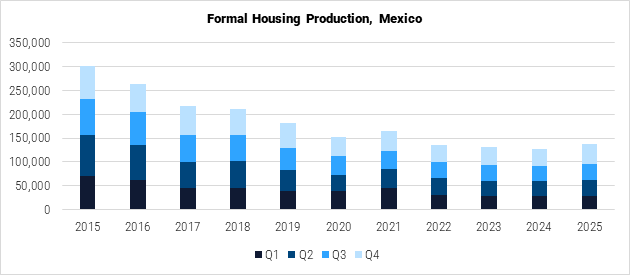
On new supply, the Housing Registry (Registro Único de Vivienda, RUV) indicates that in 2025, formal housing production rose to 138,631 dwellings, representing an 8.18% year-on-year increase. This exceeded 2022–2024 levels but remained below 2021, underscoring both the depth of the prior downturn and the still-modest pace of recovery relative to Mexico’s estimated needs. Production remained geographically concentrated, with Nuevo León, Jalisco, Quintana Roo, the State of Mexico, and Guanajuato accounting for around 42% of total completions.
Data Source: RUV.
Formal housing production, selected markets:
| Number of Dwellings, 2025 | YoY, % | |
| Ciudad de México | 1,222 | 5.62% |
| Estado de México | 8,668 | 4.01% |
| Nuevo León | 17,343 | -1.99% |
| Jalisco | 14,136 | 14.17% |
| Quintana Roo | 9,380 | 5.52% |
| Baja California Sur | 760 | -7.20% |
| Querétaro | 3,899 | 7.89% |
| Yucatán | 5,646 | 17.58% |
| Baja California | 5,644 | -2.15% |
| Guanajuato | 8,531 | 15.28% |
| Nationwide | 138,631 | 8.18% |
| Data Source: RUV. | ||
Despite the recent improvement, the supply gap remains structural. BBVA Research estimates that closing affordability stress would require around 2.3 million additional homes; when “natural demand” (population growth, household mobility, and rising incomes) is included, total needs could reach about 4.8 million units nationwide. BBVA’s 2025 H2 update also emphasizes the scale of underlying demand, estimating roughly 7.5 million units of potential demand in the coming years, concentrated in lower- and middle-income segments where formal, affordable delivery is most difficult to scale.
Policy is now a key swing factor for supply. Launched in late 2024 and expanded in August 2025, the Housing for Well-being Program (Programa de Vivienda para el Bienestar, PVB) has been positioned as the federal government’s main tool for increasing new housing supply. After the August 2025 expansion, the six-year target was raised to 1.8 million new homes, with 1.2 million to be delivered by Infonavit, 500,000 by Conavi, and 100,000 by Fovissste, primarily targeted at lower-income households.
From a market standpoint, this supply push should be most supportive for the entry-level segment if execution scales. BBVA Research expects a “gradual recovery” supported by Infonavit’s and Conavi’s housing policy orientation toward affordable supply, but cautions that “so far, no tangible results are visible in terms of greater availability”, highlighting that measurable impact will ultimately depend on land readiness, starts, and completed delivery, rather than headline targets alone.
Rental Market: Rents and Rental Yields
Asking Rents Up in Key Submarkets, Upcoming World Cup Constricts Supply in Mexico City
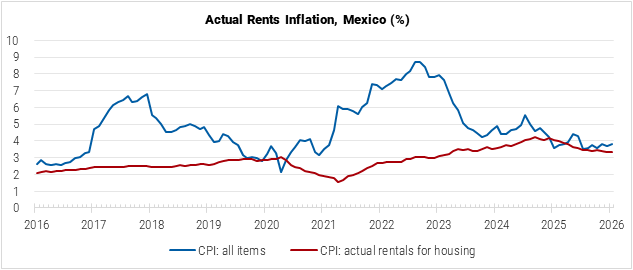
Despite indications of an expanding tenant base, rental inflation in Mexico remained moderate in the second half of 2025 and early 2026, still trending below the overall price growth in the country. The actual rentals for the housing component of the consumer price index (CPI), as reported by the National Institute of Statistics and Geography (INEGI), registered a 3.4% year-on-year growth in January 2026, compared to a 3.8% increase in the all-item CPI over the same period.
Mexico's rent price index:
In Mexico City, the country’s largest submarket, this pattern has been supported by local regulations that cap annual rent increases for existing contracts at the level equal to the previous year’s inflation. The respective amendment to the local civil code was initially introduced in 2024 and officially validated by the Supreme Court of Mexico in February 2026.
Some experts caution, however, that moderate rental inflation figures may understate the true dynamics of the market due to the prevalence of informal rental arrangements and significant regional disparities. “In some areas, particularly those attracting digital nomads or influenced by short-term rental platforms such as Airbnb, demand and rents have surged. At the same time, other large urban areas remain dominated by informal leasing, often without professional oversight,” observed Pablo Cotler, research professor at Universidad Iberoamericana.
Data Sources: INEGI, OECD.
When it comes to asking rents, data from the real estate platform Inmuebles24 also indicates a continued upward trend in average rates, although the dynamic varies widely across regional submarkets and individual neighborhoods. Based on the platform’s analysis of listed apartments, the year-on-year growth most recently reached 9.4% in Mexico City, 8.6% in Guadalajara, and 1.1% in Monterrey.
In nominal terms, the average asking rent for 2-bedroom apartments (65 sqm) was reported by Inmuebles24 at MXN 21,398 (USD 1,213) in Mexico City (January 2026), MXN 24,969 (USD 1,415) in Monterrey (January 2026), and MXN 17,722 (USD 962) in Guadalajara (October 2025). Within the capital city, the highest average rents, all exceeding MXN 20,000 a month for this type of units, were reported in the boroughs of Cuauhtémoc, Miguel Hidalgo, Cuajimalpa de Morelos, and Benito Juárez.
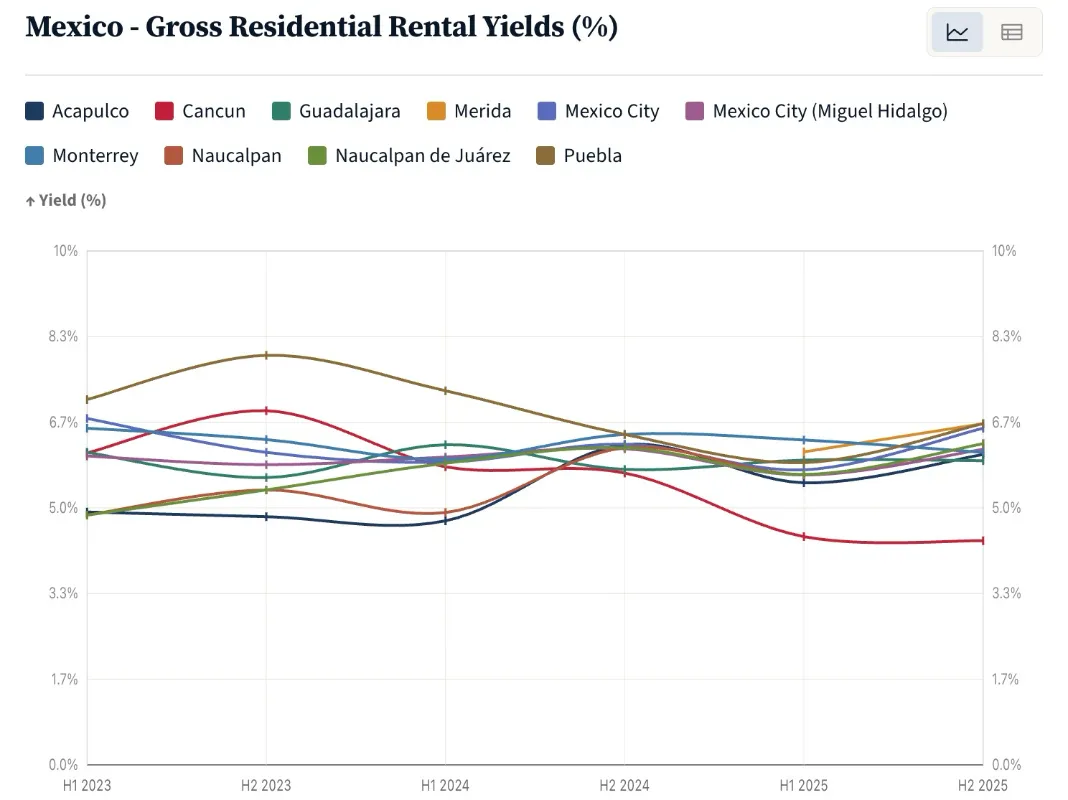
In this environment, gross rental yields for apartments in Mexico averaged 6.06%, according to research by Global Property Guide conducted in December 2025. Among the monitored regional submarkets, the highest average yield was observed in Mérida and Puebla (6.64%, both), and Mexico City (6.55%). The lowest potential performance was reported for properties in Cancún (4.36%).
Overall, in the face of high and increasing property prices, a growing share of Mexico’s population has been opting for rental housing. According to the most recent National Housing Survey published by the INEGI, as of 2020, 16.4% of occupied dwellings in Mexico were rented, compared to 15.2% previously reported in 2014. In parallel, the share of owner-occupied dwellings dropped from 61.4% in 2014 to 57.1% in 2020.
The survey also showed that more than half of those renting their primary residence (51.4%) did so due to a lack of access to credit or insufficient funds to buy, with a further 9.7% remaining tenants due to potential mortgage payments exceeding their monthly rents.
More recently, this gradual shift in housing patterns, especially in high-demand urban areas, was outlined in an analysis by the proptech company Morada Uno, which expects the rental segment to continue expanding across Mexico. “What we are seeing, without a doubt, is that most states are moving towards more rental housing,” said Santiago Morales, CEO of Morada Uno, as quoted by El Economista.
The Mexican Chamber of the Construction Industry (CMIC) forecasts that rental housing could account for up to 50% of occupied dwellings within the next two decades. “Over the past 20 years, housing prices have grown faster than incomes, driving a sustained expansion of the rental market as homeownership becomes less attainable,” noted Luis Armando Díaz Infante, CMIC national secretary.
Against this background, a growing trend of residential units being repurposed for short-term rentals (now reportedly intensifying in Mexico City ahead of the 2026 World Cup) is expected to put further strain on the long-term rental stock and asking rates in the capital and other large cities.
Mortgage Market and Interest Rates
Interest Rates Broadly Stable, Lending Activity Slows
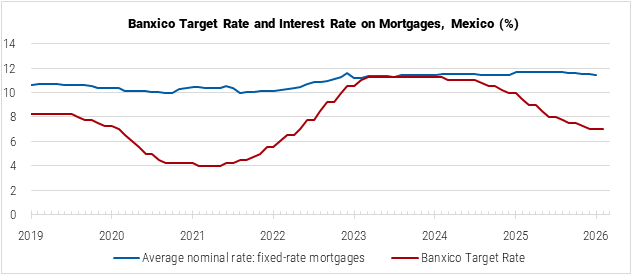
In the second half of 2025, the Bank of Mexico (Banxico) continued to bring down its monetary policy rate — the overnight interbank target rate. Since March 2024, when the easing cycle began, the benchmark has been gradually reduced from its 11.25% peak level to the current 7.00% standing announced in December 2025. In February 2026, however, the regulator decided to keep the target rate unchanged and announced a pause in the rate-cutting cycle, citing headline and core inflation forecasts, which were revised upwards for the period between Q1 2026 and Q1 2027, as well as changes in economic policy by the US administration, which continue adding uncertainty to the economic outlook.
Mexico's mortgage loan interest rates:
Data Source: Banxico.
Despite the substantial decline in the Banxico target rate, as well as yields on long-term government bonds (typically more impactful in markets primarily comprised of fixed-rate loans), mortgage rates in Mexico have remained broadly stable, with only marginal fluctuations over the past two years. Most recently, the central bank reported an average nominal interest rate for fixed-rate mortgages of 11.45% in January 2026.
As noted by BBVA Research in their latest real estate market overview, “mortgage financing costs remained inflexible in the face of changes in monetary policy,” and, considering a high ratio of non-market-based loans provided by public institutions in Mexico, this pattern is likely to persist in 2026.
Nominal interest rates on fixed-rate mortgage loans to households:
| January 2026 | YoY | January 2025 | YoY | January 2024 | |
| Average nominal rate | 11.45% | ↓ | 11.66% | ↑ | 11.46% |
| Nominal rate associated to the minimum APCR | 9.99% | ↑ | 9.36% | ↓ | 9.49% |
| Nominal rate associated to the maximum APCR | 21.13% | = | 21.13% | ↓ | 22.75% |
| Data Source: Banxico. | |||||
In terms of new mortgage originations, reporting from BBVA Research shows a total of 224.3 thousand new mortgage loans originated in the first half of 2025, of which 78.5% were granted by public lenders, 24.1% by private lenders, and 2.5% were co-financed. The total value of new loans during this period amounted to MXN 251.0 billion (USD 12.6 billion); of those, mortgages granted by public lenders reached MXN 120.0 billion (USD 6.0 billion), while mortgages granted by the private sector amounted to MXN 131.0 billion (USD 6.6 billion).
Despite signs of gradual recovery exhibited by the Mexican mortgage market in the previous year, BBVA figures show a clear slowdown in lending activity in the first half of 2025. Total new lending decreased by 9.0% in volume and by 4.5% in value, compared to the same period in 2024. A modestly positive dynamic was observed only for public lenders, such as the Institute of the National Housing Fund for Workers (Infonavit) and Housing Fund of the Institute for Social Security and Services for State Workers (Fovissste), which registered a 1.1% year-on-year growth in the value of new loans, while the value of new lending in the private banking segment declined by 4.5%.
These developments can be attributed to a weaker macroeconomic environment and, specifically, negative trends in formal employment and household purchasing power, which suppress demand for mortgages. “Housing appreciation <…> has far outpaced income growth, exacerbating the lack of affordability. In this context, the market faces a double challenge: expanding access to mortgage credit in a sustainable way and ensuring a greater supply of affordable housing, especially in the social interest segment, where the greatest need and the least financial dynamism are concentrated,” said the BBVA report.
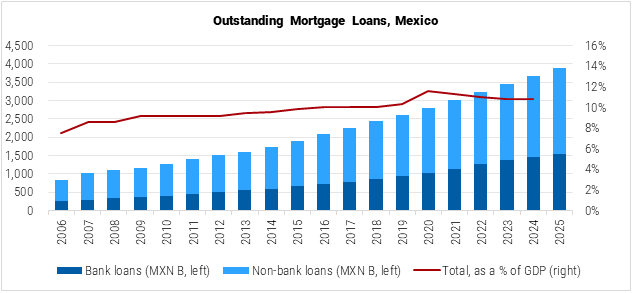
In this environment, the relative size of the mortgage market in Mexico remains limited, estimated to equal just 10.8% of GDP at current prices in 2024. As of the end of 2025, the total value of outstanding mortgage loans stood at MXN 3.9 trillion (USD 202.5 billion), a 5.9% growth since the beginning of the year. Bank credit comprised 39.8% of the stock, up from 25.0% in 2005.
Data Sources: Banxico, World Bank.
Economic and Social Factors
Economy on Slow Track Amid Trade Uncertainty
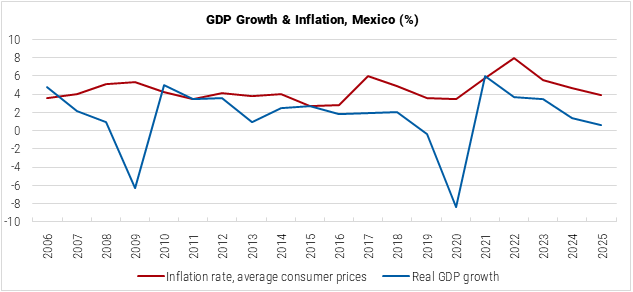
With activity constrained by fiscal consolidation and the dampening effect of trade uncertainty on consumption and investment, the Mexican economy decelerated further from a 1.4% real GDP growth in 2024 to an estimated 0.6% in 2025, according to the International Monetary Fund (IMF). On the back of eased domestic policies, activity is expected to pick up to 1.5% in 2026 and 2.1% in 2027, although the effects of tariffs and trade uncertainty will continue to constrain growth.
“With trade with the US representing 80% of total exports and 27 percent of GDP, Mexico [is] especially vulnerable to changes in US trade policy,” noted the 2025 Article IV report from the IMF.
“Investment is anticipated to remain weak at least until the second half of 2026, reflecting the uncertainty over the trade relationship with the United States and the upcoming USMCA review,” said the latest quarterly report from Banxico.
After easing from the average annual level of 4.7% in 2024 to 3.9% in 2025, consumer price index (CPI) inflation in Mexico is expected to converge to the central bank’s 3% target in the second half of 2026. Most recently, the indicator was reported by the INEGI at 3.8% in January 2026.
Data Source: IMF.
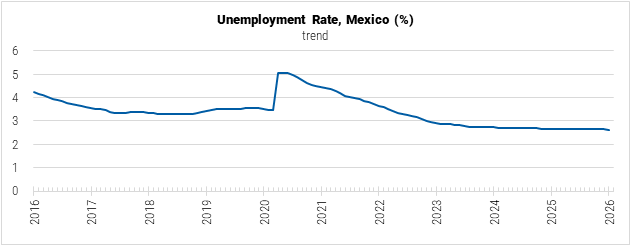
In Mexico’s labor market, the unemployment rate trend remained stable throughout 2025, most recently reported by the INEGI at 2.6% in January 2026. However, this stability has been supported by lower participation, while formal employment growth remained stagnant. Data from the Mexican Social Security Institute (IMSS), as cited by Mexico Business News, shows that 278,697 formal jobs were added nationwide in 2025, a figure “slightly higher than in 2024 but well below Mexico’s historical range and far short of the estimated 1 million to 1.2 million jobs required annually to absorb new labor market entrants”. The annual growth rate of registered employment stood at 1.3%, one of the lowest observed in recent years.
Overall, according to the Organization for Economic Co-operation and Development (OECD), 55% of employment in Mexico is informal (representing approximately 32 million people), which is among the highest rates in the OECD and Latin America. Job informality is especially prevalent among youth and adults with low levels of education.
“Taken together, recent data points to a weakening labor market: low unemployment, but accompanied by higher informality, limited creation of formal jobs, and more moderate real wage growth, which continues to constrain the dynamics of the total wage bill,” BBVA Research summarized in the December 2025 economic outlook for Mexico.
Data Source: INEGI.
Overall, the economists polled by Reuters in January 2026 agreed that Mexico's economy will stay on a slow track this year amid high uncertainty. The main near-term risks to the economic outlook emanate from the country’s trade relationship with the US (including the upcoming review of the USMCA) and the potential for tighter global financial conditions.
Sources:
- National Institute of Statistics and Geography (INEGI)
- Economy and Productive Sectors (ES): https://www.inegi.org.mx/
- Consumer Price Index (CPI): https://en.www.inegi.org.mx/
- Employment and Occupation: (ES): https://www.inegi.org.mx/
- Census of Population and Housing 2020: https://en.www.inegi.org.mx/
- National Housing Survey (ENVI) 2020: https://en.www.inegi.org.mx/
- Bank of Mexico (Banxico)
- Monetary Policy Statement, February 5, 2026: https://www.banxico.org.mx/
- Monetary Policy Statement, December 18, 2025: https://www.banxico.org.mx/
- Quarterly Report October-December 2025, Executive Summary: https://www.banxico.org.mx/
- Monetary Aggregates and Financial Activity in January 2026 (ES): https://www.banxico.org.mx/
- Banking and Alternative Financing Sources to the Domestic Private Sector: https://www.banxico.org.mx/
- Federal Mortgage Society (SHF)
- SHF Mexican Housing Price Index, Q4 2025 (ES): https://www.gob.mx/
- Housing for Wellbeing Programs (ES): https://www.informegobierno.gob.mx/
- The Six-Year Goal of the Housing for Well-Being Program Has Been Increased… (ES): https://www.gob.mx/
- Institute of Statistical and Geographic Information (IIEG)
- House Price Index for the Fourth Quarter of 2025 (ES): https://iieg.gob.mx/
- Registro Único de Vivienda (RUV)
- Strategic Information, Basic Figures (ES): https://portal.ruv.org.mx/
- International Monetary Fund (IMF)
- Country Overview: Mexico: https://www.imf.org/
- 2025 Article IV Staff Report: https://www.imf.org/
- World Economic Outlook Update, January 2026: https://www.imf.org/
- Organization for Economic Co-operation and Development (OECD)
- OECD Data Explorer: https://data.oecd.org/
- OECD Economic Surveys: Mexico 2026: https://www.oecd.org/
- World Bank
- World Development Indicators: https://databank.worldbank.org/
- Mexico MPO, October 2025: https://thedocs.worldbank.org/
- BBVA Research
- Real Estate Situation in Mexico, First Semester 2025: https://www.bbvaresearch.com/
- Real Estate Situation in Mexico, Second Semester 2025: https://www.bbvaresearch.com/
- Mexico Economic Outlook, December 2025: https://www.bbvaresearch.com/
- Inmuebles24
- Sales and Rent Price Index, Mexico City, Jan 2026 (ES): https://www.inmuebles24.com/
- Sales and Rent Price Index, Monterrey, Jan 2026 (ES): https://www.inmuebles24.com/
- Sales and Rent Price Index, Guadalajara, Oct 2025 (ES): https://www.inmuebles24.com/
- Banorte
- House Prices in Mexico Increased 4.4% Annually in January 2026 (ES): https://banorte-v2.cd.invdcloud-is.us/
- Mexican Chamber of the Construction Industry (CMIC)
- The Rental Market is Growing Due to Inability to Buy a Home in Mexico: https://www.cmic.org/
- Fitch Ratings
- North America and Latin America Housing Markets Slowing in 2026: https://www.fitchratings.com/
- Fitch Affirms Mexico at 'BBB-'; Outlook Stable: https://www.fitchratings.com/
- El Economista
- Are Housing Prices in Mexico Losing Steam?... (ES): https://www.eleconomista.com.mx/
- Experts Warn of a Massive Exodus of Rental Housing From Mexico City Due to the 2026 World Cup (ES): https://www.eleconomista.com.mx/
- The Supreme Court of Justice of Mexico Officially Validates the Rent Cap in Mexico City (ES): https://www.eleconomista.com.mx/
- How Much Does it Cost to Rent an Apartment in the Most Desirable Boroughs of Mexico City? (ES): https://www.eleconomista.com.mx/
- Housing Rents in Mexico are not Keeping up with Inflation, but Access to Housing Remains Limited (ES): https://www.eleconomista.com.mx/
- Rental Housing is Becoming a More Established Option for Living in Mexico (ES): https://www.eleconomista.com.mx/
- Reuters
- Mexico Economy to Stay on Slow Track in 2026 Amid Trade Deal Uncertainty: https://www.reuters.com/
- Mexico Business News
- Mexico Achieves 44.6% Formal Employment, but Job Growth Slows: https://mexicobusiness.news/
- Cronica
- Rents and Inflation: Are We Measuring It Right (ES): https://www.cronica.com.mx/